
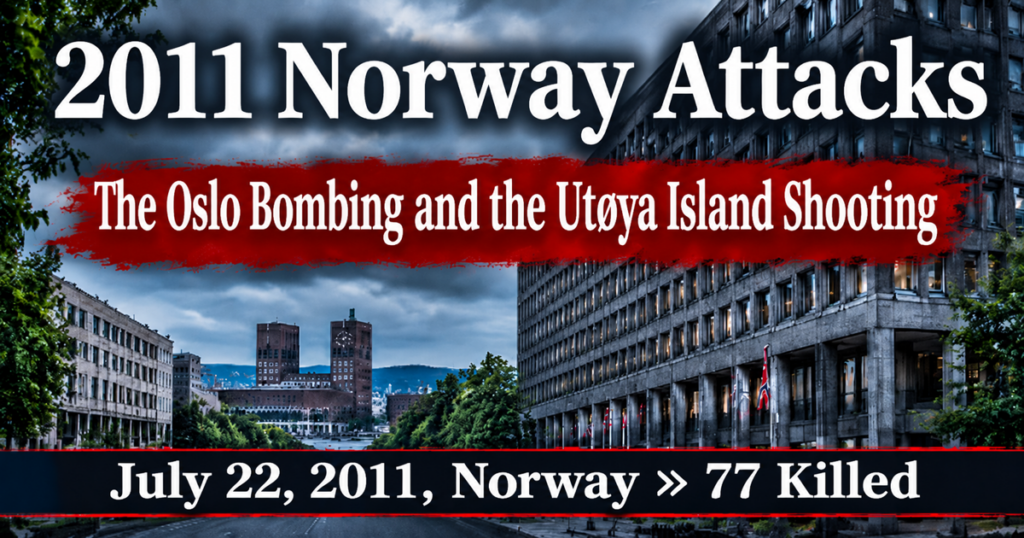
2011 Norway Attacks | The Oslo Bombing and Utøya Island Shooting: Two Attacks on the Same Day That Left 77 Dead
On July 22, 2011, a bombing in Oslo's government quarter and a shooting on Utøya Island in Norway left 77 people dead. The perpetrator was convicted at trial, and a sentence of 21 years' preventive detention became final. This record follows the attacks, the trial, and the official inquiry.
| Item | Details |
|---|---|
| Event name | 2011 Norway Attacks |
| Date and time | July 22, 2011. The Oslo bombing occurred at 3:25 p.m. CEST; the Utøya Island shooting began at approximately 5:22 p.m. and continued until 6:34 p.m. |
| Country | Norway |
| Locations | The Government Quarter in Oslo (Regjeringskvartalet); the Labour Party’s youth wing (AUF) summer camp on Utøya Island |
| Type of incident | Terrorist attacks involving a vehicle bomb and a shooting |
| Deaths | 77: eight in Oslo and 69 on Utøya Island (67 direct deaths from the shooting and two indirect deaths) |
| Injuries | More than 323 people were injured, according to the compiled figures |
| Perpetrator | Anders Behring Breivik |
| Age at the time of the attacks | 32 |
| Ideological background | Far-right ideology. He was treated at trial as an adherent of far-right ideology. |
| Arrest | Arrested on Utøya Island on July 22, 2011 |
| Charges and trial | Charged after his arrest. Tried at the Oslo District Court from April 16 to June 22, 2012. |
| Sentence | Found guilty on August 24, 2012; sentenced to 21 years of preventive detention (forvaring), with a minimum term of 10 years |
| Finality of the judgment | The judgment became final after the defendant did not appeal. |
| Current status | Still serving preventive detention; he has not been released. |
On July 22, 2011, two locations in Norway were attacked in succession.
On July 22, 2011, two terrorist attacks by the same perpetrator took place in Oslo, the capital of Norway, and on the island of Utøya. The first attack was a bombing in the Government Quarter in central Oslo. That evening, a shooting took place on Utøya Island, where the Labour Party’s youth wing (AUF) was holding a summer camp.
The two attacks occurred one after the other on the same day. The vehicle bomb exploded in Oslo at 3:25 p.m., while the shooting on Utøya began at approximately 5:22 p.m. and continued until 6:34 p.m. Two very different locations — a district where the functions of government were concentrated and an island camp where young people had gathered — were attacked within a short period of time. A total of 77 people were killed in the attacks: eight in the Oslo bombing and 69 on Utøya Island. Of the 69 deaths on Utøya, 67 were direct deaths caused by the shooting, while the total also includes two indirect deaths. More than 323 people were also injured, according to the compiled figures, leaving a toll that cannot be conveyed by the number of deaths alone.
The first attack took place in Oslo’s Government Quarter.
At 3:25 p.m. on July 22, a vehicle bomb exploded in Regjeringskvartalet, the Government Quarter in Oslo. Eight people were killed in the explosion. The first scene of the attacks was the district where Norway’s government agencies were concentrated.
The bombing preceded the second attack, which took place later that day. The bombing in the Government Quarter and the shooting on Utøya Island were not treated as two unrelated incidents at separate locations; they were investigated and tried as a series of terrorist attacks carried out by the same person.
After the bombing in Oslo, a shooting took place at another location that evening. The police and emergency services had to respond to events involving two scenes: the Government Quarter and Utøya Island. The total number of deaths from the attacks was recorded as 77.
That evening, the AUF summer camp on Utøya Island came under attack.
Later that same day, Breivik travelled to Utøya Island posing as a police officer and opened fire at the summer camp of the Labour Party’s youth wing (AUF). The shooting is reported to have begun at approximately 5:22 p.m. and continued until 6:34 p.m. Young people had gathered on the island, and most of the victims were teenagers.
A total of 69 people died on Utøya Island. This figure includes 67 direct deaths from the shooting as well as two indirect deaths. The total of 69 therefore encompasses both people killed directly by gunfire and indirect deaths associated with the attack. The fact that most of the victims were teenagers was another defining feature of the harm caused by the attack.
The shooting ended at 6:34 p.m., and Breivik was arrested by police on Utøya Island that same day. The bombing in Oslo, the shooting on the island, and the arrest all took place within a single day, and the attacks came to be recorded as a major terrorist incident that shook Norway as a whole.
Breivik, who carried out both attacks, was arrested that same day.
The perpetrator was Anders Behring Breivik, who was 32 years old at the time of the attacks. The bombing in Oslo’s Government Quarter and the shooting on Utøya Island were both investigated as acts committed by Breivik, and were later examined in the criminal trial as a connected series of terrorist acts.
Breivik was arrested on Utøya Island. The arrest took place on July 22, 2011, the day the attacks occurred. Criminal proceedings followed his arrest, and Breivik was charged.
An arrest and a final determination of criminal responsibility at trial are separate stages. The arrest secured the suspect’s custody; the subsequent proceedings involved charges, a trial, and a judgment. In this case, although the defendant admitted carrying out the attacks themselves, he disputed his criminal responsibility, making his capacity to be held criminally responsible a major issue at trial.
The trial addressed not only the attacks themselves but also criminal responsibility.
Breivik’s trial was held at the Oslo District Court from April 16 to June 22, 2012. The defendant admitted carrying out the bombing in Oslo and the shooting on Utøya Island, but denied criminal responsibility. He also raised the defense of necessity in relation to the attacks.
The central issue at trial was not simply whether the defendant had carried out the attacks. The court had to determine whether he had the capacity required to be held criminally responsible for his actions. Admitting to having committed the acts and being found legally capable of bearing criminal responsibility are not the same thing; the court had to reach its decision in light of the evidence and the psychiatric assessments.
In Norway’s criminal justice system, psychiatric assessments play an important role in determining criminal responsibility. In this case, two psychiatric assessments reached different conclusions, making the question of which evaluation the court would accept an important issue in the outcome of the trial.
The two psychiatric assessments reached opposite conclusions about criminal responsibility.
Two assessments of the defendant’s mental state were conducted in this case. The first assessment concluded that Breivik was in a psychotic state and lacked criminal responsibility. The second assessment, by contrast, found that he had personality disorders but retained the capacity to be held criminally responsible.
The difference between the two assessments went beyond a disagreement over diagnostic labels. A finding that a defendant lacks criminal responsibility can lead to treatment different from a conviction based on ordinary criminal responsibility. Conversely, if criminal responsibility is established, the defendant is held legally accountable for his actions.
The court adopted the conclusion of the second assessment. It found that the defendant had criminal responsibility and found him guilty of the attacks. The conflict between the first and second assessments became a central issue in the Norwegian justice system’s determination of criminal responsibility.
On August 24, 2012, the court found Breivik guilty and sentenced him to 21 years of preventive detention.
On August 24, 2012, the Oslo District Court found that Breivik was criminally responsible and delivered a guilty verdict. The sentence was 21 years of preventive detention (forvaring). The defendant did not appeal, and the judgment became final.
The 21 years specified in the judgment was the term of preventive detention, with a minimum term of 10 years. Unlike an ordinary fixed-term sentence, this penalty is based on a system under which the period of detention can be extended if the risk of reoffending continues.
The legal sequence was as follows: Breivik’s arrest on July 22, 2011; the filing of charges after his arrest; the trial from April 16 to June 22, 2012; the guilty verdict on August 24 of that year; and the judgment becoming final because no appeal was filed. Arrest, charging, trial, judgment, and finality are distinct procedural stages, and in this case the guilty judgment became final.
Preventive detention can be extended when the risk of reoffending continues.
Norway has neither the death penalty nor life imprisonment, and the ordinary maximum prison sentence is 21 years. For serious crimes, however, the country has a system known as preventive detention (forvaring), which is intended for cases in which a person is considered to pose a continuing risk of reoffending even after serving the specified term.
Under preventive detention, the court sets a period of detention as well as a minimum term. The term imposed on Breivik was 21 years, with a minimum term of 10 years. The expiry of the minimum term does not automatically result in release; the question is whether continued detention remains necessary.
Under this system, a court may extend the period of detention in five-year increments if it finds that the risk of reoffending persists. Consequently, even when the initial term is 21 years, its expiry does not necessarily mean that the person will be released. If extensions are repeatedly ordered, detention may in practice become indefinite. The purpose of the system is not to ensure that detention always ends once a specified number of years has passed, but to make it possible to protect society when the risk of reoffending continues. Both the 21-year term and the extension mechanism are relevant to Breivik’s sentence.
The government established an independent commission to examine the response on the day of the attacks.
On August 12, 2011, after the attacks, the Norwegian government established an independent commission of inquiry. The commission examined the events of July 22 and is generally known as the “22 July Commission” or, after its chair, the “Gjørv Commission.”
On August 13, 2012, the commission submitted its report, NOU 2012:14, to the prime minister. The report examined security measures and the police response on the day of the attacks, covering both the attack on the Government Quarter and the shooting on Utøya Island, and set out the problems it identified.
This inquiry had a different purpose from Breivik’s criminal trial. The criminal trial determined the defendant’s capacity for criminal responsibility and his legal responsibility for the offences, whereas the commission examined whether measures to prevent the attacks and the response after they began had functioned appropriately. The two processes differed in both their subject matter and the nature of their findings.
The 22 July Commission identified problems with security at the Government Quarter and the police response on Utøya Island.
Regarding the attack on the Government Quarter, the 22 July Commission concluded that it might have been prevented if security measures that had already been decided upon had been implemented effectively. This finding was not about measures conceived only after the attack; it questioned whether measures that had already been adopted had actually been put into practice.
Regarding the response on Utøya Island, the commission found that the authorities had not made full use of their ability to protect the people on the island. It stated that a faster police operation had been realistically possible and that the perpetrator might have been stopped earlier that day.
These were findings set out by the commission in its report. For the Government Quarter, the issue was the implementation of pre-existing security measures; for Utøya Island, it was the speed of the police operation. The problems identified at the two scenes were not the same. They concerned different stages: security measures intended to prevent the bombing in advance, and police action to stop the perpetrator after the shooting had begun. The report brought to light problems in the preparedness and response of the administration and the police.
Legal proceedings concerning the conditions of Breivik’s detention continued after the judgment.
Even after the guilty verdict became final, legal proceedings concerning Breivik’s detention continued. He made applications concerning his conditions of confinement, including under the European Convention on Human Rights, and the European Court of Human Rights’ decision in “Hansen v. Norway” is also part of the relevant judicial record.
These proceedings concerned his treatment and conditions of detention after the conviction became final in 2012. The fact that an application was made concerning detention conditions does not mean that the original guilty judgment was overturned.
Proceedings concerning applications for parole have also been reported, but Breivik has not been released and remains in detention.
The legal outcome of the attacks and the official inquiry remain separate records.
In the Norway attacks, the criminal trial established Breivik’s criminal responsibility, and the guilty verdict and sentence of 21 years of preventive detention became final. The defendant admitted carrying out the attacks but denied criminal responsibility; the court adopted the second psychiatric assessment and found that he was criminally responsible. This was the central determination in the criminal trial.
Separately, the 22 July Commission’s report identified opportunities to prevent the attack on the Government Quarter and the possibility that the police could have stopped the perpetrator sooner on Utøya Island. The report did not determine whether the defendant was guilty or innocent; it documented an examination of the actions of the authorities and police on the day of the attacks.
The two attacks killed 77 people and left many others injured. Most of the victims were teenagers, and the attack on Utøya Island exacted a particularly heavy toll on the younger generation. The perpetrator’s responsibility, established by the final criminal judgment, and the commission’s findings about the response of public institutions remain separate records.
Sources
- Norwegian Government and the 22 July Commission, NOU 2012:14, English-language excerpts (submitted August 13, 2012). https://www.regjeringen.no/contentassets/bb3dc76229c64735b4f6eb4dbfcdbfe8/en-gb/pdfs/nou2012_14_eng.pdf
- Government of Norway, Meld. St. 29 (2011–2012), Chapter 3, “The Terrorist Attacks of July 22, 2011.” https://www.regjeringen.no/no/dokumenter/meld-st-29-20112012/id685578/?ch=3
- European Court of Human Rights, “Hansen v. Norway,” decision (2018). https://www.nhri.no/wp-content/uploads/2018/10/EMDs-avgj%C3%B8relse-i-Hansen-mot-Norge-2018.pdf
- Ingrid Melle, “The Breivik case and what psychiatrists can learn from it,” World Psychiatry, 2013; 12(1):16–21. https://pmc.ncbi.nlm.nih.gov/articles/PMC3619172/
- 22 July Centre, “Frequently asked questions.” https://www.22julisenteret.no/en/read-more/frequently-asked-questions
- “2011 Norway attacks,” Wikipedia. https://en.wikipedia.org/wiki/July_22_Attacks
Original Japanese record: ノルウェー連続テロ事件(2011年)|オスロ爆破とウトヤ島銃撃、77人が犠牲となった同日の二つの攻撃
Last updated: