
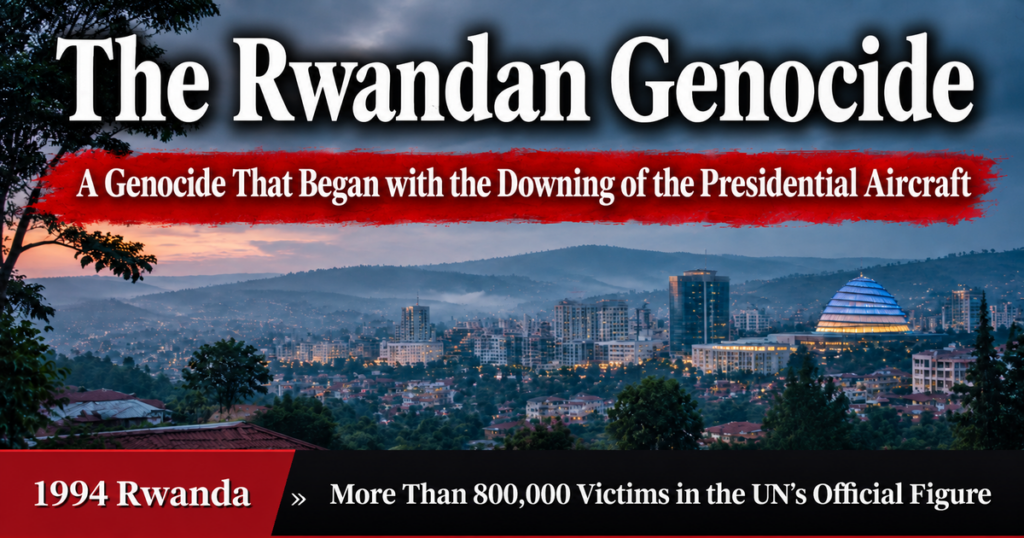
The Rwandan Genocide | A Genocide That Began with the Downing of the Presidential Aircraft and Lasted Approximately 100 Days
A genocide in Rwanda that began with the downing of the presidential aircraft in April 1994 and continued for approximately 100 days. The United Nations' official figure puts the victims at more than 800,000. This record follows the trials before the international tribunal and what came afterward, based on public records.
| Case name | The Rwandan Genocide |
|---|---|
| Local-language name | Jenoside yakorewe Abatutsi |
| Period | Night of April 6 to mid-July 1994 (approximately 100 days) |
| Country | Rwanda |
| Area | Throughout Rwanda |
| Type of incident | Genocide; systematic mass killings |
| Trigger | On the night of April 6, 1994, an aircraft carrying President Juvénal Habyarimana of Rwanda and President Cyprien Ntaryamira of Burundi was shot down in Kigali |
| Main victims | Tutsi, moderate Hutu, and others |
| Number of victims | The United Nations’ official formulation is “more than 800,000.” Estimates vary, and the exact total has not been established |
| Perpetrators | Hutu extremist personnel from government forces, militia groups (including the Interahamwe), and mobilized civilians |
| Perpetrators of the aircraft attack | Not identified |
| International judicial body | The International Criminal Tribunal for Rwanda (ICTR), established under United Nations Security Council Resolution 955 |
| ICTR legal status | 93 individuals indicted; 61 convicted; 14 acquitted; 10 cases referred to national courts |
| Domestic justice | Numerous trials were held in ordinary courts and Gacaca courts |
| Closure of the ICTR | The ICTR closed on December 31, 2015. Its residual functions were taken over by the International Residual Mechanism for Criminal Tribunals (MICT) |
On the night of April 6, 1994, the aircraft carrying the presidents was shot down in Kigali.
On the night of April 6, 1994, an aircraft carrying Rwandan President Juvénal Habyarimana and Burundian President Cyprien Ntaryamira was shot down in Kigali, the capital of Rwanda. Both presidents died in the attack. This event became the immediate trigger for the Rwandan Genocide, which lasted approximately 100 days.
The person or persons who shot down the aircraft have not been identified. No determination attributing responsibility for the attack to any particular individual or organization has been made, and those responsible remain unidentified.
After the aircraft was shot down that night, systematic killings targeting Tutsi and moderate Hutu began in Rwanda from April 7 onward and eventually spread throughout the country. The political crisis that began with the downing of the presidential aircraft developed into a large-scale genocide that engulfed the population.
After the presidents’ deaths, the prime minister and United Nations peacekeepers were also killed.
During the initial phase from April 7 onward, Prime Minister Uwilingiyimana was killed. Ten Belgian members of the United Nations peacekeeping force were also killed. Immediately after the downing of the presidential aircraft, people holding senior government positions and United Nations peacekeepers lost their lives.
The killings that began during this period were not confined to particular locations or a limited group of people. Systematic killings directed at Tutsi and moderate Hutu spread throughout Rwanda. The victims included not only Tutsi, who were the principal targets, but also moderate Hutu and others.
The killing of United Nations peacekeepers was one of the events that took place as the genocide unfolded. While those responsible for shooting down the aircraft have not been identified, killings that included the prime minister and peacekeepers occurred from April 7 onward, and systematic killings spread across the country.
The killings targeted Tutsi primarily, but also extended to moderate Hutu.
The principal victims of the Rwandan Genocide were Tutsi, but moderate Hutu and other people were also killed. Although Tutsi made up the majority of the victims, the violence was not limited to them.
Moderate Hutu were also targeted for killing. The perpetrators included Hutu extremist government and military personnel and militia groups, among others, and systematic killings were carried out against Tutsi, moderate Hutu, and others.
The genocide unfolded throughout Rwanda and continued for approximately 100 days. The harm was not a localized series of incidents confined to a particular area; it reached a scale that affected the entire country. Although estimates of the total number of victims vary, the United Nations’ figure of more than 800,000 shows that an enormous number of people were killed in a short period.
Personnel from government forces and militia groups were involved in killing civilians.
The perpetrators included Hutu extremist personnel from government forces, militia groups such as the Interahamwe, and civilians who had been mobilized. The killings were not the work of a single individual; they unfolded as collective crimes involving a regime, organizations, and numerous individuals.
An important point in understanding the scale of the genocide is that those involved in the killings came from several different layers of society. People in different positions—including government and military personnel, militia members, and mobilized civilians—are identified as perpetrators. The killings proceeded systematically with the involvement of these different groups.
In addition to mobilization by the state and armed organizations, the media was also part of the structure of mobilization. Amid the involvement of these multiple actors, the killings spread throughout the country. The ICTR also examined the responsibility of senior figures and adjudicated the individual legal responsibility arising from collective crimes.
The genocide lasted approximately 100 days, and the United Nations reported more than 800,000 victims.
The genocide lasted from the night of April 6, 1994, until mid-July, a period of approximately 100 days. During this short period, more than 800,000 people were killed, according to the United Nations’ formulation. The victims were primarily Tutsi, but also included moderate Hutu and others.
The phrase “more than 800,000,” used by the United Nations, is an official figure describing the number of victims. However, it does not mean that the exact total has been definitively established. The total number of people killed in the genocide remains unconfirmed, and estimates vary. The United Nations’ published figure and other estimates should be treated as distinct.
Estimates of the death toll range from approximately 500,000 to more than one million. The United Nations’ official formulation is more than 800,000, while other estimates have a broader range. The exact total has not been established.
The United Nations’ published figure of more than 800,000 and estimates ranging from approximately 500,000 to over one million are not the same kind of figure. When presenting the death toll, it is important to state both the figure published by the United Nations and the range of estimates, rather than fixing an unconfirmed total at a single number.
The international response was delayed, and the United Nations acknowledged its own failure.
As the genocide progressed, the international community’s response was inadequate. The United Nations later concluded that it “could have done more.” The delay and inadequacy of the international response became important issues in the reviews conducted after the genocide.
In the United Nations’ assessment, the reduction of UNAMIR and delays in responding were discussed as factors in understanding the failure of the response. The presence of peacekeepers on the ground was not the same as taking sufficient action to stop the genocide. The United Nations itself acknowledged that its response had been inadequate.
The United Nations examined problems in its response, including the reduction of UNAMIR, and acknowledged that the international community “could have done more.” Rather than assigning responsibility solely to one country or one individual, the failure is recorded as a failure of the response that the United Nations itself reviewed.
The advance of the Rwandan Patriotic Front brought the genocide to an end in July.
The genocide that began in April 1994 came to an end in mid-July. During this process, the Rwandan Patriotic Front (RPF) advanced militarily. As the RPF advanced, the killings that had continued for approximately 100 days came to an end in July.
The systematic killings that began throughout the country from April 7 onward continued for approximately 100 days and ended in mid-July. The United Nations’ figure of more than 800,000 victims indicates the scale of the harm inflicted during this short period.
The end of the genocide following the RPF’s advance and the identification of all those responsible for carrying it out are separate matters. The perpetrators of the aircraft attack have not been identified, and the perpetrators of the killings included a regime, organizations, and numerous individuals. After the military end of the genocide, prosecutions and trials were conducted through the international tribunal and Rwanda’s domestic judicial system to determine legal responsibility for individual acts.
The United Nations Security Council established the ICTR through Resolution 955.
As part of the international judicial response after the genocide, the United Nations Security Council adopted Resolution 955 on November 8, 1994, establishing the International Criminal Tribunal for Rwanda (ICTR). The ICTR was an ad hoc international tribunal established by the United Nations Security Council and based in Arusha, Tanzania. It was separate from the permanent International Criminal Court (ICC); the two are distinct institutions.
The ICTR’s jurisdiction covered acts committed between January 1 and December 31, 1994. It was established to prosecute those responsible for genocide in Rwanda and serious violations of international humanitarian law.
The ICTR provided an international framework for examining responsibility for the genocide as individual criminal responsibility. Even when collective crimes involved states or organizations, the charges and responsibility of each defendant were examined individually at trial. Legally, an assessment of an organization as a whole is distinct from a judgment finding a particular individual guilty.
The ICTR distinguished between indictments, convictions, acquittals, and referrals to national courts.
During its work, the ICTR indicted 93 individuals. An indictment means that the prosecution initiated proceedings to hold a defendant criminally responsible; it does not mean that everyone indicted was found guilty. As a result of the trials, 61 individuals were convicted and 14 were acquitted. In addition, 10 cases were referred to courts in Rwanda.
These figures represent different legal stages and outcomes. The figure of 93 refers to the number of individuals indicted, 61 to the number convicted, and 14 to the number acquitted. By contrast, the number of cases referred to national courts was 10. The number of individuals and the number of cases cannot be added together as though they were the same unit.
In its summary at the time of closure, the United Nations stated that the ICTR had delivered 45 judgments and sentenced 61 individuals. The number of judgments and the number of individuals convicted are separate measures. Because some cases involved multiple defendants, the number of judgments cannot be treated as the number of defendants.
The fact that a person was indicted does not, by itself, establish guilt. Likewise, a defendant who was acquitted cannot be treated as a criminal merely because that person was indicted. At the ICTR, the legal stages of indictment, trial, conviction, acquittal, and referral to national courts were kept distinct.
The ICTR issued important rulings on the definition of genocide and individual responsibility.
The ICTR became the first international tribunal to deliver a conviction for genocide. Through its judgments from 1998 onward, it developed international criminal law concerning genocide. It established, through actual trials, a framework in which responsibility for genocide could be examined before an international tribunal and individuals could be found guilty or not guilty.
One of the ICTR’s important rulings was its recognition of rape as a means of committing genocide. The ICTR also ruled on the relationship between sexual violence and genocide, issuing judgments that influenced the definition and application of international criminal law.
In determining individual criminal responsibility, the superior responsibility of senior officials and proof of the “intent to destroy” required for genocide were central to the proceedings. A person’s membership in an organization or regime did not automatically determine that person’s guilt. It was necessary to examine, on the basis of individual evidence, who held what responsibilities and whether the required intent could be established.
The ICTR was the first international tribunal to issue a conviction for genocide and recognized rape as a means of committing genocide. These achievements were also identified as part of the Tribunal’s legal significance in the United Nations’ summary at its closure.
Théoneste Bagosora was sentenced to life imprisonment in 2008.
In one of the ICTR’s individual judgments, Théoneste Bagosora was sentenced to life imprisonment on December 18, 2008. Bagosora was described as one of the “masterminds” of the genocide. The judgment is an example of the international tribunal examining the responsibility of a person who had held a senior position in the government and military.
At the ICTR, the charges and evidence were examined separately for each defendant, and guilt or innocence and the sentence were determined individually. In Bagosora’s case, the judgment of December 18, 2008, imposed a sentence of life imprisonment.
Bagosora’s judgment illustrates both that the genocide was a crime involving numerous individuals and organizations and that criminal trials determine responsibility by identifying the liability of individuals. In the ICTR proceedings, the responsibility of senior figures and the intent required for genocide were central issues, and judgments concerning individual defendants were delivered one by one.
Rwanda held trials in ordinary courts and Gacaca courts.
Apart from the ICTR, which was an international tribunal, numerous trials were also held within Rwanda. The domestic judicial response included ordinary courts and Gacaca courts. Proceedings to establish criminal responsibility after the genocide took place not only before the international tribunal but also within Rwanda’s domestic judicial system.
The 10 cases referred by the ICTR to national courts and the numerous trials held within Rwanda cannot be treated as the same figure. The 10 cases were those referred by the ICTR; they do not represent the total number of trials conducted within Rwanda.
Gacaca courts were one form of judicial proceeding conducted within Rwanda. Unlike the ICTR, an ad hoc international tribunal established by the United Nations Security Council, the Gacaca courts belonged to Rwanda’s domestic judicial system. The international tribunal and the domestic courts operated under different systems.
Numerous trials were held domestically through ordinary courts and Gacaca courts. The 10 cases referred by the ICTR to national courts are a separate figure from the total number of trials conducted within the domestic judicial system.
The ICTR closed in 2015, and its residual functions were transferred to the MICT.
The ICTR formally closed on December 31, 2015. In its summary at the time of closure, the United Nations noted, among other things, that the Tribunal had delivered 45 judgments and sentenced 61 individuals. The ICTR, established as an international tribunal to address the 1994 genocide, ended approximately 21 years of work.
The closure meant that the activities of the ICTR as an ad hoc tribunal had ended. Its residual functions, however, were taken over by the International Residual Mechanism for Criminal Tribunals (MICT). The closure of the ICTR and the subsequent transfer of its functions are separate stages.
The legal response to the Rwandan Genocide included international prosecutions and judgments by the ICTR, established by the United Nations Security Council, as well as domestic trials in Rwanda’s ordinary courts and Gacaca courts. The number of individuals indicted by the ICTR, the number convicted, the number acquitted, and the number of cases referred to national courts each represent a different legal stage. After the international tribunal closed, its residual functions were transferred to the MICT.
Sources
- United Nations, “UN tribunal on Rwandan genocide formally closes” (December 31, 2015), UN News.
https://news.un.org/en/story/2015/12/519212 - United Nations, “Outreach Programme on the Rwanda Genocide and the United Nations: Historical Background.”
https://www.un.org/en/preventgenocide/rwanda/historical-background.shtml - United Nations Security Council, “International Tribunals” (Resolution 955 and the ICTR).
https://main.un.org/securitycouncil/en/content/repertoire/international-tribunals - Kofi Annan, “Secretary-General’s remarks at Memorial Conference on the Rwanda Genocide” (March 26, 2004), United Nations.
https://www.un.org/sg/en/content/former-secretary-general/statement/2004-03-26/secretary-generals-remarks-memorial-conference-the-rwanda-genocide-organized-the-governments-of-canada-and-rwanda - International Criminal Tribunal for Rwanda, “Bagosora, Ntabakuze and Nsengiyumva given life sentences; Kabiligi acquitted” (December 18, 2008).
https://unictr.irmct.org/en/news/bagosora-ntabakuze-and-nsengiyumva-given-life-sentences-kabiligi-acquitted
Original Japanese record: ルワンダ虐殺事件|大統領機撃墜を機に始まった約100日間のジェノサイド
Last updated: