
The Ayotzinapa Students Mass Disappearance | The Fate of 43 Students and the Examination of the "Historical Truth"
Basic Information
| Case name | Ayotzinapa Students Mass Disappearance |
|---|---|
| Date and time | Night of September 26 to the early hours of September 27, 2014 |
| Country | Mexico |
| Region | State of Guerrero |
| Location | Iguala and surrounding areas |
| Type of incident | Mass disappearance of students, enforced disappearance, and shootings |
| Victims | Forty-three Ayotzinapa students disappeared. Six people, including three students, were killed in attacks that same night, and many others were injured |
| Identification | As of 2025, the remains of three students had been identified |
| Main institutions involved | Iguala Municipal Police, Cocula Municipal Police, Federal Police, the military, and prosecutors |
| Criminal organization involved | Guerreros Unidos |
| Initial government announcement | In January 2015, prosecutors announced what they called the “Historical Truth” |
| Independent review | Investigation by the Interdisciplinary Group of Independent Experts (GIEI) of the Inter-American Commission on Human Rights |
| Truth-seeking body | Truth and Justice Commission (COVAJ) |
| Legal status | Investigation ongoing; the search for the truth remains incomplete |
The incident took place from the night of September 26 into the early hours of the following day.
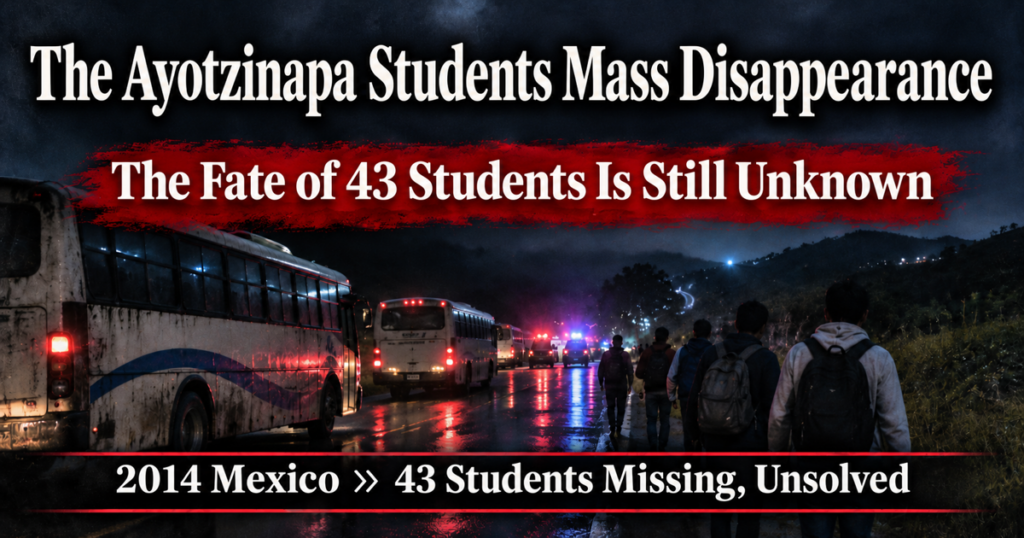
The Ayotzinapa Students Mass Disappearance took place from the night of September 26, 2014, into the early hours of September 27, in and around Iguala, in the Mexican state of Guerrero. Students from the Raúl Isidro Burgos Rural Teachers’ College, commonly known as Ayotzinapa, were attacked by police, after which 43 of them went missing. In several attacks that occurred that same night, six people, including three students, were killed, and many others were injured.
The disappearance of the 43 students must be distinguished from the deaths of the six people killed in the attacks. The fact that six people were killed does not mean that the deaths of all 43 missing students have been confirmed. As of 2025, forensic examination of human remains had identified only three of the students. Authorities had described the remaining students as showing no signs of life, but the deaths of all of them had not been individually confirmed.
Even after many years, the full circumstances of the 43 students’ disappearance have not been established. Investigations raised questions not only about collusion between police and a criminal organization, but also about the involvement of the Federal Police and the military, the handling of information by authorities, and the reliability of the initial investigation. Government announcements, reviews by international experts, and a later re-examination by government bodies reached different conclusions. As a result, the case has become not only a question of what happened to the missing students, but also of how state institutions were involved in the search for the truth.
The students had secured buses to attend a commemorative march.
On the day of the incident, the students were preparing to travel to Mexico City to take part in a march commemorating the 1968 Tlatelolco incident. To make the journey, they obtained buses in Iguala and set out. During the trip, however, they encountered police checkpoints and gunfire. The students’ journey developed into multiple attacks by police, resulting in serious harm over the course of the night.
The theory that drugs were being transported on the buses has appeared in hypotheses advanced by the GIEI and in journalistic investigations, but it has not been established as the motive for the incident.
The circumstances surrounding the buses the students intended to use have become one of the issues in examining the background to the case. It is essential, however, to maintain a boundary between hypotheses and established facts. Filling unresolved questions about what prompted the police action or what information particular people possessed with speculation would only make the investigation needed to establish the truth about the disappearances less clear.
Multiple attacks took place in Iguala and nearby areas, leaving six people dead.
From the night of September 26 into the early hours of September 27, multiple attacks occurred in Iguala and surrounding areas. As a result, six people, including three students, were killed, and many others were injured. The incident cannot be understood by separating the disappearance of the 43 students from the other events. The students went missing after being taken away by police amid a series of attacks at several locations that same night, during which people were killed and injured.
Sources differ in how they describe the breakdown of the number of people injured and other details of the casualties. It is therefore appropriate to state what can be established with confidence rather than fix a more detailed figure where the sources do not agree: six people were killed, three of them students. Giving a clear figure for the deaths is necessary to convey the scale of the incident, but it is equally important not to fill in numbers that have not been confirmed.
The people killed that night must also be distinguished, in both the records and the investigation, from the 43 students who disappeared. The existence of six confirmed deaths does not in itself establish the final fate of the 43 missing students. As of 2025, remains had been identified as belonging to three of the 43 students, while the circumstances of the others remained unresolved. This distinction is fundamental to any account of the case.
The 43 students disappeared after being taken into police custody.
Amid the attacks that night, 43 students were taken into police custody and subsequently disappeared. The central issue in the case is that, after the students had been placed under police control, it remained unclear where they were taken and what happened to them. This was not simply a case in which their whereabouts became unknown: because they disappeared after being detained by police exercising public authority, the case has been examined as an instance of enforced disappearance.
The initial investigation established that the municipal police of Iguala and Cocula detained the students and were colluding with the criminal organization Guerreros Unidos. The relationship between the police and the criminal organization became an important element in understanding the course of events. The extent to which the Federal Police and the military were involved, however, remained a separate issue. The finding of collusion between the municipal police and the criminal organization cannot automatically be extended to establish criminal responsibility on the part of other state institutions or individual officials.
The account presented in the initial government announcement about where the students were taken after being detained by police, and what happened to them afterward, was later rejected. It is therefore inappropriate to reproduce the government’s former account as an established sequence of events. The record of the case needs to distinguish between the fact that the students were detained by police, the fact that the 43 disappeared, and the subsequent collapse in the credibility of the explanations offered about what happened to them.
The initial investigation established collusion between municipal police and a criminal organization.
The initial investigation established that the municipal police of Iguala and Cocula detained the students and were colluding with the criminal organization Guerreros Unidos. This showed that the case was not simply a matter of confusion during police operations, but involved a relationship between local police forces and a criminal organization. To clarify how the students disappeared after being taken into police custody, it was necessary to establish not only what the officers involved in the detentions had done, but also what kind of coordination existed between the police and the criminal organization.
The findings of the initial investigation, however, are not the same as facts conclusively established about the entire case. In particular, the scope of the Federal Police’s and the military’s involvement remained contested, and later expert reviews identified additional problems. The finding that the police had colluded with a criminal organization does not mean that every explanation offered by the initial investigation about what subsequently happened to the 43 students was correct. At each stage of the investigation, it is necessary to distinguish what was substantiated from what was later called into question.
The investigation conducted after the incident itself also became a subject of scrutiny. Later reviews raised questions about the reliability of the earlier investigation, the handling of testimony and evidence, and the concealment of information by authorities. Establishing the truth requires the conclusions presented by investigative bodies to be examined again, with substantiated information separated from information whose reliability has been rejected.
The government announced the Cocula incineration theory as the “Historical Truth.”
In January 2015, prosecutors under the Peña Nieto administration, then the Office of the Attorney General of the Republic (PGR), announced what they called the “Historical Truth.” According to that account, the municipal police handed the 43 students over to Guerreros Unidos, and the students were killed and incinerated at a garbage dump in Cocula. The government presented this as its explanation of the case, but it was later subjected to scientific examination by independent experts, who rejected its central elements.
The “Historical Truth” should not be treated as an account of facts established today. It was the explanation announced by the government at the time, and later reviews identified serious problems with its scientific basis. In particular, the GIEI’s review concluded that the claim that the remains of 43 people had been incinerated at Cocula was scientifically impossible. The announcement therefore cannot be presented as the confirmed course of events. It must instead be understood as an account the government issued at the time and that was subsequently rejected through independent review.
This issue went beyond the correction of a single investigative hypothesis. The explanation the government had presented as its final account of the case did not withstand scientific examination. The later Truth and Justice Commission also acknowledged that the “Historical Truth” was a fabricated account. How the government announcement was constructed and why that explanation was made public consequently became important issues in their own right.
The GIEI’s scientific review rejected the initial government announcement.
The Interdisciplinary Group of Independent Experts (GIEI), established under the framework of the Inter-American Commission on Human Rights (IACHR), investigated the case and published reports between 2015 and 2016 rejecting the “Historical Truth.” The GIEI stated that the account claiming that the 43 students had been incinerated at the Cocula garbage dump was scientifically impossible. This meant that the central conclusion of the government’s announcement could not be supported and that the explanation of the case had to be fundamentally reconsidered.
The GIEI’s role was not to replace the government’s announcement with another government position, but to examine documents and evidence from the standpoint of independent experts. In a case in which state institutions may themselves be subjects of investigation or parties to the events, it is important not to rely solely on explanations provided by the investigative authorities, but to conduct an independent review. In the Ayotzinapa case, the involvement of experts through an international framework helped bring the problems with the original account to light.
On March 28, 2022, the GIEI also published its third report, making important findings concerning the military’s involvement. The report stated that the military had monitored the students in real time and, through intercepted communications, had been aware of exchanges among those who had taken the students into custody, yet had not rescued them. It also pointed to evidence tampering and concealment by authorities, including the Navy. These were findings concerning military and government surveillance, inaction, and the handling of evidence; they did not mean that direct involvement in the killings had been established. The reported findings must be clearly distinguished from a determination of criminal responsibility.
The new administration established a Truth and Justice Commission and reopened the investigation.
In December 2018, President Andrés Manuel López Obrador issued a presidential decree establishing the Truth and Justice Commission (COVAJ). The commission began its work on January 15, 2019, and pursued efforts to establish the truth about the case. COVAJ was not a court with authority to determine guilt or innocence. It was a truth-seeking body established by presidential decree. Its report is an important source for examining the course of events and the involvement of state institutions, but it is different in nature from a criminal court judgment concerning individual suspects.
On August 18, 2022, COVAJ published its report and concluded that the Ayotzinapa case was a “crime of the state.” It also stated that there were no signs of life among the students. This wording does not mean that the remains of all 43 students had been found or that the death of each one had been individually established. As of 2025, only three students had been identified, and the whereabouts of the remaining students were still unknown. The commission’s assessment must not be confused with the facts that have been confirmed about each individual student.
COVAJ further referred to suspicions that an army colonel had ordered the killing of six students who remained alive for up to four days after their disappearance. This was made public as a serious suspicion; it cannot be written as though the order or direct involvement in the killings had been established. The criminal responsibility of individual military personnel remained subject to investigation and judicial proceedings. The commission’s assessment of state involvement and the responsibility of a particular individual as established through a criminal trial are matters at different stages.
Also in 2022, former Attorney General Jesús Murillo Karam was arrested. This showed that questions of responsibility extended beyond the investigation into the missing students’ whereabouts to include former investigators involved in the original investigation and the construction of the “Historical Truth.” Nevertheless, the fact of an arrest alone cannot establish the responsibility of any individual or resolve the truth of the entire case. Reviewing the original investigation and determining the students’ whereabouts remain parallel tasks.
Military surveillance and concealment were reported, but direct involvement in the killings remains unconfirmed.
In the Ayotzinapa case, what the military knew and what it did on the night of the incident became major points of dispute. The GIEI’s third report, published in March 2022, stated that the military had monitored the students in real time and had learned through intercepted communications about exchanges among those who had taken them into custody. The report also pointed to the military’s failure to rescue the students, as well as evidence tampering and concealment by authorities, including the Navy. These findings are important for examining the possibility that state institutions knew what was happening and how they responded afterward.
In its 2022 report, COVAJ also concluded that the case was a “crime of the state” and raised questions about the involvement of state institutions. However, findings of surveillance, inaction, or concealment of evidence by state institutions are not the same as a legal determination that specific members of the military directly carried out or ordered the killings of the students. The alleged order by an army colonel mentioned by COVAJ also remained a suspicion under investigation. The commission’s findings should not be treated as though they were a final court judgment establishing an individual’s criminal responsibility.
The extent of the military’s involvement is an unavoidable issue in establishing the truth about the case, but it would also be inappropriate to rush to a definitive conclusion. Separate questions need to be examined: which institutions knew what; what decisions led to the failure to rescue the students; who was involved in tampering with or concealing evidence; and whether evidence exists demonstrating direct involvement in the killings. It is important to report the findings of the GIEI and COVAJ accurately without turning suspicions still under investigation into established facts.
Only three students have been identified, and the whereabouts of the 43 remain unresolved.
Of the 43 students, forensic examination of human remains had identified three as of 2025. Two additional students were identified between 2020 and 2021, bringing the total to three, including the one identified earlier. These identifications are important developments, but they do not mean that the whereabouts or ultimate fate of all 43 students have been established. The circumstances of the remaining students have not been fully clarified.
In its 2022 report, COVAJ stated that there were no signs of life. This assessment must be treated as an official explanation based on the investigation and examination of information. However, there is a significant difference between saying that there are “no signs of life” and saying that the deaths of all 43 students have been confirmed. Since remains have been identified as belonging to only three students, it cannot be stated as an established fact that all of the remaining 40 were killed. An inference of death, an assessment by an official body, and the identification of an individual through human remains must be treated as separate kinds of information.
The families continue to call for the students’ return, saying: “They were taken alive; we want them back alive” (Vivos se los llevaron, vivos los queremos).
Investigations into enforced disappearance raise questions about independence from state institutions.
Understanding this case requires taking account of the crime of enforced disappearance. The students went missing after being taken into police custody, and the central issues are their detention by state authorities and their subsequent disappearance. In cases where public institutions may have been involved, it is important to ensure that the investigation is independent rather than entrusting it solely to the institutions involved in the detention or to their chain of command. The questions surrounding state involvement and the credibility of the initial investigation were among the reasons why an international expert review was sought in the Ayotzinapa case.
In Mexico, the roles of COVAJ, which pursued efforts to establish the truth, and the prosecutors responsible for criminal prosecution are different. COVAJ was a commission established by presidential decree. It investigated the course of events and the involvement of state institutions and published its views in a report. Because it is not a court, its report does not establish the criminal responsibility of individual people. Criminal investigations and prosecutions are instead handled by the Special Investigation Unit (UEILCA) of the Office of the Attorney General of the Republic (FGR). It is necessary to distinguish between the role of a commission seeking to establish the truth and the role of prosecutors seeking to establish criminal responsibility.
The IACHR and the GIEI were also involved as mechanisms for examining the case from positions different from those of domestic investigative bodies and commissions. The GIEI’s scientific review and its third report in 2022 examined the initial government announcement and identified problems concerning military surveillance and the authorities’ handling of evidence. International review does not automatically replace the decisions of domestic institutions, but it provides an independent perspective from which to examine documents and explanations in cases involving state institutions. Establishing the truth requires careful attention to the powers of each institution and the stage at which its findings or decisions stand.
The families continue to demand the students’ return.
At the center of the investigations and debates over reports concerning the Ayotzinapa case are the families of the students who went missing. The families continue to say: “They were taken alive; we want them back alive” (Vivos se los llevaron, vivos los queremos). Their words show that the case has not ended with past investigative records or assessments of government reports. With the whereabouts of the 43 still unknown and only three students identified, establishing the truth remains an ongoing task for the families.
The “Historical Truth” announced in 2015 was rejected through the GIEI’s scientific review, and COVAJ later acknowledged that it was a fabricated account. In 2022, the GIEI reported military surveillance and inaction, as well as evidence tampering and concealment by authorities, while COVAJ concluded that the case was a “crime of the state.” Prosecutions of people involved in the original investigation also moved forward, and former Attorney General Murillo Karam was arrested. Even so, these reports and investigative developments have not established the whereabouts of all 43 students. Both the examination of institutional responsibility and the task of determining the whereabouts of each individual student remain unfinished.
Sources
- Ayotzinapa Case: Key Points to Understand the Mexican Government’s New Actions — WOLA
https://www.wola.org/?p=57207 - Lies, Cover-Up, and Military Involvement: Third Expert Report — WOLA
https://www.wola.org/analysis/lies-cover-up-military-involvement-fresh-facts-ayotzinapa/ - Mexican Military Archives Produce New Revelations in the Ayotzinapa Case — National Security Archive, George Washington University
https://nsarchive.gwu.edu/news/mexico-ayotzinapa/2022-04-01/mexican-military-archives-produce-new-revelations-ayotzinapa-case?eType=EmailBlastContent&eId=90ec04b9-ce44-40ef-b57d-9960c4d0af1f - The Missing 43: Five Years Later — The New York Review of Books
https://www.nybooks.com/articles/2019/09/26/ayotzinapa-missing-five-years-later/
Original Japanese record: アヨツィナパ学生集団失踪事件|43名の行方と「歴史的真実」をめぐる検証
Last updated: