
Boston Marathon Bombing | The Death Sentence Reinstated by the Supreme Court and the Ongoing Inquiry into Juror Bias
The bombing that struck Boston, USA, on 15 April 2013. This record traces how three people were killed in the blasts and how the death sentence imposed on Dzhokhar Tsarnaev was reinstated by the Supreme Court after being vacated, while an inquiry into juror bias continues.
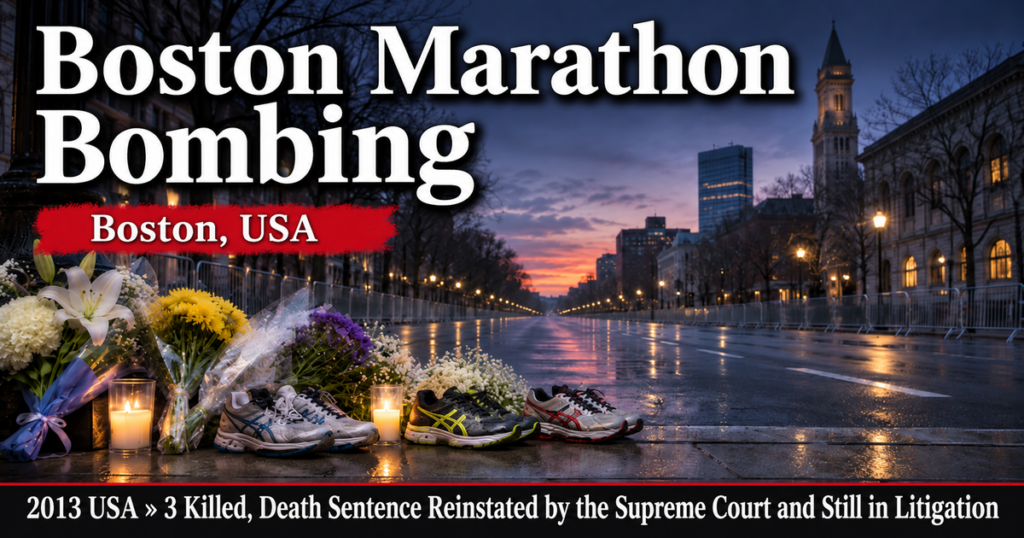
Three lives were lost at the 117th Boston Marathon.
On 15 April 2013, a terrorist bombing took place in Boston, Massachusetts, in the United States, during the 117th Boston Marathon. The event was held on Patriots’ Day, a public holiday in Massachusetts. Three spectators were killed by the bombing, and many others were injured. Those who lost their lives were two women, aged 29 and 23, and a boy who was just eight years old. The 23-year-old woman was an international student from China.
Two brothers of Chechen descent, Tamerlan Tsarnaev and Dzhokhar Tsarnaev, were identified as the perpetrators. At the time of the bombing, the elder brother was 26 and the younger brother was 19. Tamerlan died during the subsequent police search, whilst Dzhokhar faced criminal proceedings in a federal court. In addition to those harmed by the bombing itself, police officers also lost their lives in connection with the subsequent search.
Dzhokhar was sentenced to death in 2015. However, that sentence was vacated by a federal appeals court in 2020 and reinstated by a ruling of the US Supreme Court in 2022. In 2024, a further inquiry was ordered into allegations concerning the impartiality of jurors who had actually served at the trial. As of November 2026, judicial proceedings relating to sentencing remain ongoing.
Basic Information
| Item | Details |
|---|---|
| Case name | Boston Marathon Bombing |
| Date of the bombing | 15 April 2013 |
| Location | Boston, Massachusetts, United States |
| Deaths resulting from the bombing | 3 (Krystle Campbell, 29; Lingzi Lu, 23; Martin Richard, 8) |
| Injuries | An estimated 264 people taken to hospital, based on Associated Press figures; a separate count of 281 cited by Wikipedia; more than 500 according to the FBI |
| Police officers who died in connection with the search | Sean Collier (27, died on 18 April 2013) and Dennis Simmonds (died on 10 April 2014). These deaths are separate from those caused by the bombing. |
| Perpetrators | Tamerlan Tsarnaev (aged 26 at the time, died on 19 April 2013) and Dzhokhar Tsarnaev (aged 19 at the time) |
| Courts | US District Court for the District of Massachusetts, US Court of Appeals for the First Circuit, US Supreme Court |
| Sentence and current status | Dzhokhar was convicted. Sentenced to death in 2015; the sentence was vacated in 2020 and reinstated in 2022. The inquiry into juror bias ordered in 2024 remains ongoing. The death sentence remains in force, but no execution date has been set (as of November 2026). |
| Place of imprisonment | ADX Florence federal prison, Colorado |
Injury estimates range from 264 to more than 500 people.
Whilst three people were killed by the bombing, the reported number of injured people varies between sources. A widely cited estimate based on Associated Press figures puts the number at 264, referring to injured people who were taken from the scene to hospital. Encyclopaedia Britannica gives the number of injured as more than 260.
The injury figures cited by Wikipedia include a separate count of 281, in addition to the figure of 264. By contrast, the official website of the Federal Bureau of Investigation (FBI) states that more than 500 people were injured. The latter figure is based on a count in a subsequent federal report and covers a broader range of people, including those who sought medical treatment. An estimate based primarily on hospital transports and a count that also includes those who sought treatment differ in the scope of the population counted.
Some victims sustained injuries that necessitated the amputation of limbs. According to the FBI, 14 victims who had undergone amputations testified at the trial. A separate count puts the number at 12, meaning that figures for particular categories of injury also vary between accounts. The victims included not only those who lost their lives but also people who suffered serious physical injuries and subsequently gave evidence in court.
The FBI had conducted an investigation between the brothers’ arrival in the United States and the bombing.
The Tsarnaev family emigrated to the United States in 2002 after living in Kyrgyzstan and the Russian Republic of Dagestan. Dzhokhar travelled to the United States with his parents, and his elder brother, Tamerlan, joined them the following year. The family applied for political asylum and settled in Cambridge, Massachusetts.
Tamerlan had originally aspired to become a boxer, but his commitment to Islam reportedly deepened from around 2009. In 2011, the FBI investigated Tamerlan after receiving information from Russia’s Federal Security Service (FSB). The FBI interviewed him, but found no evidence substantiating terrorist activity, and that investigation was closed.
The following year, in 2012, Tamerlan visited Dagestan for approximately six months. On 11 September that same year, his younger brother Dzhokhar obtained US citizenship.
Two police officers died as a result of incidents connected with the search.
Following the bombing, the FBI released photographs and video footage of two suspects and received a large volume of information from the public. During the police search, residents of the Greater Boston area were asked to remain at home, whilst public transport services and businesses shut down.
On 18 April 2013, Sean Collier, a police officer at the Massachusetts Institute of Technology (MIT), was killed. He was 27 years old. Criminal responsibility for Collier’s killing was subsequently among the matters addressed in Dzhokhar’s federal trial.
Dennis Simmonds, an officer with the Boston Police Department, also sustained serious injuries in a shoot-out in Watertown on 19 April 2013. He died as a result of those injuries on 10 April 2014, approximately one year after the bombing. Neither officer was killed by the explosions at the marathon; both were victims of incidents associated with the subsequent search.
Tamerlan also sustained injuries from gunfire and a vehicle in connection with the shoot-out in Watertown on 19 April 2013 and was pronounced dead in hospital. Wikipedia records a total of six deaths across the series of incidents. That figure includes the two police officers and Tamerlan, one of the perpetrators, and therefore covers a different set of deaths from the figure of three people killed by the bombing itself.
Federal criminal proceedings began after the younger brother was taken into custody.
Dzhokhar was taken into custody on 19 April 2013 whilst injured. On 22 April, charges were brought against him in federal district court through proceedings conducted at the hospital where he was receiving treatment. The initial charges concerned the use of a weapon of mass destruction and the malicious destruction of property resulting in death.
Dzhokhar’s questioning also became a subject of debate because there was a period during which he was not given a Miranda warning. The investigators initially questioned him without giving the warning, relying on the ‘public safety exception’, which prioritises establishing whether there is an imminent threat. After subsequently receiving the warning, Dzhokhar exercised his right to remain silent. The application of the exception became a legal issue concerning the relationship between rights in criminal proceedings and public safety.
The case was heard not in a Massachusetts state court, but in the US District Court for the District of Massachusetts. This was because terrorism-related offences under federal law, including the use of a weapon of mass destruction, formed the central part of the prosecution. On 10 July 2013, Dzhokhar pleaded not guilty to 30 counts, including charges relating to the killing of Officer Collier. From that point, the federal court was to determine whether he was guilty or not guilty of those counts and what punishment should be imposed in the event of a conviction.
Dzhokhar’s account and the FBI’s assessment shed light on the motive.
According to the explanation Dzhokhar reportedly gave investigators, the bombing was motivated by opposition to the wars in Iraq and Afghanistan. He also stated that he had become radicalised independently rather than acting on the instructions of an external terrorist organisation. Furthermore, a written note of his that was used as evidence at the trial contained statements characterising the bombing as retaliation for US military operations in Iraq and Afghanistan.
The FBI has also officially described the brothers as self-radicalised (‘self-radicalized’). The investigation did not establish any specific connection with a larger terrorist organisation. The explanation of the brothers’ motives came from Dzhokhar’s statements and writings, whilst the conclusion concerning their links to terrorist organisations was based on the investigative authorities’ assessment.
At the trial, however, the prosecution and the defence disputed the role Dzhokhar himself had played in the case. The prosecution portrayed him as someone who had actively participated in an extremist struggle against the United States. The defence argued that Tamerlan, the elder brother, had been the driving force behind the bombing and that Dzhokhar was a follower who had been strongly influenced by him. Separate from Dzhokhar’s stated motives and the investigators’ assessment of radicalisation, the extent of each brother’s responsibility became a contested issue bearing on sentencing.
In 2015, the jury found Dzhokhar guilty on all 30 counts.
Before the trial, jury selection took place from 5 January to 3 March 2015. The trial began on 4 March. According to the FBI, the prosecution presented more than 100 witnesses and more than 1,000 pieces of evidence. In addition to the bombing itself, the trial addressed criminal responsibility for other matters, including the killing of Officer Collier.
Although Dzhokhar had pleaded not guilty to the 30 counts during the proceedings in 2013, his defence acknowledged his involvement in the offences from the outset of the trial in 2015. The defence focused on the extent of his elder brother’s influence and the younger brother’s position in relation to him. The dispute with the prosecution extended beyond the question of involvement in the offences to whether Dzhokhar should be sentenced to death.
On 8 April 2015, the jury returned guilty verdicts on all 30 counts. Of these, 17 were counts on which the death penalty could potentially be imposed. The verdicts established his guilt at this stage, but did not mean that death sentences had been decided upon for all 17 counts. In federal court, the proceedings determining guilt were separate from the sentencing proceedings that determined the nature and severity of the punishment. Following the guilty verdicts, the choice of sentence was therefore entrusted to the jury.
A formal sentence was imposed after proceedings in which the death penalty was sought.
During the sentencing phase, the defence placed particular emphasis on the influence it maintained Tamerlan had exerted over Dzhokhar. Whilst acknowledging Dzhokhar’s involvement in the offences, the defence developed its argument that his elder brother had been the driving force behind the case. The prosecution took a different position, emphasising Dzhokhar’s own agency.
The victims’ families were not unanimous in their views on whether the death penalty should be pursued. In 2015, it was reported that the parents of the boy who had been killed expressed their opposition to the pursuit of the death penalty in an open letter, describing the suffering that prolonged appeals would cause their family.
On 15 May that year, at the conclusion of the sentencing phase, the jury recommended the death penalty on six counts. On 24 June, federal district court Judge O’Toole formally imposed the death sentence. Dzhokhar was also given multiple life sentences. At his sentencing, he apologised to the victims.
The guilty verdicts of 8 April, the jury’s recommendation of the death penalty on 15 May and the formal sentencing on 24 June each represented a distinct stage of the federal proceedings. The defence subsequently challenged jury selection in the district court and the treatment of evidence during sentencing, and the case moved to the US Court of Appeals for the First Circuit.
In 2020, the federal appeals court vacated the death sentence on two grounds.
On 30 July 2020, the US Court of Appeals for the First Circuit vacated Dzhokhar’s death sentence. The ruling, delivered approximately five years after the sentence had been imposed in 2015, identified two problems: the district court’s approach to jury selection and the treatment of evidence offered during the sentencing phase.
The first ground was that the district court had not adequately established the extent to which prospective jurors had been exposed to media coverage of the case. Holding the trial in Boston, the city affected by the bombing, raised the question of whether an impartial jury capable of reaching a fair decision could be selected from members of the public who had been exposed to widespread coverage. The appeals court questioned the district court’s method of establishing prospective jurors’ exposure to that coverage.
The second ground concerned the exclusion from the sentencing phase of evidence indicating that Tamerlan had been suspected of involvement in a murder case that occurred in Waltham, Massachusetts, on 11 September 2011. The defence had sought to introduce the evidence in support of its argument about the controlling influence that the elder brother had exerted over the younger. However, Tamerlan had neither been charged nor convicted in connection with the Waltham case. The evidence the defence wished to present related to suspicions of his involvement in that separate case.
The appeals court vacated the death sentence and the convictions on three counts, ordering a new sentencing proceeding before a new jury. Meanwhile, the multiple life sentences based on the remaining convictions were upheld. Even at this stage, when the death sentence had been vacated, Dzhokhar’s position as a prisoner facing imprisonment for the remainder of his life was unchanged.
In 2022, the US Supreme Court reinstated the death sentence in a 6–3 ruling.
The federal government challenged the ruling of the US Court of Appeals for the First Circuit, and the US Supreme Court agreed to hear the appeal in March 2021. Oral arguments were heard on 13 October that year. The question before the Supreme Court was whether the federal district court’s handling of the two issues identified by the appeals court as grounds for vacating the death sentence had been permissible.
On 4 March 2022, the US Supreme Court reversed the appeals court’s decision by six votes to three. The case is reported as United States v. Tsarnaev (595 U.S. 302). The majority opinion, written by Justice Thomas, held that both the district court’s handling of questions put to prospective jurors and its exclusion of evidence relating to the Waltham case had fallen within the district court’s discretion.
The majority held that Dzhokhar had received the fair trial before an impartial jury guaranteed by the Sixth Amendment to the US Constitution. It also concluded that the district court had been entitled to exclude the evidence relating to the Waltham case on grounds that included concerns about its reliability. Justice Breyer dissented, joined by Justices Sotomayor and Kagan.
The Supreme Court’s ruling reinstated the death sentence imposed in 2015. However, issues other than those addressed by the Supreme Court remained to be considered on appeal. The case was therefore remanded to the US Court of Appeals for the First Circuit. In the proceedings that followed, specific allegations relating to individual jurors, distinct from the method of questioning prospective jurors during jury selection, became the subject of judicial consideration.
In 2024, an inquiry into allegations of bias involving two jurors was ordered.
On 21 March 2024, the US Court of Appeals for the First Circuit, in a 2–1 decision, directed the district court to investigate allegations of juror bias. Two years had passed since the Supreme Court’s 2022 ruling reinstating the death sentence, but the issue on this occasion was whether sufficient investigation had been conducted during the selection of two jurors who had actually served at the trial.
One juror was alleged to have retweeted a derogatory post about Dzhokhar despite having stated during jury selection that they had never commented online about the case. The other juror was alleged to have received a post from a friend encouraging them to serve on the jury and find Dzhokhar guilty. Both allegations were raised as matters concerning the impartiality of the jury.
The appeals court held that the district court’s failure to investigate these allegations during jury selection had not met constitutional requirements. Whereas the appeals court’s 2020 ruling had concerned the manner in which prospective jurors were questioned about their exposure to media coverage, its 2024 ruling called for an investigation of allegations concerning two specific jurors.
Following the remand to the district court, the inquiry into the jurors’ fitness to serve remains ongoing under Judge O’Toole. Depending on the outcome, vacating the death sentence and conducting a new sentencing proceeding before a new jury are possible judicial outcomes. The appeals court expressly stated, however, that the guilty verdicts themselves would remain in place and that the outcome of the sentencing-related inquiry would not result in Dzhokhar’s release from prison.
Judicial proceedings in the individual case continue despite changes in federal execution policy.
During the appellate proceedings in Dzhokhar’s case, US policy on carrying out federal death sentences also changed. In July 2021, Attorney General Garland announced a temporary suspension of federal executions, known as a moratorium. When the Supreme Court reinstated Dzhokhar’s death sentence the following year, in 2022, this federal moratorium was in place.
In December 2024, President Biden commuted the sentences of 37 of the 40 federal prisoners on death row to life imprisonment. Dzhokhar was one of the three prisoners excluded from the commutations. The measure therefore did not change his death sentence to life imprisonment.
On 20 January 2025, President Trump signed an executive order calling for executions to resume. The Attorney General reportedly formally lifted the moratorium on 5 February that year. The administration’s policy on the federal death penalty shifted from suspending executions to resuming them, but the criminal proceedings in Dzhokhar’s individual case remain ongoing, with the inquiry into juror bias ordered in 2024 still under way.
As of November 2026, Dzhokhar is imprisoned at ADX Florence, a highly secure federal prison in Florence, Colorado. More than 13 years have passed since the bombing and more than 11 years since the guilty verdicts. His convictions are final, and the multiple life sentences mean that he will remain in prison for the rest of his life. The death sentence reinstated in 2022 remains in force, but the inquiry that could overturn the sentence is still pending, and no execution date has been set.
Sources
- Boston Marathon Bombing — official FBI website (the course of the case, the figure of three deaths and more than 500 injuries, and an overview of the trial): https://www.fbi.gov/history/cases-and-criminals/boston-marathon-bombing
- Boston Marathon bombing of 2013 — Encyclopaedia Britannica (the course of the incident, the figure of more than 260 injuries, and a summary of the 2015 sentence, its vacation in 2020 and its reinstatement in 2022): https://www.britannica.com/event/Boston-Marathon-bombing-of-2013
- Boston Marathon bombing — Wikipedia (the times and locations of the explosions, the breakdown of deaths and injuries and the range of reported figures, the proceedings from the initial charges through the trial, the 2020 vacation of the sentence and the 2022 Supreme Court ruling, and the motive and background): https://en.wikipedia.org/wiki/Boston_Marathon_bombing
- Federal Appellate Court Ruling Requires Investigation into Jury Bias in Boston Marathon Case — Death Penalty Information Center (details of the First Circuit Court of Appeals’ remand order of 21 March 2024 directing an inquiry into juror bias): https://deathpenaltyinfo.org/federal-appellate-court-ruling-requires-investigation-into-jury-bias-in-boston-marathon-case
Original Japanese record: ボストンマラソン爆弾テロ事件|最高裁で復活した死刑判決と続く陪審員偏向の調査
Last updated: