
Oklahoma City Bombing | The Execution of a Federal Death Sentence and 161 Life Sentences Imposed at the State Trial
The bombing of a federal building in Oklahoma City, USA, on 19 April 1995, which killed 168 people. This record traces the course of events through to the execution of Timothy McVeigh in 2001 and the 161 life sentences imposed on Terry Nichols at his state trial.
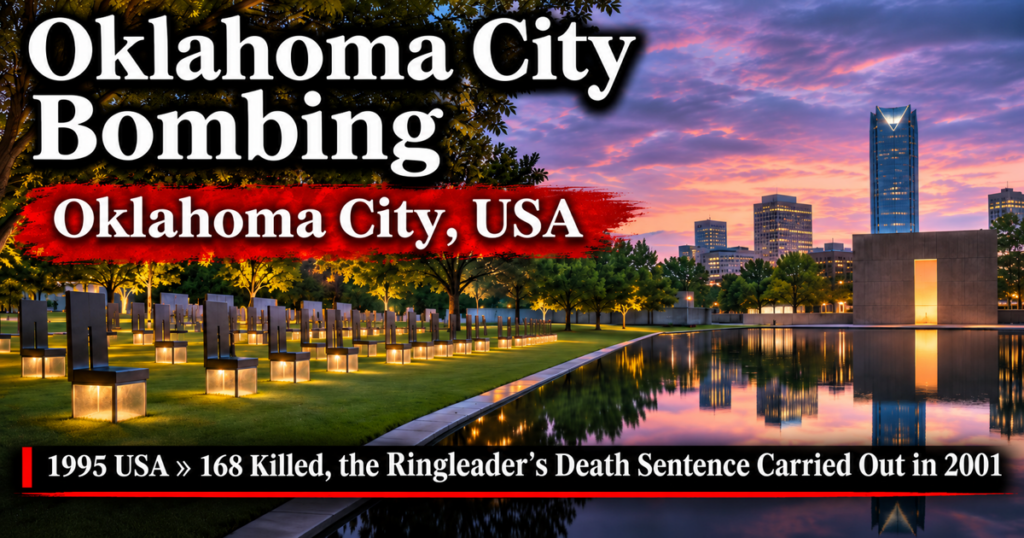
A federal government building was bombed, claiming 168 lives.
On 19 April 1995, a bombing took place at the Alfred P. Murrah Federal Building in Oklahoma City, in the US state of Oklahoma. A total of 168 people, including 19 children, lost their lives, and more than 680 people were injured. The explosion of a truck bomb caused approximately one third of the building to collapse, and the damage extended to neighbouring buildings.
The Murrah Federal Building was nine storeys high and housed 14 federal agencies. As well as accommodating federal government departments, the building contained a childcare centre called America’s Kids on its second floor. Many of the children who died had attended this centre. The victims of the bombing therefore included not only employees of federal agencies but also young children.
The two principal defendants prosecuted in connection with the case were Timothy McVeigh and Terry Nichols, both former US Army soldiers. McVeigh was sentenced to death at his federal trial, and the sentence was carried out in 2001. After receiving a sentence of life imprisonment without the possibility of parole at his federal trial, Nichols faced separate criminal proceedings in the state of Oklahoma.
Basic information
| Item | Details |
|---|---|
| Case name | Oklahoma City Bombing |
| English name | Oklahoma City bombing |
| Date of incident | 19 April 1995 |
| Location | Alfred P. Murrah Federal Building, Oklahoma City, Oklahoma, United States |
| Overview | Bombing of a federal government building |
| Casualties | 168 people killed (including 19 children); more than 680 injured (figures vary according to the source) |
| Principal defendants | Timothy McVeigh and Terry Nichols |
| Legal proceedings against McVeigh | Convicted on all 11 counts at his federal trial; death sentence finalised and carried out on 11 June 2001 |
| Legal proceedings against Nichols | Found guilty at his federal trial in 1997 and sentenced to life imprisonment without parole in 1998. Convicted of 161 counts of first-degree murder and other offences at his state trial in 2004; sentenced to 161 consecutive terms of life imprisonment without parole |
| Other individuals involved | Michael Fortier was sentenced to 12 years’ imprisonment under a plea agreement and released in 2006. Lori Fortier received immunity from prosecution in exchange for her testimony |
A life was also lost during the rescue operation, and 324 neighbouring buildings were damaged.
The death toll given by the Federal Bureau of Investigation (FBI) and the memorial is 168. This figure includes not only the 167 people who died as a direct result of the explosion but also one person involved in the rescue operation who sustained a fatal head injury from falling debris. According to the opinion issued by the US Court of Appeals for the Tenth Circuit, 163 of the victims died inside the building and five outside it.
Of the 168 people who lost their lives, 19 were children. The presence of a childcare centre in a building housing federal government agencies meant that children were among those affected by the bombing. A memorial would subsequently be established at the site of the incident to commemorate all 168 victims, adults and children alike.
As for the number of people injured, the memorial museum and media reports use a figure of more than 680. Some accounts give a total of 684, whilst other sources using different counting criteria give a figure of 592. Differences between sources remain concerning the definitive total number of people injured.
The damage to property was also extensive. In addition to the collapse of part of the Murrah Federal Building itself, 324 surrounding buildings were damaged, and the total cost of the damage has been estimated at approximately US$652 million. The severely damaged federal building was demolished on 23 May of that year. The bombing resulted not only in the loss of a federal government building but also in widespread damage to properties in the surrounding area.
McVeigh claimed that the bombing was retaliation for the federal government’s actions.
Timothy McVeigh was a former US Army soldier who had served in the Gulf War. He had met Terry Nichols and Michael Fortier in 1988 during basic training at the US Army’s Fort Benning. The two men who would later become defendants in federal court and the man who would become a witness co-operating with the prosecution had therefore known one another since their time in the Army.
In letters and interviews, McVeigh claimed that the bombing was retaliation for the federal government’s handling of the Ruby Ridge incident in 1992 and the Waco siege in 1993. The Ruby Ridge incident involved a confrontation between federal agents and an armed family in Idaho, which resulted in deaths. During the Waco siege in Texas, the Branch Davidian compound caught fire, and numerous members of the religious group lost their lives.
The Waco siege ended on 19 April 1993. The Oklahoma City bombing occurred on 19 April 1995, exactly two years later. According to McVeigh’s own account and the arguments presented by the prosecution at trial, the anniversary was connected with his stated motive of retaliation for the siege.
Unlike McVeigh, who spoke of retaliation against the federal government, Nichols made few statements of his own concerning his motives. The courts established that both men had been involved in planning the bombing, but Nichols did not publicly express the same motive as McVeigh.
The FBI investigation identified McVeigh, and Nichols surrendered to the authorities.
Following the bombing, the FBI pursued its investigation. By 20 April, the following day, evidence from the recovered vehicle had provided a lead towards identifying those involved. A composite sketch of McVeigh was also released, and on 21 April he was identified as the perpetrator of the bombing. By that point, McVeigh was already in custody on suspicion of an unrelated offence.
Nichols also became the subject of the investigation. Having learnt that he was being investigated by the authorities, Nichols surrendered to them in Herington, Kansas, on 21 April. Both men who would subsequently stand trial for their involvement in the bombing were thus in the custody of the authorities shortly after the incident.
During the investigation, eyewitness accounts were also received concerning an unidentified man referred to as ‘John Doe No. 2’. In response to accounts from several eyewitnesses, the FBI released a composite sketch and searched for the man. However, no individual was identified as that man and charged in connection with the bombing. The defence would later raise the question of his possible involvement during the trials.
A federal grand jury indicted both men on 11 counts.
On 10 August 1995, a federal grand jury indicted McVeigh and Nichols on 11 counts. These comprised one count of conspiracy to use a weapon of mass destruction, one count of using a weapon of mass destruction, one count of destruction by explosives, and eight counts of first-degree murder relating to the deaths of eight federal law enforcement officers.
Although the bombing had claimed 168 lives, the murder charges brought in federal court consisted of eight counts. This reflected the division of criminal jurisdiction between the federal government and the state governments in the United States. The destruction of federal property and the killing of federal law enforcement officers fall within the federal criminal justice system, whilst the prosecution of murders involving the other victims takes place under state law. The 11 counts in the federal indictment represented the offences charged under this jurisdiction.
The venue for the trials was also changed. Given the shock caused by the bombing and the extensive media coverage, it was considered difficult to select an impartial jury within Oklahoma. The federal trials were transferred to Denver, Colorado, where US District Judge Richard Matsch presided over the proceedings against both defendants. A viewing facility was also provided in Oklahoma City for victims and bereaved families, enabling them to follow the proceedings via closed-circuit television.
Although the trials took place in a state other than the one in which the bombing had occurred, arrangements were made for victims and bereaved families to observe the proceedings from their own city. McVeigh and Nichols were tried by separate juries, and the same 11-count indictment ultimately led to different verdicts.
McVeigh was found guilty on all 11 counts and sentenced to death.
On 2 June 1997, a federal jury in Denver returned guilty verdicts against McVeigh on all 11 counts in the indictment. In addition to finding him guilty of conspiracy to use and using a weapon of mass destruction, and destruction by explosives, the jury found him guilty of the first-degree murders of eight federal law enforcement officers.
In federal capital cases, the proceedings to determine guilt or innocence are separate from those to determine the sentence. A unanimous decision by the jury is required for the death penalty to be selected. The guilty verdicts returned on 2 June did not therefore constitute the formal imposition of a death sentence.
On 13 June, following the sentencing proceedings, the jury unanimously recommended that McVeigh receive the death penalty. Judge Matsch subsequently imposed the formal death sentence on 14 August. The guilty verdicts were thus followed by separate sentencing proceedings and a jury recommendation before the federal court formally sentenced McVeigh to death.
McVeigh’s defence appealed against the judgement. In 1998, the US Court of Appeals for the Tenth Circuit upheld the convictions and death sentence in its ruling in United States v. McVeigh, 153 F.3d 1166. The following year, in 1999, the US Supreme Court declined to grant discretionary review. This did not mean that the Supreme Court had reconsidered the question of guilt or innocence and delivered a new verdict; rather, it had declined to hear the appeal. McVeigh subsequently withdrew his remaining appeals.
Nichols was found guilty of involuntary manslaughter rather than first-degree murder at his federal trial.
On 23 December 1997, the jury returned its verdicts at Nichols’s federal trial. Whereas McVeigh had been found guilty on all 11 counts, Nichols was found guilty of conspiracy to use a weapon of mass destruction and eight counts of involuntary manslaughter relating to the deaths of the federal law enforcement officers. He was acquitted of the charges of using a weapon of mass destruction and first-degree murder.
One of the issues that distinguished the verdicts against the two defendants was the proof of an intention to kill. Whilst the jury found that Nichols had participated in planning the bombing, it concluded in the federal trial that the intention to kill the victims had not been sufficiently established. Accordingly, it found him guilty of involuntary manslaughter rather than first-degree murder in relation to those deaths.
The sentencing outcomes also differed. Whilst the jury at McVeigh’s trial had unanimously recommended the death penalty, the jury in Nichols’s case could not agree on whether he should be sentenced to death. Consequently, on 4 June 1998, the federal court sentenced him to life imprisonment without the possibility of parole. He was also ordered to pay US$14.5 million in restitution.
The convictions relating to the deaths in this federal trial were for involuntary manslaughter in respect of the eight federal law enforcement officers. Even after Nichols had been sentenced in federal court, proceedings continued in Oklahoma to prosecute him in relation to victims whose deaths had not been covered by the federal trial.
Fortier entered into a plea agreement and testified against both defendants.
Michael Fortier had known McVeigh and Nichols since their Army days and had prior knowledge of the plan. Although Fortier declined to participate in carrying out the bombing, he did not report the plan to the authorities. As a result, he faced criminal liability on charges different from those brought against the two men whose direct involvement in the bombing was established.
Fortier entered into a plea agreement with the prosecution. He pleaded guilty to offences including misprision of felony (failure to report a felony), making false statements to the FBI and transporting stolen firearms, and testified at the trials of McVeigh and Nichols. This procedure combined a guilty plea with co-operation in the investigation and trials, and was separate from the proceedings in which the two defendants were tried for their involvement in the bombing.
His wife, Lori Fortier, also co-operated with the authorities and gave evidence. Lori, who was alleged to have been involved in producing forged documents connected with the case, received immunity from prosecution in exchange for her testimony. Whereas Michael pleaded guilty to his own offences and was sentenced, Lori was granted immunity from prosecution.
On 27 May 1998, Michael Fortier was sentenced to 12 years’ imprisonment under the plea agreement. Unlike McVeigh’s death sentence or Nichols’s sentence of life imprisonment without parole, this was a sentence of a fixed duration. Fortier was released from federal prison on 20 January 2006 and was reported to have entered a witness protection programme.
The FBI’s failure to disclose investigative records came to light shortly before the execution.
McVeigh’s execution had originally been scheduled for 16 May 2001. This was after the federal appellate court had upheld the judgement, the US Supreme Court had declined discretionary review and McVeigh himself had withdrawn his remaining appeals. However, in May of that year, shortly before the scheduled execution, the US Department of Justice disclosed a problem concerning the release of investigative records.
More than 3,000 investigative records had not been disclosed by the FBI to McVeigh’s defence team. As these undisclosed records came to light after the death sentence had already been finalised, the defence needed to be given time to examine them. The execution was therefore postponed by approximately one month.
On 6 June 2001, Judge Matsch, who had presided over McVeigh’s federal trial, delivered his ruling concerning the previously undisclosed records. He concluded that the material neither established McVeigh’s innocence nor overturned the guilty verdicts that had already been returned, and allowed the execution to proceed. The failure to disclose the records had altered the execution schedule, but the convictions and the death sentence themselves remained in force.
The fact that investigative records had not been disclosed to the defence became grounds for criticism of the reliability of the FBI’s investigation. The investigation had begun in 1995 and led to guilty verdicts and a death sentence in 1997. The disclosure problem, however, was not made public until after those proceedings had concluded, shortly before the execution in 2001.
On 11 June 2001, the federal government carried out its first execution in 38 years.
On 11 June 2001, Timothy McVeigh was executed by lethal injection at the federal prison in Terre Haute, Indiana. He was 33 years old. It was the first execution carried out by the US federal government since 1963, 38 years earlier. Approximately six years after the bombing in 1995, the federal criminal proceedings against McVeigh culminated in his execution.
The bombing had also affected the legal framework governing the death penalty. In 1996, the Antiterrorism and Effective Death Penalty Act (AEDPA) was enacted. This legislation included measures to tighten the time limits and requirements for prisoners sentenced to death under state law and others seeking habeas corpus relief in federal court. Federal habeas corpus review is a procedure through which individuals convicted within a state’s criminal justice system may challenge the legality of their detention.
Although McVeigh himself had withdrawn his appeals, the FBI’s failure to disclose records shortly before the execution had required a further judicial determination. After the federal court allowed the execution to proceed, the postponed death sentence was carried out. Because McVeigh’s federal death sentence had been finalised and carried out, no separate murder trial against him took place in Oklahoma.
The state of Oklahoma prosecuted Nichols separately from the federal proceedings.
In March 1999, the year after Nichols had been sentenced to life imprisonment without parole in federal court, an Oklahoma grand jury indicted him on charges of violating state law. The federal proceedings had concerned, among other offences, the deaths of federal law enforcement officers. The state prosecution sought to establish his criminal responsibility in relation to victims whose deaths had not been covered by the federal proceedings.
Underlying these two prosecutions was the dual sovereignty doctrine, which treats the federal government and the state as separate sovereigns. Because federal and state law have their own independent criminal statutes, prosecutions by both sovereigns under their respective laws for the same conduct are not considered to violate the prohibition against double jeopardy. Nichols’s state trial was not a proceeding intended to reconsider the sentence that had already been imposed in federal court.
The state grand jury also examined the possible existence of other accomplices over a period of approximately 18 months, but Nichols was the only person indicted through these proceedings. The selection of an impartial jury also presented an issue in the state case, and the trial was transferred from Oklahoma City to McAlester, elsewhere in the state of Oklahoma.
On 26 May 2004, the jury at Nichols’s state trial found him guilty of 161 counts of first-degree murder, first-degree arson and conspiracy. The 161 counts of first-degree murder included one relating to the death of an unborn child. Although Nichols had been acquitted of first-degree murder in federal court, he was convicted of first-degree murder in the state proceedings, which concerned a different group of victims from those covered by the federal trial.
The state jury, too, was unable to reach agreement on whether to impose the death penalty. On 9 August 2004, Judge Steven Taylor sentenced Nichols to 161 consecutive terms of life imprisonment without the possibility of parole. These sentences under state law became final separately from the sentence of life imprisonment without parole that had already been imposed in federal court. Nichols continues to serve his sentence at the ADX Florence federal prison in Colorado.
Suspicions concerning another accomplice did not lead to an indictment.
The defence teams for McVeigh and Nichols also alleged the involvement of another person in connection with the unidentified man referred to as ‘John Doe No. 2’, for whom the FBI had searched. However, the search prompted by eyewitness accounts did not establish that this man existed or confirm his identity. Nor did it lead to the identification and indictment of another person directly involved in the bombing.
Judge Taylor, who presided over Nichols’s state trial, concluded that there was no credible evidence demonstrating that anyone other than McVeigh and Nichols had been directly involved in the bombing. Even after the state grand jury’s examination of the matter, no other person was indicted. Criminal responsibility for participation in planning the bombing was established in the separate trials of the two defendants.
A memorial was established at the site to commemorate the 168 victims.
In 1997, the Oklahoma City National Memorial Act provided for the establishment of a memorial to preserve the memory of the bombing and commemorate its victims. The Oklahoma City National Memorial, established on the site of the Murrah Federal Building, was dedicated on 19 April 2000, the fifth anniversary of the bombing.
The Field of Empty Chairs, which forms part of the memorial, contains 168 chairs representing the 168 people who lost their lives. The death toll includes 19 children as well as the one person who died during the rescue operation. The memorial subsequently became an affiliated area of the National Park System, and the memorial museum opened on 19 February 2001.
When the memorial was dedicated, McVeigh had not yet been executed and Nichols’s state trial had not yet concluded. McVeigh was subsequently executed in 2001, and Nichols was sentenced at his state trial in 2004. Fortier was then released in 2006. As the different criminal proceedings concerning those involved in the bombing of 1995 ran their respective courses, the chairs commemorating the 168 victims remained at the site.
Sources
- Terror Hits Home: The Oklahoma City Bombing — FBI official website: https://www2.fbi.gov/libref/historic/famcases/oklahoma/oklahoma.htm
- 30th Anniversary of Oklahoma City Bombing — FBI official website (18 April 2025): https://www.fbi.gov/news/stories/30th-anniversary-of-oklahoma-city-bombing
- Oklahoma City bombing — Wikipedia: https://en.wikipedia.org/wiki/Oklahoma_City_bombing
- Terry Nichols — Wikipedia: https://en.wikipedia.org/wiki/Terry_Nichols
Original Japanese record: オクラホマシティ連邦政府ビル爆破事件|連邦死刑の執行と州裁判で科された161件の終身刑
Last updated: