
Charles Taylor War Crimes Trial | From the Indictment of a Sitting President to Final Convictions on All 11 Counts and a 50-Year Prison Sentence
The trial of former Liberian president Charles Taylor before the Special Court for Sierra Leone, over crimes committed in the neighbouring country's civil war. He was convicted on all eleven counts of aiding and abetting, and a 50-year sentence became final, whilst superior responsibility was not established. This record traces the proceedings.
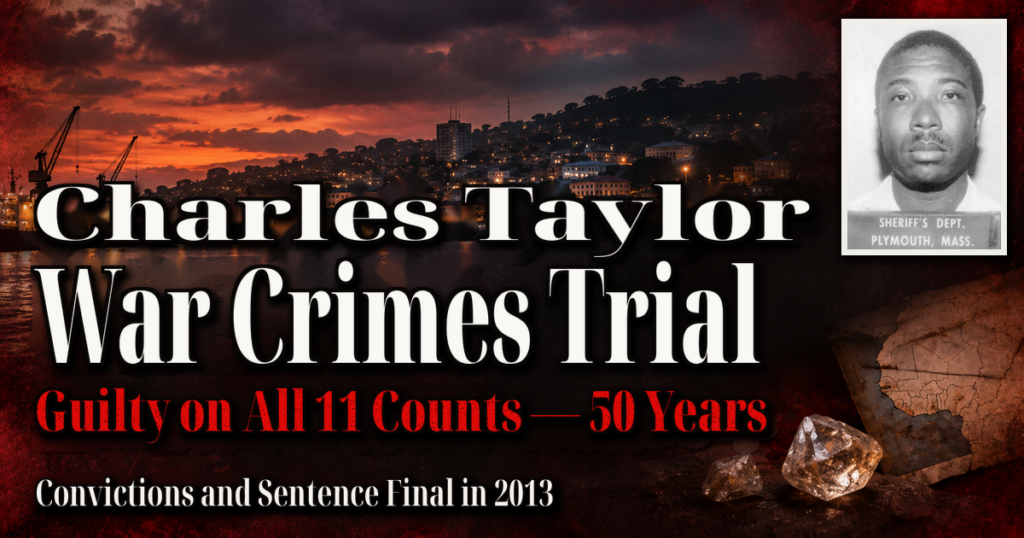
A former Liberian president stood trial over the civil war in a neighbouring country.
On 26 April 2012, in The Hague, the Netherlands, the Special Court for Sierra Leone (SCSL) delivered its trial judgement against former Liberian President Charles Taylor. Trial Chamber II, presided over by Judge Richard Lussick, unanimously found him guilty on all 11 counts in the indictment.
Although Taylor had served as president of Liberia, the crimes at issue in the trial had taken place in neighbouring Sierra Leone. The proceedings concerned the nature of Taylor’s criminal responsibility for crimes committed between 30 November 1996 and 18 January 2002, during the Sierra Leone Civil War, which lasted from 1991 to 2002.
The judgement established Taylor’s responsibility for aiding and abetting crimes committed by armed groups in Sierra Leone and for his involvement in planning certain attacks. It did not find that Taylor had personally perpetrated the crimes, nor did it convict him as a superior exercising effective command and control over those armed groups.
Indicted in 2003 while still serving as president, Taylor went into exile abroad in August of that year and was transferred to the Special Court in 2006. The 50-year prison sentence imposed at trial was upheld on appeal in September 2013. Roughly ten years after his indictment as a sitting president, his convictions on every count became final.
Basic Information
| Item | Details |
|---|---|
| Case name | Charles Taylor War Crimes Trial |
| Defendant | Charles Ghankay Taylor (born 28 January 1948) |
| Term as President of Liberia | 2 August 1997 – 11 August 2003 |
| Location of the crimes | Sierra Leone |
| Period covered by the indictment | 30 November 1996 – 18 January 2002 |
| Indictment made public | 4 June 2003 |
| Presidential resignation and start of exile | 11 August 2003 |
| Arrest and transfer to the Special Court | 29 March 2006 |
| Court | Special Court for Sierra Leone (SCSL) |
| Trial venue | The Hague, the Netherlands |
| Counts | Five counts of crimes against humanity, five counts of war crimes and one count of other serious violations of international humanitarian law |
| Trial judgement | 26 April 2012: guilty on all 11 counts |
| Modes of liability | Aiding and abetting (all 11 counts); planning (certain attacks) |
| Sentencing judgement | 30 May 2012: 50 years’ imprisonment |
| Appeal judgement | 26 September 2013: convictions and sentence upheld and made final |
| Enforcement of sentence | Reportedly serving his sentence at HMP Frankland in the United Kingdom (as of November 2026) |
Cross-border support linked two separate civil wars.
Charles Taylor was born in Liberia on 28 January 1948. In December 1989, armed action by the National Patriotic Front of Liberia (NPFL), led by Taylor, marked the beginning of the First Liberian Civil War. The Doe government collapsed in 1990.
Meanwhile, in Sierra Leone, the Revolutionary United Front (RUF), led by Foday Sankoh and supported by Taylor, began an armed struggle in March 1991, marking the start of the civil war. Liberia’s NPFL and Sierra Leone’s RUF were distinct organisations, and the two civil wars were separate conflicts.
On 30 November 1996, the government of Sierra Leone and the RUF concluded the Abidjan Peace Agreement. The civil war did not end, however. On 25 May 1997, the Armed Forces Revolutionary Council (AFRC), a faction of Sierra Leone’s armed forces, staged a coup and established military rule in alliance with the RUF.
Around that time in Liberia, Taylor won the presidential election in July 1997 and took office as president on 2 August. The subsequent trial judgement found that, by around the time of his inauguration at the latest, Taylor knew of the atrocities being committed against civilians by the RUF and the AFRC. The fact that he provided support to armed groups with knowledge of their crimes became an important factor in determining his liability for aiding and abetting.
In Liberia, a rebellion by anti-government forces began in 1999 and developed into the Second Liberian Civil War, which continued until 2003. By contrast, the Sierra Leone Civil War was declared over on 18 January 2002. It was crimes committed during the latter conflict that the Special Court examined. Crimes committed by the NPFL within Liberia fell outside its jurisdiction.
A Special Court was established to address crimes committed during the civil war.
The Sierra Leone Civil War, which lasted approximately 11 years, inflicted immense suffering on the civilian population. Estimates of the scale of the losses differ between sources. Wikipedia and Encyclopaedia Britannica put the death toll at no fewer than 50,000, whilst Wikipedia’s article on the civil war gives a figure of between 50,000 and 70,000. Amnesty International’s account puts the number of civilian deaths at approximately 75,000 and notes that estimates range from 50,000 to 200,000.
Some estimates also put the number of displaced people at more than two million, whilst the United Nations publication Africa Renewal states that half the country’s population was forced to flee. These figures relate to the human cost of the civil war as a whole and are distinct from the number of victims of the specific crimes listed in Taylor’s indictment.
On 16 January 2002, before the declaration that the civil war had ended, the United Nations and the government of Sierra Leone signed an agreement establishing the Special Court for Sierra Leone to hold those responsible for serious crimes to account. Based in the capital, Freetown, it was a hybrid court with both Sierra Leonean and foreign judges and prosecutors. Its operations depended heavily on voluntary contributions from states.
The Court’s jurisdiction covered serious violations of international humanitarian law and other offences committed within Sierra Leone from 30 November 1996, the date on which the Abidjan Peace Agreement was concluded. Its mandate was to try those who bore the greatest responsibility for those crimes. The offences within its jurisdiction included crimes against humanity, war crimes and other serious violations of international humanitarian law, such as the conscription of children under the age of 15 or their use in hostilities.
Under this jurisdiction, Taylor, who had been supporting armed groups in Sierra Leone from the Liberian side of the border, also became the subject of prosecution. Although the crimes occurred in a different country from the one in which the defendant had served as president, the basis of his indictment was his involvement in crimes committed on Sierra Leonean territory.
The indictment of a sitting president was made public during peace talks.
In March 2003, the Prosecutor of the Special Court for Sierra Leone indicted Taylor on 17 counts. The indictment was confirmed on 7 March but was initially kept under seal. Taylor was still President of Liberia at the time, and the country’s second civil war was continuing.
The indictment was made public on 4 June that year. Taylor was visiting Accra, the capital of Ghana, to attend peace talks concerning Liberia. During his visit, the Special Court made the indictment and arrest warrant public. The Ghanaian authorities, however, did not arrest Taylor, and he returned to Liberia.
On 11 August, several months after his indictment, Taylor resigned as president. He went into exile in Calabar, Nigeria, on the condition that he would not involve himself in Liberian politics. His presidency had ended after approximately six years in office, but the criminal proceedings before the Special Court for Sierra Leone continued.
On 31 May 2004, the Special Court’s Appeals Chamber ruled on Taylor’s motion claiming immunity on the grounds that he had been a head of state at the time of his indictment. It dismissed his motion to quash the indictment, holding that the sovereign equality of states did not preclude the prosecution of a head of state before an international criminal tribunal.
Although Taylor had become a former president following his resignation, the Court did not terminate the criminal proceedings on the grounds that he had been a serving head of state when indicted. At this stage, however, the Court had decided only that immunity did not bar his prosecution. It had yet to determine his guilt or innocence in relation to the crimes charged.
Taylor was transferred to the Special Court’s custody nearly three years after going into exile in Nigeria.
It was in March 2006 that Taylor finally came into the custody of the Court. On 16 March, an amended indictment reducing the original 17 counts to 11 was approved. The following day, 17 March, Liberian President Sirleaf formally requested that Nigeria surrender Taylor.
Nigeria announced on 25 March that it would comply with the request. Taylor subsequently disappeared from his residence in exile, but he was arrested at Gamboru on the border with Cameroon on 29 March. His period of exile in Nigeria thus came to an end.
After being taken to the Liberian capital, Monrovia, Taylor was arrested by the Liberian police and handed over to the United Nations Mission in Liberia (UNMIL). He was then transferred to Freetown in Sierra Leone and placed in the custody of the Special Court that same day. The period spent in detention from that date onwards would later be credited towards his prison sentence.
On 3 April 2006, Taylor made his first appearance before the Special Court. He pleaded not guilty to all 11 counts in the amended indictment. Having progressed through the indictment of a sitting president, exile abroad and a dispute over head-of-state immunity, the case now entered the stage at which evidence would be examined to establish the defendant’s specific involvement in the crimes.
Holding Taylor’s trial in Freetown, where the Special Court was based, nevertheless raised concerns about regional security. Once his custody had been secured, the question of where to conduct the trial also had to be resolved.
Security concerns led to the relocation of the trial to The Hague.
In Taylor’s case, it was considered that his very presence in Freetown might undermine regional stability. Consequently, unlike the other cases before the Special Court for Sierra Leone, Taylor’s trial alone was to be held in The Hague, in the Netherlands.
Ahead of the trial abroad, on 15 June 2006, the United Kingdom announced its willingness to enforce Taylor’s sentence in the United Kingdom should he be convicted. The Special Court’s system provided that sentences would ordinarily be served in Sierra Leone, whilst allowing enforcement in another country where circumstances such as limited prison capacity warranted it.
On 16 June, the United Nations Security Council adopted Resolution 1688. The resolution authorised a Trial Chamber of the Special Court for Sierra Leone to sit at the facilities of the International Criminal Court (ICC) in The Hague. Taylor was transferred to The Hague on 20 June and held at the ICC detention facility in Scheveningen.
Although the venue of the trial and the detention facility had changed, the court responsible for the case had not. It was Trial Chamber II of the Special Court for Sierra Leone that conducted the trial; Taylor was neither indicted nor tried by the ICC itself. The judgement would also be delivered under the Statute of the Special Court for Sierra Leone.
In 2007, the United Kingdom enacted domestic legislation concerning the international tribunal for Sierra Leone. Through the co-operation of several countries and international institutions, arrangements were put in place for the trial to be held in The Hague and for the United Kingdom to take responsibility for enforcing the sentence in the event of a conviction.
The lengthy trial involved 115 witnesses.
The trial in The Hague opened on 4 June 2007. On the first day, Taylor boycotted the proceedings because of his dissatisfaction with his defence arrangements and did not appear in court. The substantive presentation of the prosecution’s evidence did not begin until 7 January 2008.
The prosecution concluded the presentation of its case on 27 February 2009. According to the trial judgement summary, the prosecution called a total of 94 witnesses, including those heard when its case was reopened. On 4 May that year, the Trial Chamber dismissed a motion for acquittal, and the proceedings moved on to the presentation of the defence case.
Taylor himself took the witness stand. He gave evidence over a period of approximately seven months, from 14 July 2009 to 18 February 2010. The defence called a total of 21 witnesses. Together with the prosecution witnesses, this brought the total number of witnesses involved in the proceedings to 115.
Among the matters examined in court were diamond transactions between Taylor and armed groups in Sierra Leone. In August 2010, the model Naomi Campbell and others gave evidence concerning a gift of diamonds that Taylor was alleged to have received in South Africa in 1997. Testimony concerning the transfer and receipt of diamonds formed part of the evidence relating to the connection between diamonds and support for the armed groups.
The defence concluded the presentation of its case on 12 November 2010. Closing arguments ended on 11 March 2011, bringing the proceedings, which had lasted a total of 420 trial days, to a close. Several years after the trial opened in 2007, the evidence and the arguments of both parties were before the Court. It was now for the Court to determine whether Taylor had been involved in the crimes and, if so, the applicable modes of liability.
Taylor was found guilty of aiding and abetting on all 11 counts.
In its trial judgement of 26 April 2012, the Special Court found Taylor guilty on every one of the 11 counts in the amended indictment. These comprised five counts of crimes against humanity, five counts of war crimes and one count of other serious violations of international humanitarian law.
The crimes against humanity were murder, rape, sexual slavery, other inhumane acts and enslavement. The war crimes were acts of terrorism, violence to life, health and related interests (murder), outrages upon personal dignity, cruel treatment and pillage. The remaining count concerned the conscription, enlistment or use in hostilities of children under the age of 15, a serious violation of international humanitarian law relating to child soldiers.
None of these convictions was based on a finding that Taylor had personally perpetrated the crimes in Sierra Leone. The Court found that Taylor had continued to provide support to the RUF and the AFRC despite knowing that they pursued a strategy of targeting civilians and repeatedly committed crimes.
His support included military and operational assistance, advice and moral support. The judgement found that such assistance had a substantial effect on the commission of the crimes. It also established that Taylor had received diamonds in return for his support.
On the basis of these findings, the Court held that Taylor was liable for aiding and abetting under Article 6(1) of the Statute on all 11 counts. Although this was a mode of liability distinct from direct perpetration, Taylor was held individually criminally responsible for assistance provided with knowledge of the crimes and which had a substantial effect on their commission.
Taylor’s involvement in planning was established, but superior responsibility was not.
In addition to aiding and abetting, the Court found Taylor liable for planning under Article 6(1) of the Statute in relation to certain attacks. It found that, in November 1998, Taylor had devised a plan for attacks jointly with RUF commander Sam Bockarie. The finding of guilt for planning was confined to the series of attacks concerning Kono, Makeni and Freetown between December 1998 and February 1999.
Not all the modes of liability advanced by the prosecution were established, however. Taylor’s participation in a joint criminal enterprise was not found to have been proved beyond reasonable doubt. Nor was he convicted on the basis of ordering or instigating the crimes.
With regard to superior responsibility under Article 6(3) of the Statute, the issue was whether Taylor exercised effective command and control over the RUF and the AFRC. The Court acknowledged that he was President of Liberia, that the leaders of the armed groups respected him as an elder statesman and that his advice was generally heeded.
Nevertheless, Taylor’s advice and guidance remained at an advisory level, and they were not invariably followed. The Court distinguished between exercising influence and exercising effective command and control over subordinates in the capacity of a superior. It held that the latter had not been proved. Superior responsibility was therefore not established.
The criminal liability established in the trial judgement consisted of aiding and abetting on all 11 counts and involvement in planning a limited set of attacks. It was not a finding that Taylor had planned military operations throughout the civil war or that he had occupied a superior position within the chain of command of either the RUF or the AFRC.
The contradiction between Taylor’s role as a peace mediator and his support for armed groups contributed to a 50-year prison sentence.
On 30 May 2012, approximately one month after his conviction, the Special Court for Sierra Leone sentenced Taylor to 50 years’ imprisonment. Rather than imposing a separate sentence for each of the 11 counts, the Court imposed a single sentence covering them all. Time spent in detention from 29 March 2006 onwards was to be credited towards the sentence.
A factor given particular weight in sentencing was the duality of Taylor’s public role and the support he was actually providing. Taylor was President of Liberia and also held a senior position within the Economic Community of West African States (ECOWAS). The Court found that, whilst publicly presenting himself as a mediator seeking peace in Sierra Leone, he had continued to support the RUF and the AFRC.
Although his liability was based primarily on aiding and abetting rather than superior responsibility, the Court did not regard Taylor’s involvement as minor. In addition to his continued support despite knowing of crimes targeting civilians, the contradiction between his actions and his position as a head of state was given considerable weight in determining the sentence.
Under the sentencing framework of the Special Court for Sierra Leone, the death penalty could not be imposed, and life imprisonment was not available either. Sentences were imposed for fixed terms specifying the number of years to be served. The 50-year term was among the most severe sentences imposed under the Court’s system.
Taylor had been found guilty on all 11 counts and sentenced to a lengthy term of imprisonment, but the judicial proceedings had not yet reached their conclusion. On appeal, the findings of guilt and the sentence were contested, and the prosecution also renewed its arguments concerning modes of liability that had not been established at trial.
The Appeals Chamber upheld the convictions and sentence without extending the scope of Taylor’s liability.
On 26 September 2013, the Appeals Chamber of the Special Court for Sierra Leone unanimously upheld the convictions on all 11 counts and the 50-year prison sentence imposed at trial. The convictions and sentence thereby became final, and the sentence was to be enforced immediately.
One of the legal issues contested on appeal was whether ‘specific direction’ was necessary to establish liability for aiding and abetting. The Appeals Chamber held that it was not a required element of aiding and abetting. Its decision not to adopt the legal principle set out in the Perišić judgement of the International Criminal Tribunal for the former Yugoslavia (ICTY) was also an important ruling in the jurisprudence of international criminal law.
Regarding sentencing, the Appeals Chamber held that the Trial Chamber had erred in treating aiding and abetting as generally less serious than other modes of liability. Nevertheless, it considered the actual sentence of 50 years’ imprisonment to be appropriate and did not alter its length.
The prosecution had argued that Taylor should also have been convicted on the basis of ordering and instigating the crimes. The Appeals Chamber rejected that argument. Whilst the convictions on every count were upheld, the modes of liability on which they were based were not extended beyond those established at trial.
Ten years after his indictment as a sitting head of state in 2003, and approximately seven and a half years after his arrest, Taylor’s criminal liability was finally determined. The ultimate outcome of the proceedings was liability for aiding and abetting on all 11 counts, liability for planning in relation to certain attacks, and a single sentence of 50 years’ imprisonment covering every count.
Taylor continues to serve his sentence in the United Kingdom following the closure of the Special Court.
On 15 October 2013, Taylor was transferred to the United Kingdom and placed in the maximum-security prison HMP Frankland in County Durham. The United Kingdom’s undertaking in 2006 to receive Taylor in the event of a conviction was thus fulfilled after the appeal judgement became final.
Having completed proceedings in all its cases with the delivery of the appeal judgement in Taylor’s case, the Special Court for Sierra Leone closed in December 2013. Its successor institution, the Residual Special Court for Sierra Leone (RSCSL), assumed responsibility for functions such as supervising the enforcement of sentences, protecting witnesses and managing records. Taylor’s imprisonment is also subject to the supervision of the Residual Special Court.
Taylor sought a transfer to Rwanda, but the Residual Special Court dismissed his application in March 2015, and his imprisonment in the United Kingdom was to continue. According to the United Nations publication Africa Renewal, under the British system he could become eligible for consideration for early release after serving two-thirds of his sentence, but by that point Taylor would be over 90 years old. As of November 2026, according to his biographical article on Wikipedia, he is reportedly still serving his sentence at HMP Frankland.
Taylor’s case was the first instance of a sitting head of state being indicted by an international tribunal. He has also been described as the first former head of state whose conviction became final before such a tribunal since Dönitz, who was convicted at the Nuremberg trials following the Second World War. President Milošević of the former Yugoslavia also stood trial before an international tribunal, but he died before judgement was delivered and was therefore never convicted.
Having rejected immunity on the basis of head-of-state status, the Special Court ultimately established Taylor’s individual criminal responsibility for crimes committed in a neighbouring country. Its ruling distinguished between influence over armed groups in that country and effective command and control, and was based on the proven instances of aiding and abetting and involvement in planning. The ruling of the Court, which concluded the trial proceedings in 2013, lives on in the 50-year prison sentence that is still being enforced in the United Kingdom.
Sources
- Special Court for Sierra Leone (SCSL), official press release, “Charles Taylor Convicted” (2012-04-26) — https://s3.eu-west-1.amazonaws.com/rscsl.org/Documents/Press/2012/pressrelease-042612.pdf
- Special Court for Sierra Leone (SCSL), official press release, “Appeals Chamber Upholds Taylor Conviction and Sentence” (2013-09-26) — https://s3.eu-west-1.amazonaws.com/rscsl.org/Documents/Press/2013/pressrelease-092613.pdf
- SCSL, official trial judgement summary (Judgement Summary, reproduced by Sierra Herald) — http://sierraherald.com/charles-taylor-judgement-summary.htm
- English-language Wikipedia, “Charles Taylor (Liberian politician)” — https://en.wikipedia.org/wiki/Charles_G._Taylor
- Encyclopaedia Britannica, “Charles Taylor” — http://www.britannica.com/biography/Charles-Ghankay-Taylor
- United Nations Africa Renewal, “The Special Court for Sierra Leone rests – for good” — https://africarenewal.un.org/en/magazine/special-court-sierra-leone-rests-good
Original Japanese record: チャールズ・テーラー戦犯裁判|現職大統領の起訴から全11訴因の有罪と禁錮50年の確定まで
Last updated: