
Pablo Escobar and Medellín Cartel Crimes | Conflict with the State over Extradition and Escobar's Death Following a Plea Bargain and Prison Escape
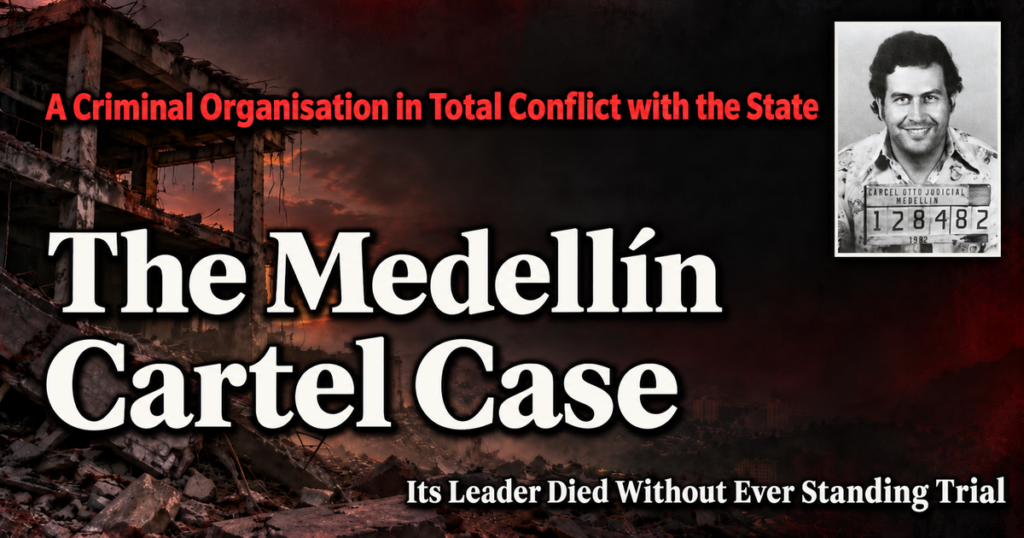
The confrontation between Colombia's Medellín Cartel and the state. After the assassination of a presidential candidate and the bombing of a passenger aircraft, the cartel's leader Pablo Escobar surrendered under a plea agreement, escaped, and was killed in 1993. No trial of Escobar himself was ever held for the principal crimes. This record traces those events.
The bombing of a passenger aircraft claimed civilian lives in the conflict between a criminal organisation and the state.
On 27 November 1989, Avianca Flight 203 was bombed in Colombia. According to the English-language Wikipedia article on the incident, which draws on the Aviation Safety Network’s accident records, a total of 110 people died, including those aboard the aircraft and victims on the ground. Presidential candidate César Gaviria, believed to have been the intended target of the attack, was not aboard the aircraft and later became President of Colombia.
Earlier that year, Luis Carlos Galán, who had preceded Gaviria as a presidential candidate, was assassinated, and the headquarters of Colombia’s Administrative Department of Security (DAS) was also bombed that year. Behind these incidents lay the conflict between the Medellín Cartel, a drug-trafficking organisation, and the Colombian state. A particularly contentious issue was the system under which drug traffickers could be extradited to the United States.
The victims of the cartel’s crimes were not confined to police officers and members of the judiciary involved in efforts to dismantle the organisation. Journalists who exposed its crimes, politicians, people travelling on the passenger aircraft and civilians on the ground also lost their lives. Violence intended to prevent extradition went beyond a dispute over government policy and inflicted widespread harm on society.
Pablo Escobar, the cartel’s leader, surrendered in 1991 under a plea bargain with the government, but escaped from prison the following year. Until his death on 2 December 1993, no trial was held in which he stood as a defendant in connection with the major assassinations and bombings.
Basic Information
| Item | Details |
|---|---|
| Case name | Pablo Escobar and Medellín Cartel Crimes |
| Country | Colombia |
| Date of incident | 27 November 1989 (the date of the Avianca Flight 203 bombing) |
| Period of organisational activity | 1976–1993 |
| Principal organisation | Medellín Cartel |
| Leader | Pablo Emilio Escobar Gaviria |
| Principal crimes | Drug trafficking, assassination, bombing, bribery, intimidation and other offences |
| Major related cases | Avianca Flight 203 bombing; assassination of Luis Carlos Galán |
| Surrender | June 1991, under a plea bargain with the government |
| Prison escape | 22 July 1992 |
| Death of Escobar | 2 December 1993, Medellín, aged 44 |
| Case resolution status | Solved |
| Investigation status | Closed |
| Judicial proceedings status | Closed owing to Escobar’s death |
| Sentence enforcement status | Not applicable (the five-year sentence imposed under the plea bargain was not served in full owing to his escape) |
The Medellín Cartel was a criminal organisation that brought together several drug traffickers.
The Medellín Cartel is believed to have been established in 1976. Alongside Escobar, who was a central figure in the organisation, its principal members included the Ochoa brothers — Jorge Luis, Juan David and Fabio — as well as José Gonzalo Rodríguez Gacha and Carlos Lehder.
However, it is misleading to regard the Medellín Cartel as an organisation in which every member was subordinate to a single leader. The English-language Wikipedia article on the cartel, drawing together assessments by law enforcement authorities at the time and subsequent research, describes its character as a consortium in which individual traffickers retained their independence while co-operating in matters such as finance and the use of force.
The same article gives an estimate of between 70,000 and 100,000 members, based on materials including US Senate hearing records. This is not a definitively established figure. Estimates of the proportion of the US cocaine market supplied by the cartel also vary according to the period and the source; the Medellín Cartel did not hold a monopoly over the market.
Estimates of Escobar’s personal wealth also differ. Encyclopaedia Britannica puts it at approximately US$25 billion, while his English-language Wikipedia biography gives an estimate of approximately US$30 billion at the time of his death. Although these figures indicate the scale of the financial power acquired through crime, both are estimates rather than definitively established totals for his assets.
The organisation’s activities included not only drug trafficking but also bribery, intimidation and killings directed against investigations and judicial proceedings. Escobar was arrested by the DAS in 1976, but is reported to have been released following the replacement of a judge and bribery. The investigators involved in his arrest were subsequently assassinated. Violence against those engaged in investigating crime was already evident as the cartel came into conflict with state institutions.
Escobar’s move into politics came to an end when the justice minister challenged him over his criminal record.
In 1982, Escobar was elected as an alternate member of the Chamber of Representatives for the Liberal Party, obtaining parliamentary immunity and a diplomatic passport. While operating as the leader of a drug-trafficking organisation, he had also acquired a position within the legislature.
Escobar also provided housing for people on low incomes and built football pitches. His English-language Wikipedia biography and Encyclopaedia Britannica describe how these activities earned him support among some local residents. This was one aspect of his efforts to cultivate a public image, and is a separate matter from the harm caused by his criminal organisation. The fact that some residents received assistance does nothing to diminish the harm suffered by investigators and ordinary citizens.
Between 1983 and 1984, Justice Minister Rodrigo Lara Bonilla challenged Escobar in parliament over his criminal record. Galán, then a Liberal Party leader, also expelled Escobar from the party. In January 1984, Escobar announced his retirement from politics.
On 30 April of the same year, Lara Bonilla was assassinated in Bogotá. The killing of the justice minister who had publicly challenged Escobar over his criminal record demonstrated that the cartel’s crimes directly affected the political and judicial spheres. Members of the judiciary and senior police officers who supported extradition continued to be killed in the years that followed.
Extradition to the United States became the principal point of contention between the criminal organisation and the government.
A treaty existed between the United States and Colombia that permitted the extradition of Colombian nationals to the United States. What drug traffickers strongly opposed was the prospect of being held criminally accountable in the United States under this system.
Escobar and others adopted the name Los Extraditables, meaning ‘those liable to extradition’, and called for the extradition system to be invalidated. Their activities were not merely expressions of opposition to a policy; they involved intimidation and assassination directed against those responsible for promoting the system. In addition to justice ministers, judges and senior police officers, journalists were also targeted.
In November 1985, the guerrilla organisation M-19 attacked the Palace of Justice, and many people, including Supreme Court justices, lost their lives. There has been testimony alleging that the cartel provided funding to obstruct a judicial review of the constitutionality of the extradition treaty. Although the Truth Commission’s investigations are reported to have corroborated some of this testimony, former guerrillas have also given testimony denying the allegation, and the cartel’s provision of funding has not been definitively established.
In 1986, Colombia’s Supreme Court invalidated the extradition treaty on the grounds of a defect in the signing procedure. President Barco, however, renewed the agreement with the United States. Despite the court’s ruling on the treaty, the government’s commitment to maintaining extradition remained unchanged, and its conflict with the cartel continued.
Journalists who exposed crime and those working in the justice system became victims.
On 17 December 1986, Guillermo Cano, editor-in-chief of the newspaper El Espectador, was assassinated. The newspaper had publicised Escobar’s criminal record. Cano’s killing was an attack on a journalist whose work involved informing society about the realities of organised crime.
Escobar and his associates used bribery and violence against those involved in pursuing their crimes. This policy is known in Spanish as plata o plomo. It was a means of exerting pressure to subordinate public duties and journalism to the interests of a criminal organisation, and people were indeed killed.
The English-language Wikipedia article on the Medellín Cartel records killings of Supreme Court justices, an attorney general, judges, senior police officers, journalists and others. Although estimates have been given for the total number of assassinations attributed to the cartel, there were limits to what the justice system could establish about the full extent of the crimes, and no definitive count encompassing all the victims has been obtained.
The harm suffered by members of the judiciary and police officers cannot be explained solely in terms of the policy dispute over extradition. Those who lost their lives were performing their respective duties: investigating a criminal organisation, bringing its members to trial and exposing its crimes to the public. The cartel’s violence was directed against the very foundations on which the functioning of the justice system and the press depended.
Presidential candidate Galán was assassinated in 1989.
Luis Carlos Galán was the politician who had previously expelled Escobar from the Liberal Party. By 1989, he had become a presidential candidate and was one of the political opponents of the cartel, which remained embroiled in the dispute over extradition to the United States.
On 18 August 1989, Galán was assassinated in Soacha. The assassination is believed to have been carried out on Escobar’s orders. On the same day, the commander of the Antioquia departmental police was also killed by the cartel. Amid repeated violence against politicians and senior police officers, Galán’s death became a major incident affecting the presidential election.
César Gaviria succeeded Galán as a presidential candidate. However, the cartel’s violence against politicians did not end with Galán’s assassination. It extended to the bombing of Avianca Flight 203, of which Gaviria is believed to have been the intended target.
Investigations into the criminal responsibility of those involved in Galán’s assassination continued afterwards. Many years after the event, a judicial ruling would be handed down against former senator Alberto Santofimio in connection with his incitement of Escobar. However, Escobar himself, who was alleged to have ordered the assassination, never stood trial for the crime.
The bombings of an aircraft and the headquarters of the Administrative Department of Security inflicted serious harm on society.
The bombing of Avianca Flight 203 on 27 November 1989 claimed the lives of people on the ground as well as passengers and crew. Although Gaviria was believed to be the intended target, he was not aboard the aircraft. Those whose lives were actually taken were people who were not parties to the political dispute.
US nationals were among the victims, and the incident marked the beginning of direct involvement by the US government. The conflict, which had originally centred on extradition to the United States, entered a new phase following the aircraft bombing, with the US government becoming involved in the response to the incident.
On 6 December of the same year, the DAS headquarters building in Bogotá was bombed. DAS is short for Departamento Administrativo de Seguridad, the name of Colombia’s Administrative Department of Security. Its director at the time, Miguel Maza Márquez, is believed to have been the intended target, but he was unharmed.
The sources disagree on the death toll from the bombing of the DAS headquarters. The English-language Wikipedia article on the Medellín Cartel gives a figure of 52, while its article on Avianca Flight 203 gives a figure of 63. The figures reported in the sources range from 52 to 63 deaths.
The series of bombings directed against aircraft and state institutions illustrates the serious harm that the cartel’s attempts to exert pressure over extradition policy inflicted on ordinary citizens. Although politicians and senior officials of security agencies were targeted, the lives of the many people who actually fell victim to these attacks were lost for ever.
The government introduced a surrender policy offering exemption from extradition and reduced sentences.
Gaviria, who had succeeded Galán as a presidential candidate, was elected President and introduced a policy intended to encourage drug traffickers to surrender. Known as ‘submission to justice’, the policy offered reduced sentences and exemption from extradition to the United States on condition that offenders turned themselves in and confessed to their crimes.
The Ochoa brothers and others also surrendered under this framework. Since the Medellín Cartel was a consortium of several traffickers, the government’s policy was not applied to Escobar alone.
In June 1991, the Constituent Assembly prohibited the extradition of Colombian nationals to the United States under the new Constitution. The system that the traffickers had sought to invalidate through assassination and intimidation was now subject to a constitutional prohibition. This became the decisive condition that made Escobar’s surrender possible.
Escobar surrendered under an agreement with the Gaviria administration, confessed to a limited set of offences and received a five-year sentence. That sentence, however, was not the outcome of a trial concerning Galán’s assassination or the bombing of Avianca Flight 203. The limited offences dealt with through the plea bargain under the surrender policy and the major cases that had not been brought to trial were treated differently in judicial terms.
The government took Escobar into custody through the plea bargain, but the process did not reach the point at which his criminal responsibility for the major assassinations and bombings would be established in court. Furthermore, special arrangements were made for his detention, unlike those of an ordinary prison.
Escobar’s imprisonment in a detention facility he had built himself ended in escape.
Escobar was held at La Catedral, in Envigado, Colombia. He had built the facility himself. Although enforcement of his sentence began as a result of the plea bargain, the nature of his detention differed considerably from imprisonment in an ordinary prison.
Escobar continued his criminal activities during his detention. When it came to light that members of the cartel had been tortured and killed inside La Catedral, the government attempted to transfer Escobar to a regular prison.
On 22 July 1992, Escobar escaped. His detention under the agreement with the government ended, and his five-year sentence was never served in full. The leader of the organisation, who had been taken into custody following his surrender the previous year, was once again a wanted man.
The National Police pursued the investigation through the Search Bloc (Bloque de Búsqueda), a special unit tasked with tracking down Escobar. The United States also provided technical and intelligence assistance, and the search extended across the country.
The events between Escobar’s surrender and his escape reveal the gap between taking the leader of a criminal organisation into custody through a plea bargain and the state’s ability to retain control of that person and enforce the sentence. New crimes were committed at La Catedral, and the government lost custody of Escobar when it sought to transfer him. The conflict between the government and the cartel returned to the stage of a criminal investigation aimed at securing his arrest.
Violence by the rival organisation Los Pepes spread alongside the National Police’s pursuit of Escobar.
Initially, the Medellín and Cali cartels co-operated by dividing up distribution territories in the US market. However, territorial disputes and personal conflicts led to a decisive breakdown in their relationship from around 1988.
Following Escobar’s escape from prison, a vigilante organisation known as Los Pepes operated independently of the National Police’s pursuit. Its name is a Spanish abbreviation meaning ‘people persecuted by Pablo Escobar’, and the organisation is believed to have been formally established in January 1993.
Los Pepes received funding from the Cali Cartel and was led by the Castaño brothers and others. The group killed people close to Escobar and destroyed property, targeting not only his close associates but also accountants, lawyers and property belonging to his family. Although Los Pepes was hostile to Escobar, its activities were not an attempt to establish criminal responsibility through judicial proceedings; instead, they involved further violence.
The relationship between state institutions and Los Pepes also remains a subject of debate. According to the English-language Wikipedia article on Los Pepes, which summarises documents from the US Central Intelligence Agency (CIA) released in 2008, the director of Colombia’s National Police had stated that he instructed his subordinates to establish contact with Fidel Castaño for the purpose of gathering intelligence.
Whilst documentary evidence confirms intelligence-related contact with some police personnel, the extent of organised collusion between state institutions and Los Pepes has not been definitively established. Some members of Los Pepes also subsequently took part in founding the paramilitary organisation AUC.
After escaping from prison, Escobar was pursued by the National Police with US support, whilst also facing pressure from a cartel with which he had previously co-operated and from a hostile vigilante organisation. The state investigation and the rivalry between criminal organisations were unfolding simultaneously.
Escobar’s death on 2 December 1993 brought the judicial proceedings against him to an end.
On 2 December 1993, Escobar was found in Medellín. According to the official account, a gunfight occurred when the National Police’s Search Bloc attempted to arrest him, and Escobar died. Born on 1 December 1949, he was 44 years old at the time of his death.
There are also accounts of his death that differ from the official version. His English-language Wikipedia biography and Encyclopaedia Britannica discuss the possibility of suicide, and his surviving family has claimed that he took his own life. However, this claim has not overturned the official account, and no definitive conclusion has been established concerning the precise circumstances of his death.
Escobar’s death brought the investigation and judicial proceedings against him to an end. Enforcement of the five-year sentence he had received in 1991 had not resumed after his escape in 1992, and following his death there was no longer a person against whom that sentence could be enforced.
Escobar himself was never brought to trial for the major crimes, including Galán’s assassination and the bombing of Avianca Flight 203. The fact that his death ended the National Police’s pursuit is not equivalent to a definitive judicial determination of his criminal responsibility. Although a limited set of offences had been dealt with through a plea bargain with the government, the proceedings ended without a trial to hold him accountable for the major crimes.
Trials of other individuals and efforts to remember the victims continued after the organisation collapsed.
After Escobar’s death, the Medellín Cartel collapsed and fragmented. Its rival, the Cali Cartel, became dominant in the cocaine market, but its leaders had also been killed or arrested by the mid-1990s. The collapse of the Medellín Cartel did not bring organised crime associated with drug trafficking to an end.
Criminal trials of other individuals involved in the major crimes continued after Escobar’s death. In 1994, Dandeny Muñoz Mosquera of the Medellín Cartel was found guilty in a US federal district court of offences including involvement in the bombing of Avianca Flight 203 and was sentenced to ten consecutive life sentences. This was a trial in which a member of the organisation involved in the bombing stood as the defendant.
Galán’s assassination was also reinvestigated following testimony from Escobar’s former girlfriend, Virginia Vallejo. On 31 August 2011, former senator Alberto Santofimio was sentenced to 24 years’ imprisonment for conspiracy on the grounds that he had incited Escobar. This judicial ruling came more than 20 years after Galán’s murder.
Assets derived from the proceeds of crime were dealt with under the asset forfeiture law known as Extinción de Dominio, which extinguishes ownership rights. Assets including Hacienda Nápoles were transferred to the state, and measures included transferring property to low-income households and converting sites into tourist facilities.
On 22 February 2019, the Medellín authorities demolished Edificio Mónaco, a building said to have served as a base for Escobar’s planning of attacks. They also announced plans to turn the site into a memorial park for the victims. On the occasion of the demolition, the mayor stated that the victims of the cartel’s violence included presidential candidates and numerous police officers.
The organisation’s activities from 1976 to 1993 claimed the lives of politicians, members of the judiciary, police officers, journalists and ordinary citizens amid the conflict between state institutions and a criminal organisation. Although the criminal proceedings against Escobar himself concerning the major cases ended with his death, judicial rulings against other individuals, the disposal of assets derived from criminal proceeds and efforts to preserve the memory of the victims continued after his death.
Sources
- English-language Wikipedia, ‘Pablo Escobar’ — https://en.wikipedia.org/wiki/Pablo_Escobar
- English-language Wikipedia, ‘Medellín Cartel’ — https://en.wikipedia.org/wiki/Medell%C3%ADn_Cartel
- English-language Wikipedia, ‘Avianca Flight 203’ — https://en.wikipedia.org/wiki/Avianca_Flight_203
- Encyclopaedia Britannica, ‘Pablo Escobar’ — https://www.britannica.com/biography/Pablo-Escobar
- English-language Wikipedia, ‘Los Pepes’ — https://en.wikipedia.org/wiki/Los_Pepes
Original Japanese record: パブロ・エスコバル/メデジン・カルテル事件|引き渡しをめぐる国家との対立と、司法取引・脱獄の末に迎えた死
Last updated: