
Assassination of John F. Kennedy | A Lone Gunman or a Probable Conspiracy: Two Official Investigations, 15 Years Apart
President John F. Kennedy was shot and killed in Dallas, United States, on November 22, 1963. Lee Harvey Oswald was arrested and charged but was shot dead before his trial. This record follows the official investigations and the reviews that continued afterward, based on public records.
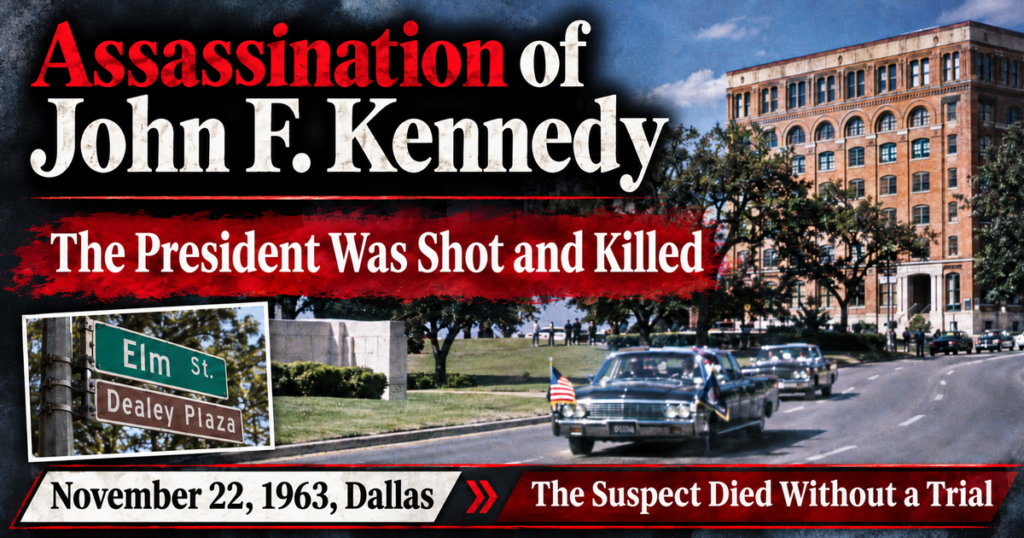
| Case Name | Assassination of John F. Kennedy |
|---|---|
| Date of Incident | November 22, 1963 (local date) |
| Country and Region | Dallas, Texas, United States |
| Location | Dealey Plaza and the surrounding area |
| Type of Incident | Presidential assassination and murder |
| Victims | President John F. Kennedy (killed); Texas Governor John Connally (wounded) |
| Related Incident on the Same Day | Murder of Dallas Police Department Officer J. D. Tippit |
| Suspect | Lee Harvey Oswald |
| Criminal Charges | According to the Warren Commission Report, formal charges were filed against Oswald for the murders of Officer Tippit and President Kennedy, but no grand jury indictment was returned. |
| Legal Status | Oswald died on November 24, 1963, following his arrest and the filing of formal charges. No grand jury indictment, trial, or verdict. |
| Warren Commission | Submitted its final report on September 24, 1964. Concluded that Oswald was responsible for the assassination and found no evidence establishing a conspiracy. |
| House Select Committee on Assassinations (HSCA) | Issued its final report in 1979. Found that Oswald was directly involved and concluded that the assassination was probably the result of a conspiracy. The identity of another suspected gunman and the extent of the possible conspiracy could not be established. |
| Current Status | Oswald’s death prevented a criminal trial. The official investigations reached different conclusions regarding the existence of a conspiracy, and assessments of the acoustic evidence remain disputed. |
The Assassination of a President in Dallas and Two Separate Murders
On November 22, 1963, President John F. Kennedy was assassinated in Dallas, Texas, United States. The assassination occurred during a presidential motorcade in the vicinity of Dealey Plaza. Texas Governor John Connally, who was accompanying the president, was also wounded by gunfire. President Kennedy was taken to Parkland Memorial Hospital in Dallas, where he died.
On that same day, November 22, Dallas Police Department Officer J. D. Tippit was also murdered. Although public attention focused overwhelmingly on the death of President Kennedy, the murder of the police officer constitutes a separate crime with its own victim. The assassination of the president and the murder of the police officer were two distinct homicide cases involving different victims. However, the same individual was identified as a suspect in both cases, providing an important connection between the two investigations.
In the Kennedy assassination, the question of who was directly responsible for the president’s death and the question of whether anyone else was involved ultimately produced different conclusions. The existence of two official investigations does not mean that the facts concerning the victims themselves are disputed. A defining feature of the case is that the official assessments of whether a conspiracy existed differed according to the period in which the investigations were conducted and the evaluation of the available evidence.
Oswald’s Death Prevented a Criminal Trial
Lee Harvey Oswald was arrested as a suspect in the assassination of President Kennedy. According to the Warren Commission Report, formal charges were filed against him not only for the murder of Officer Tippit but also for the murder of the president. These charges, however, did not constitute a criminal conviction or even a grand jury indictment preceding a trial. The criminal proceedings against Oswald ended before the case could proceed to trial.
On November 24, 1963, Oswald was killed by Jack Ruby. Because Oswald died without standing trial for the murder of the president, there was no opportunity for the defense to challenge the prosecution’s allegations, dispute the credibility and probative value of the evidence, or for a court to determine whether he was guilty or not guilty. Consequently, Oswald’s criminal liability was never established through a judicial verdict.
Oswald’s death also influenced the nature of the official investigations that followed. An investigative body can examine evidence and reach findings concerning an individual’s involvement in a crime, but such findings do not constitute a criminal trial of that individual. Official investigative findings provide a basis for understanding the case, but they do not carry the same legal significance as a verdict rendered in criminal proceedings.
The Warren Commission Established by President Johnson
On November 29, 1963, one week after the assassination, President Lyndon B. Johnson established a commission to investigate the assassination through Executive Order 11130. Commonly known as the Warren Commission, this body conducted an extensive investigation and collected testimony and documentary evidence. It was chaired by Earl Warren, Chief Justice of the United States.
The investigation faced the unusual circumstance that the principal suspect was already dead. In an ordinary criminal case, evidence presented at trial and the reasoning behind a judicial decision provide a basis for reconstructing and examining the circumstances of the crime. In the Kennedy assassination, however, no trial took place, requiring the commission to reconstruct the facts directly from the available evidence. This circumstance also influenced subsequent assessments of the investigation.
The commission derived its authority from an executive order and was not established as a court with jurisdiction to adjudicate criminal cases. Its status as an official government investigation gave its findings formal public significance, but it did not confer the authority to impose criminal penalties. The commission’s conclusions were therefore different in nature from a judicial determination establishing criminal liability.
An Investigation Recording the Testimony of 550 Witnesses Concluded That Oswald Acted Alone
On September 24, 1964, the Warren Commission submitted its final report to President Johnson. The records of the accompanying hearings contain testimony from 550 witnesses. Together, the report and the testimony provide a basis for examining not only the commission’s conclusions but also the evidence underlying them.
The commission’s principal conclusion was that Oswald was responsible for the assassination of President Kennedy and that no evidence had been found establishing that he had conspired with anyone else. This finding is commonly known as the lone-gunman conclusion. It did not mean that the commission possessed evidence capable of ruling out every possibility of a conspiracy. Rather, it meant that the available evidence did not establish the existence of one.
The extensive collection of testimony demonstrates the breadth of the investigation. However, the number of witnesses does not in itself determine the validity of the findings on individual issues. What the testimony establishes, and the extent to which conclusions can be drawn from it, depends on its content and its relationship to other evidence.
The 1979 House Select Committee on Assassinations Reached a Different Conclusion
In 1979, fifteen years after the publication of the 1964 final report, the United States House of Representatives’ House Select Committee on Assassinations (HSCA) issued its final report. The committee had been established to reexamine the conclusions of the Warren Commission. It did not simply accept the earlier commission’s finding that Oswald had acted alone.
The HSCA upheld the central finding of the earlier investigation that Oswald had been directly involved in the death of President Kennedy. At the same time, it concluded that the assassination was probably the result of a conspiracy involving more than one person. The difference between the two investigations was not that the HSCA rejected Oswald’s involvement, but that it considered the involvement of additional conspirators probable.
The relationship between the two reports cannot be reduced to one investigation completely rejecting the other. They shared certain findings, while differing significantly on issues beyond those points of agreement. The subsequent investigative body’s finding that a conspiracy was probable did not invalidate the earlier finding concerning Oswald’s direct involvement.
Disagreement Remained Over the Acoustic Evidence Supporting a Probable Conspiracy
A defining feature of the HSCA’s conclusion was its assessment of acoustic evidence. Drawing in part on scientific analysis of acoustic recordings, the committee considered it probable that more than one person had been involved in the assassination. This represented a major departure from the Warren Commission’s lone-gunman conclusion. That assessment, however, depended on the interpretation of the acoustic analysis.
The validity of such analysis depends on whether the recorded sounds were connected to the incident and how reliable the analytical results were. A possibility identified through scientific analysis is not equivalent to evidence directly establishing the identity or involvement of particular individuals. Evidence suggesting the possibility of a conspiracy and proof that a specific individual participated in that conspiracy are separate matters.
Government bodies subsequently reached differing assessments of the acoustic evidence. The evaluation adopted by the HSCA did not receive unanimous support in later examinations. Disagreement over the reliability of the acoustic evidence remains part of the continuing debate over the validity of the HSCA’s conclusion.
What the House Committee Meant by the Word “Probably”
The HSCA’s final report concluded that President Kennedy was probably assassinated as the result of a conspiracy. The wording reflected both the committee’s affirmative assessment of the likelihood of a conspiracy and its decision not to present that conclusion as an established fact beyond all doubt.
The report went further than merely stating that a conspiracy could not be ruled out. After evaluating the acoustic evidence and other materials, the committee concluded that a conspiracy was probable. Nevertheless, it was unable to establish the identity of the person believed to have been another gunman or determine the extent of the possible conspiracy. The strength of its assessment therefore exceeded the scope of the specific facts it was able to establish.
Establishing criminal liability requires evidence demonstrating how each individual alleged to have been involved participated in the crime. Scientific or historical investigations assessing the likelihood of particular circumstances do not automatically establish such liability. The qualification “probably” defined the scope of the HSCA’s finding and did not provide a basis for treating unidentified individuals as criminal accomplices.
The HSCA Found No Involvement by Foreign Governments or United States Government Agencies
Although the HSCA concluded that a conspiracy was probable, it did not find that every organization suspected of involvement had participated in the assassination. In its 1979 final report, the committee concluded, on the basis of the available evidence, that neither the Soviet government nor the Cuban government had been involved in the assassination. It did not conclude that the assassination had been carried out by a foreign government.
With regard to organizations within the United States, the committee also concluded that the national syndicate of organized crime, as an organization, had not been involved. It likewise concluded that the Federal Bureau of Investigation (FBI), the Central Intelligence Agency (CIA), and the United States Secret Service had not been involved in the assassination. These findings appeared in the same report that concluded that a conspiracy was probable.
In the case of organized crime in particular, the finding that the organization itself had not been involved was distinct from ruling out the possible involvement of individual members. However, the fact that individual involvement could not be ruled out did not establish that any such individual had actually participated in the assassination. Establishing organizational responsibility and individual responsibility requires evidence in each instance. The finding of a probable conspiracy did not establish responsibility on the part of governments or agencies whose involvement the report did not recognize.
The Differences Between the Two Official Investigations Were Never Resolved Through a Criminal Trial
Both the Warren Commission and the HSCA conducted investigations under official authority. However, the subsequent committee’s examination of the earlier commission’s findings was different from an appellate court reviewing a lower court’s judgment. The HSCA did not constitute an appellate proceeding against the Warren Commission Report, nor did its 1979 report overturn or modify a criminal verdict.
The conclusions of both commissions were based on the materials available at the time of their respective investigations and their evaluations of those materials. Findings from the earlier report that were upheld by the subsequent investigation received support from a separate investigative body. Where the two investigations reached different conclusions, however, the assessment of the evidence and the reasoning behind those conclusions remained matters of dispute. The number of official bodies supporting a particular conclusion does not, by itself, establish its correctness.
In Oswald’s case, the fact that no criminal trial took place remained unchanged. Regardless of the findings reached by the subsequent committee, there was no criminal verdict establishing his guilt or innocence. Nor did the HSCA report establish the individual criminal liability of any other person whose possible involvement it had identified. A clear distinction remained between what the official investigations had established concerning involvement in the assassination and what had been established through judicial proceedings.
Additional Releases of Assassination Records Allow Further Examination
Records concerning the assassination of President Kennedy are maintained by the United States National Archives. The official reports issued in 1964 and 1979 are accessible through the National Archives and other government institutions. Additional documents relating to the assassination were released in 2022 and 2023.
The release of government records makes it possible to examine not only the findings of an investigation but also the materials on which those findings were based. Examining the relationship between conclusions presented in earlier reports and records that subsequently became accessible contributes to the reassessment of the official investigations. However, the release of additional documents does not in itself mean that earlier conclusions have been revised or that previously unidentified participants have been discovered.
Individual records were created at particular times and for particular purposes. Information contained in those records does not necessarily correspond to facts established at the conclusion of an investigation. The release of records expands the resources available for further examination, but it does not give every statement contained within them equal probative value. Their significance lies not simply in their availability, but in the opportunity to compare their contents with other records and establish which findings they support and where the limitations of those findings lie.
The Established Facts Concerning the Victims and the Unresolved Extent of Other Involvement
The fact that President Kennedy died and Governor Connally was wounded on November 22, 1963, and that Officer Tippit was murdered on the same day, is unaffected by the differences between the official investigations. Separate from the political consequences of the assassination and the debate over a possible conspiracy, the actual harm suffered by each victim remains central to the historical record of the case.
In the official investigations into the assassination, the two commissions agreed on Oswald’s direct involvement. The Warren Commission, however, found no evidence establishing a conspiracy, while the HSCA concluded that a conspiracy was probable but could not establish its specific extent. Assessments of the acoustic evidence cited by the latter committee also remained divided. The differences between the findings presented in the two reports constitute a significant issue in the continuing historical examination of the assassination.
Criminal liability for the death of President Kennedy was never adjudicated at a trial of Oswald himself. Subsequent investigations contributed to a deeper understanding of the case, but they did not substitute for a criminal verdict that was never rendered. The two official reports and the publicly available records remain historical resources for preserving the memory of the victims and examining the extent to which responsibility for the assassination was officially established, as well as the questions that remained unresolved.
Sources
- U.S. Government Publishing Office, GovInfo: Warren Commission Report and Hearings.
https://www.govinfo.gov/features/warren-commission-report-and-hearings - U.S. National Archives: Warren Commission Report, Chapter 1 (investigative conclusions and the filing of formal criminal charges).
https://www.archives.gov/research/jfk/warren-commission-report/chapter-1 - U.S. National Archives: Warren Commission Report, Appendix 12 (findings concerning the formal filing of murder charges).
https://www.archives.gov/research/jfk/warren-commission-report/appendix-12.html - U.S. National Archives: Warren Commission Report, Appendix 1 (Executive Order 11130).
https://www.archives.gov/research/jfk/warren-commission-report/appendix-01.html - U.S. National Archives: House Select Committee on Assassinations Report (1979).
https://www.archives.gov/research/jfk/select-committee-report/toc - U.S. National Archives: HSCA Summary of Findings.
https://www.archives.gov/research/jfk/select-committee-report/summary.html - U.S. National Archives: JFK Assassination Records – 2022 Additional Documents Release.
https://www.archives.gov/research/jfk/release-2022 - U.S. National Archives: JFK Assassination Records – 2023 Additional Documents Release.
https://www.archives.gov/research/jfk/release-2023
Original Japanese record: ジョン・F・ケネディ大統領暗殺事件|単独犯行と共謀の可能性、二つの公式調査が分かれた15年
Last updated: