
Bhopal Gas Tragedy | The Prolonged Dispute over Compensation and Criminal Liability
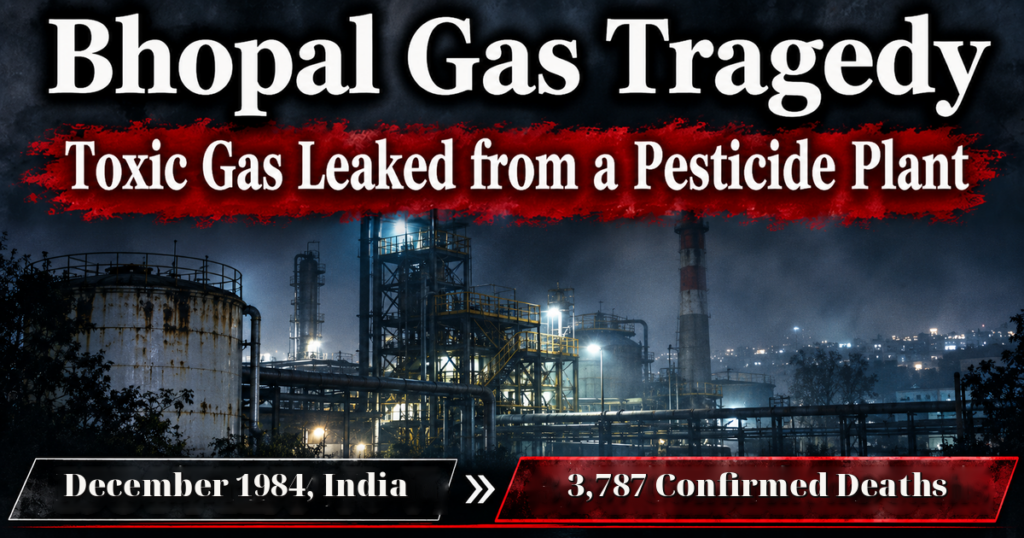
On the night of December 2–3, 1984, toxic gas leaked from a pesticide plant in Bhopal, India, causing extensive casualties. Official confirmed figures and long-term estimates of the death toll differ widely. This record follows the settlement, the criminal proceedings, and the dispute over compensation, based on public records.
Basic Information
| Item | Details |
|---|---|
| Incident name | Bhopal Gas Leak Disaster |
| English name | Bhopal gas tragedy |
| Date and time | From the night of December 2 to the early hours of December 3, 1984 |
| Country | India |
| Region | State of Madhya Pradesh |
| Location | Union Carbide India Limited (UCIL) pesticide plant in Bhopal |
| Type of incident | Toxic gas leak from a chemical plant |
| Substance released | Methyl isocyanate (MIC) |
| Quantity released | Frequently reported as approximately 40 tonnes, although the exact amount has not been confirmed |
| Death toll | 3,787, the figure confirmed by the Madhya Pradesh state government; 5,295, the figure claimed by the Government of India in its 2010 curative petition; and more than 15,000 in some estimates that include long-term gas-related deaths |
| Injuries | The Government of India reported 558,125 injury cases in a 2006 affidavit, of which approximately 3,900 were classified as severe or permanently disabling |
| Companies involved | UCIL and its parent company, Union Carbide Corporation (UCC), which was later acquired by The Dow Chemical Company |
| Key individual | Warren Anderson, then chairman of UCC |
| Civil outcome | Under settlement orders issued by the Supreme Court of India in February 1989, UCC agreed to pay 470 million dollars |
| Criminal outcome | In June 2010, a Bhopal court convicted seven former UCIL officials of causing death by negligence and sentenced them to two years’ imprisonment and fines |
| Current status | In 2023, the Supreme Court rejected the Government of India’s curative petition seeking an increase in the settlement amount. Disputes over health damage and responsibility for alleged contamination and remediation at the former factory site remain |
MIC leaked from the factory between December 2 and 3, 1984.
During the night of December 2, 1984, and into the early hours of December 3, methyl isocyanate (MIC) leaked from the pesticide plant operated by Union Carbide India Limited (UCIL) in Bhopal, in the Indian state of Madhya Pradesh. The leak originated from an MIC storage tank at the plant, exposing large numbers of nearby residents to the gas. Local records describe the incident as having occurred on the night between December 2 and 3.
Reports frequently put the quantity of MIC released at approximately 40 tonnes. However, the exact amount released has not been confirmed. The figure of approximately 40 tonnes is a commonly reported estimate, not a definitive measured quantity. The numbers used to describe the human toll, including deaths and injuries, also vary according to the institution compiling them and the period covered. The state government’s confirmed figure, the figure presented by the Government of India in court proceedings, and estimates that include long-term gas-related deaths are separate sets of figures.
The state government’s official figure and long-term estimates differ sharply.
The reported death toll from the Bhopal disaster varies depending on who compiled the figures and which period is covered. The figure repeatedly cited as the Madhya Pradesh state government’s confirmed count is 3,787. This is the number of deaths confirmed by the state government and has a different scope from estimates that include gas-related deaths over the longer term after the accident.
In an affidavit filed in 2006, the Government of India reported 558,125 injury cases. Approximately 3,900 of those cases were classified as severe or permanently disabling. In a curative petition submitted in 2010, the Government of India claimed that the death toll was 5,295. The state government’s confirmed figure of 3,787 and the figure of 5,295 presented by the central government in a later petition were not a single figure established at the same time or through the same procedure.
Some estimates found in government-related materials and media reports put the number of deaths above 15,000 when long-term gas-related deaths, in addition to deaths immediately after the accident, are included. Activist groups have argued for even higher figures. The state government’s official count, the number claimed by the Government of India in its petition, and estimates that include long-term effects cover different populations and periods. The 558,125 injury cases, including the approximately 3,900 classified as severe or permanently disabling, are also separate indicators recorded in government materials and should not be confused with the death toll.
The government and the company presented conflicting accounts of the cause.
The explanations offered by the Indian government and local parties, on the one hand, and the parent company, Union Carbide Corporation (UCC), on the other, differed over the cause of the accident. The government and local parties argued that poor plant management and deferred maintenance had allowed water used to wash pipes to flow back into an MIC storage tank. In this account, failures in plant management and equipment maintenance were identified as causes of the accident.
UCC, by contrast, claimed that water had entered the tank as a result of sabotage by an employee. The government and local parties pointed to inadequate management and deferred maintenance, while UCC alleged deliberate action by an employee. The two sides did not agree on how water had entered the MIC tank.
Seven former UCIL officials were convicted of causing death by negligence in 2010, but that judgment was a decision in the criminal case against those individuals. It did not mean that the government and local parties had accepted UCC’s explanation, or that the two sides had reached agreement on the cause of the leak. The dispute over the cause remained alongside questions concerning plant management, corporate responsibility, criminal proceedings, and compensation for victims.
Factory personnel were arrested after the accident, and chairman Anderson was also taken into custody.
After the accident, UCIL employees were arrested. On December 7, Warren Anderson, who was then chairman of UCC, was also arrested and taken into custody by the state police. He was subsequently released on bail, returned to Delhi that same day, and left India shortly afterward. Anderson was chairman of UCC at the time of the accident, and UCC was the parent company of UCIL, which operated the plant locally.
UCIL was the company that operated the pesticide plant in India, while UCC was its parent company. In the criminal proceedings after the accident, former UCIL officials were tried in a court in Bhopal, and seven of them were convicted in 2010. Anderson, by contrast, never stood trial in India and later died in the United States. The judgment against the seven former UCIL officials was not a judgment against Anderson personally.
The civil settlement involving the companies, the criminal trial of local executives, and the proceedings concerning Anderson personally involved different parties and different legal processes. The settlement amount that UCC agreed to pay and the criminal judgment against the former UCIL officials did not determine the same form of legal responsibility.
The Indian government established a system to represent victims’ claims collectively.
In 1985, under the Bhopal Gas Leak Disaster (Processing of Claims) Act, the Government of India assumed the role of representing victims’ claims collectively. The Act established a mechanism under which the government could represent and process the claims of victims as a whole. This arrangement, in which the government acted on behalf of the affected population, has been described as a form of the legal doctrine of parens patriae.
Under this system, the Government of India represented the victims in compensation litigation against UCC. The consolidated actions were initially brought in the United States District Court for the Southern District of New York, with the Union of India among the plaintiffs. The Government of India later filed a suit before the District Judge in Bhopal seeking approximately 3.3 billion dollars. The arrangement under which the government represented victims collectively provided the basis for the litigation and the subsequent settlement. The party representing the victims’ claims was the Government of India, and the proceedings were pursued with the government acting on their behalf.
Even after this system for collective representation had been established, the amount of compensation, the categories of people eligible for compensation, the payments themselves, and responses to health damage remained separate issues. After the 1989 settlement, victims’ groups criticized the amount as inadequate, and in 2010 the Government of India itself filed a curative petition seeking an increase in the settlement amount.
The compensation litigation that began in the United States was redirected to India.
Several compensation actions against UCC were initially brought in the United States District Court for the Southern District of New York. In June 1986, the U.S. federal district court dismissed the consolidated action on the grounds of forum non conveniens—the principle that a case may be heard in a more appropriate and convenient forum elsewhere. The court accepted India as an adequate alternative forum, subject to UCC agreeing to submit to the jurisdiction of the Indian courts and to satisfy any judgment rendered there.
Following that dismissal, the Government of India filed a lawsuit against UCC before the District Judge in Bhopal, seeking approximately 3.3 billion dollars in compensation. The U.S. court did not order UCC to pay 3.3 billion dollars. The 3.3-billion-dollar claim was pursued in India after the U.S. action was dismissed. The proceedings over compensation then continued in India, where the Supreme Court issued settlement orders in February 1989. The outcome of the litigation that began in the United States was therefore not a U.S. judgment fixing compensation at 3.3 billion dollars, but the continuation of the dispute in India and its eventual settlement by that country’s Supreme Court.
Subsequent compensation arrangements and the criminal trial also proceeded under India’s judicial and administrative systems. The dismissal of the U.S. litigation in favor of proceedings in India, the civil settlement ordered by the Supreme Court of India, and the criminal judgment delivered by a Bhopal court were separate proceedings, conducted at different times and addressing different issues.
The Supreme Court’s 470 million dollar settlement became the basis for the civil resolution.
On February 14 and 15, 1989, the Supreme Court of India issued settlement orders concerning the Bhopal disaster, under which UCC agreed to pay 470 million dollars. The amount was also confirmed in the Government of India’s replies to Parliament. After the compensation lawsuit filed in the United States had been redirected to India, the civil resolution was carried forward through this settlement ordered by the Supreme Court.
Victims’ groups continued to criticize the 470 million dollar settlement as too small in relation to the scale of the damage. Criticism over the amount continued after the settlement was reached, and in 2010 the Government of India filed a curative petition seeking an increase. The adequacy of the settlement amount became an issue raised by both victims’ groups and the government.
The settlement orders also affected the treatment of criminal liability. The original settlement included provisions that brought criminal proceedings to an end. In 1991, however, after reviewing the matter, the Supreme Court of India set aside that part of the settlement and restored the criminal proceedings. Thus, even after the civil settlement of 1989 had been reached, criminal proceedings were allowed to continue separately.
Compensation payments began in 1992 and were made to hundreds of thousands of claimants.
Payments of compensation under the settlement began in 1992. According to a Government of India reply reporting the position as of November 2021, the Office of the Welfare Commissioner had paid original compensation to 574,393 claimants. This figure represents the number of claimants who received compensation from the government; it is a different measure from the number of people who died or suffered injuries as a result of the accident.
Even after compensation payments began, the question of whether the total settlement amount was adequate remained unresolved. Victims’ groups criticized the 470 million dollars as insufficient, and the government also filed a curative petition in 2010 seeking an increase. The government’s request for an increase showed that it had later asked the Supreme Court to reconsider the settlement amount fixed in 1989.
The figure of 574,393 in the Government of India’s 2021 reply refers to claimants who received original compensation. It does not count the same population as the 3,787 deaths or the 558,125 injury cases. The record of original compensation payments and the later judicial proceedings seeking an increase in the settlement amount are separate parts of the history.
The 1991 Supreme Court ruling restored the possibility of criminal proceedings.
After the 1989 settlement orders, the treatment of criminal immunity became the subject of further judicial review. In 1991, the Supreme Court of India reconsidered the matter and set aside the provisions of the settlement that had granted criminal immunity. This decision restored the possibility of proceedings to establish criminal responsibility for the accident. Criminal proceedings were therefore allowed to continue even after the civil settlement had been reached.
The 1989 settlement was a civil resolution under which UCC agreed to pay 470 million dollars. The 1991 ruling was a judicial decision that set aside the part of the settlement that had extinguished criminal liability and restored the criminal proceedings. The civil payment and the determination of criminal responsibility proceeded as separate legal processes.
Subsequently, a Bhopal court delivered its judgment in the criminal case against former UCIL officials. Anderson, who had been UCC’s chairman at the time, did not stand trial in India. In addition, the Government of India stated in a 2021 parliamentary reply that proceedings, including summons-related proceedings concerning Dow Chemical, which had acquired UCC, remained pending before a Bhopal court. The proceedings concerning Dow described in the 2021 government reply were separate from the criminal judgment against the former UCIL officials and from the 1989 settlement.
Seven former UCIL officials were convicted of causing death by negligence in 2010.
In June 2010, a court in Bhopal convicted seven former UCIL officials of causing death by negligence. They were sentenced to two years’ imprisonment and fines. The two-year prison term was the maximum statutory punishment for the offence of causing death by negligence under the Indian law then in force. The criminal judgment against the former UCIL officials came approximately 25 and a half years after the accident.
Criticism continued that the sentences were too lenient in light of the seriousness of the criminal responsibility. The fact that two years was the maximum statutory term at the time was part of the background to that criticism. The judgment concerned seven former UCIL officials and was separate from the 1989 civil settlement under which UCC agreed to pay compensation. The individuals convicted in the criminal trial were former UCIL officials, while the company that agreed to pay the civil settlement was their parent company, UCC.
Anderson did not stand trial in India. The convictions of the seven former UCIL officials were not judgments against Anderson personally. The government and local parties also remained in disagreement with UCC over the cause of the accident. The criminal judgment, the civil settlement involving UCC, and the events concerning Anderson were matters involving different parties.
The government’s petition to increase the settlement was rejected in 2023.
In 2010, the Government of India filed a curative petition in the Supreme Court seeking an increase in the settlement amount agreed in 1989. A curative petition is an extraordinary remedy exercised under the Supreme Court’s inherent jurisdiction to prevent a grave miscarriage of justice. It is available only on narrowly defined grounds, such as a violation of the principles of natural justice or an apprehension of judicial bias; it is not an ordinary appeal or a routine further review. In this case, the Government of India filed the curative petitions without having itself filed review petitions against the original settlement orders; nevertheless, the Supreme Court decided to examine them in view of the nature of the matter.
On March 14, 2023, a Constitution Bench of the Supreme Court rejected the government’s petitions. Applying the restrictive principles governing curative petitions, the Court did not grant the increase in the settlement amount sought by the government. The decision left the 1989 civil settlement in place. Although victims’ groups had criticized the settlement as inadequate and the Government of India itself had sought an increase, the Supreme Court did not allow the amount to be increased through the curative petitions.
The 2023 ruling refused the government’s request to increase the settlement amount and left the 1989 civil settlement intact. As stated in the Government of India’s 2021 reply, proceedings including summons-related proceedings concerning Dow Chemical had been pending before a Bhopal court.
Disputes over health damage and contamination at the factory site remain unresolved.
Compensation payments began in 1992, and the Government of India stated that original compensation had been paid to 574,393 claimants as of November 2021. At the same time, health damage resulting from the accident has continued over the long term. The reported death toll also varies among the state government’s confirmed figure, the number claimed by the government in later proceedings, and estimates that include long-term gas-related deaths. The record of compensation payments and the health damage that followed the accident remain separate issues.
Questions about soil and groundwater contamination at and around the former factory site, as well as responsibility for remediation, remain unresolved. UCC and Dow Chemical, which acquired UCC, have denied that they bear responsibility for remediation, arguing that the Madhya Pradesh state government took over the site in 1998 and assumed responsibility for further remediation. The questions of whether and to what extent the site and surrounding area are contaminated, who bears responsibility, and how remediation should be carried out remain separate from the payment of the settlement amount. The final cost of remediation has not been confirmed.
In its 2021 reply, the Government of India stated that some proceedings, including summons-related proceedings concerning Dow Chemical, remained pending before a Bhopal court. These were separate from the curative petition seeking an increase in the 1989 settlement amount. Disputes over the remediation responsibilities of UCC and Dow Chemical, the criminal judgment against former UCIL officials, and the dismissal of the government’s petition to increase the settlement each concern different issues and have different legal significance.
Even after many years have passed since the accident, compensation, health damage, criminal responsibility, and contamination at the factory site remain distinct unresolved issues. The state government’s confirmed death toll of 3,787, the 5,295 deaths claimed by the Government of India in its 2010 curative petition, and estimates of more than 15,000 deaths over the long term are based on different methods and scopes of counting. They cannot be combined into a single definitive figure. Even after the civil settlement for the disaster was left in place, challenges concerning compensation and health effects, as well as contamination at the site and responsibility for remediation, remained.
Sources
- Government of India, Ministry of Chemicals and Fertilizers, Lok Sabha Answer AU3223 (December 17, 2021; settlement amount, compensation payment records, and pending proceedings).
https://eparlib.sansad.in/bitstream/123456789/977021/1/AU3223.pdf - “Bhopal Gas Disaster: A Tragedy No Compensation Could Settle,” The Times of India (2023; rejection of the curative petition and changes in reported death toll).
https://timesofindia.indiatimes.com/india/bhopal-gas-disaster-a-tragedy-no-compensation-could-settle/articleshow/98726593.cms - “Bhopal’s Gas Chamber,” Frontline / The Hindu (background on the settlement, reversal of criminal immunity, and remediation issues).
https://frontline.thehindu.com/environment/bhopals-gas-chamber/article23591584.ece/amp/ - “37 Years of Bhopal Gas Tragedy,” India TV News (timeline, 2010 convictions, and the competing claims concerning the cause of the accident).
https://www.indiatvnews.com/amp/news/india/bhopal-gas-tragedy-what-happened-december-3-1984-timeline-worlds-worst-industrial-disaster-details-747893
Original Japanese record: ボパール化学工場ガス漏洩事故|補償と刑事責任をめぐる長期化した問題
Last updated: