
Columbine High School Massacre | Overlooked Warning Signs and a Turning Point for School Safety
On April 20, 1999, two students opened fire at Columbine High School in Colorado, USA, killing 12 students and one teacher. This record traces the overlooked warning signs, the 2025 revision of the official victim toll, and the turning point it became for school safety.
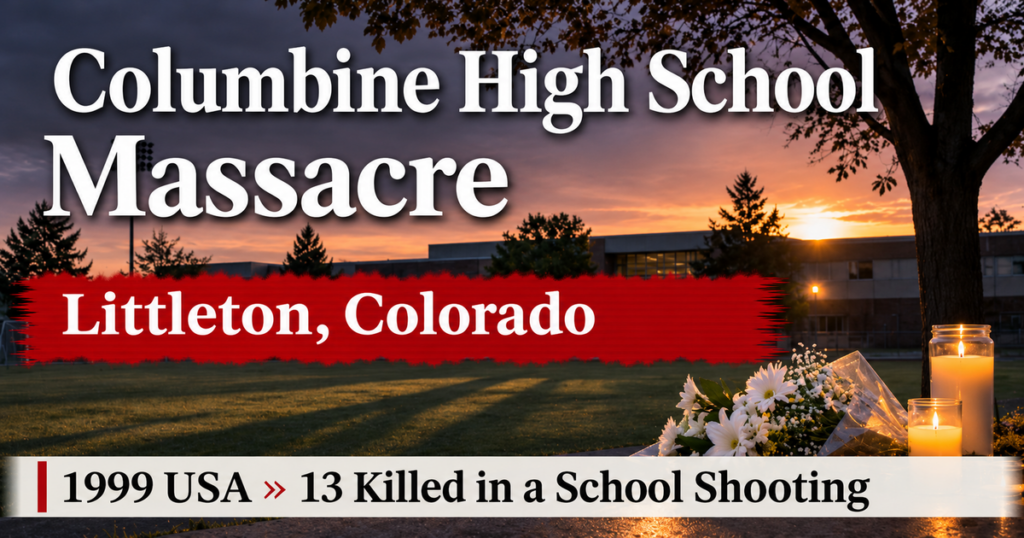
The shooting took place at Columbine High School on April 20, 1999.
A shooting occurred at Columbine High School in Jefferson County, Colorado, United States, on April 20, 1999. The shooting began at approximately 11:19 a.m., and the incident ended at approximately 12:08 p.m., when the two perpetrators died by suicide in the school library. The school was located in the unincorporated community of Columbine, near Littleton, although news reports often referred to the location as “Littleton.”
Basic Information
| Item | Details |
|---|---|
| Date and time | April 20, 1999, approximately 11:19 a.m.–12:08 p.m. (local time) |
| Location | Columbine High School, Jefferson County, Colorado, United States |
| Perpetrators | Eric Harris (18 at the time) and Dylan Klebold (17 at the time) |
| Deaths on the day | 12 students and 1 teacher, 13 in total |
| Official victim toll since 2025 | 13 students and 1 teacher, 14 in total |
| Injuries | Approximately 21–24, depending on the source |
| End of the incident | The two perpetrators died by suicide in the library |
| Planning period | Approximately one year of planning and preparation |
| Legal status | No criminal trials were held against the perpetrators because they died |
As a shooting that caused numerous casualties inside a school, the incident prompted a major reassessment of school safety and emergency police response in the United States. Investigations and reviews continued after the shooting, examining responses to warning signs, police activity while a shooting was still underway inside a school, and school safety procedures. The incident’s impact extended beyond the casualties on the day itself, influencing subsequent police tactics, school security, and debates over gun control.
The plan’s initial primary objective was mass killing through an explosion in the cafeteria.
Harris and Klebold had been planning the attack for approximately a year before the incident. The plan’s initial primary objective was to detonate propane cylinders placed in the cafeteria and carry out a mass killing. Shooting was not the only method placed at the center of the plan from the outset; it was the course of action they turned to after the planned explosion did not occur. In fact, the two propane cylinders placed in the cafeteria did not explode, and the two began shooting inside the school.
The outline of this plan shows why the incident cannot be understood simply as a shooting that happened without warning. The preparation was not a short-lived, impulsive act; it proceeded over an extended period, with the two leaving behind diaries and video recordings. Even after the existence of the plan and the length of the preparation became clear, the underlying reason why the two chose to commit the attack remained undetermined. The final investigative report also concluded that the evidence could not provide a definitive explanation for their reasons.
The major confirmed milestones in the events of that day are the start of the shooting at approximately 11:19 a.m. and the deaths by suicide of the two perpetrators in the library at approximately 12:08 p.m. There is no need to reconstruct every movement inside the school or each individual shot. The basic outline of the plan—that the intended explosion in the cafeteria did not occur and the two then turned to shooting—and the result, in which numerous people were killed or injured within a short period, convey the overall picture of the incident.
The 13 people killed on the day must be distinguished from the revised victim toll announced in 2025.
The people killed on the day of the incident were 12 students and 1 teacher, 13 in total. Ten students were killed in the library. The reported number of injured people varies among sources. The Jefferson County Sheriff’s Office final report gives a figure of 21. More recent summaries count 20 people injured by gunfire and add 3 people injured during evacuation, for a total of 23. CNN also gives the figure as 23. Accordingly, the number of injured people is generally given as a range of approximately 21–24, depending on the source.
There was an important change to the victim toll more than a quarter-century after the incident. Ann Marie Hochhalter, a former student who had been paralyzed after being injured in the shooting, died at the age of 43 on February 16, 2025. The Jefferson County coroner classified her death as a homicide caused by complications from injuries sustained in the incident. Following this determination, the official victim toll was revised to 14: 13 students and 1 teacher.
Therefore, the number of people killed on the day of the incident is 13, while the official victim toll reflecting the subsequent death is 14. These figures refer to different points in time and use different criteria. The number describing the casualties on the day itself should not be confused with the official victim toll, which includes the long-term consequences of injuries. Hochhalter’s death also demonstrated that the harm caused by the incident did not end on the day it occurred.
Both perpetrators were seniors at the school.
The two perpetrators were Eric Harris and Dylan Klebold. At the time of the incident, Harris was 18 and Klebold was 17, and both were seniors at Columbine High School. The two died by suicide in the library toward the end of the incident. As a result, no criminal trials were held against them, and there was no court proceeding in which their motives or responsibility could be examined.
There were events in the two students’ lives before the incident that were documented in connection with their school years. On January 30, 1998, Harris and Klebold were arrested in connection with a vehicle break-in involving entry into a van and theft, and they pleaded guilty. They were subsequently placed in a juvenile diversion program. This was a system under which first-time juvenile offenders could avoid formal criminal proceedings and receive a disposition by completing a rehabilitation program that included counseling and community service. The two were assigned to a 12-month program but completed it one month ahead of schedule.
After the incident, investigators reviewed the perpetrators’ earlier behavior and the information that relevant agencies had known before the shooting. Later investigations also raised the question of whether follow-up after the two completed the diversion program had been sufficient. However, the fact that problematic behavior had occurred before the incident is not the same as saying that it necessarily foretold the later attack. Investigations examined the information available at the time and the responses that were actually taken.
Harris’s website had contained threatening material before the shooting.
Harris created a website in 1996. It initially hosted game data, but its content later expanded to include death threats against classmates and material about how to make explosives. On August 7, 1997, approximately one year and eight months before the incident, the parents of Harris’s classmate Brooks Brown reported threats on the website to the Jefferson County Sheriff’s Office.
An investigator who received the report prepared a draft affidavit in support of a request for a search warrant for Harris’s home. However, the draft was never submitted to a judge. This sequence of events became public in 2001, after the incident. In other words, before the shooting, the Sheriff’s Office had received a report about threatening material, and an investigator had prepared a document considering a search of the home, but no warrant application was made.
The unsubmitted draft became a major issue in the post-incident reviews. The question was not merely the abstract one of whether the shooting could have been predicted with certainty in advance. It was also why a specific report and a related investigative document did not lead to further procedures. The review commission established by the governor and the state attorney general’s investigation examined responses to warning signs and procedures within law enforcement agencies.
The two spent about a year preparing while keeping diaries and video recordings.
Beginning around May 1998, Harris and Klebold developed their attack plan and prepared for it while keeping diaries and video recordings. The self-recorded videos later known as the “Basement Tapes” were among these records. The preparation period lasted approximately one year, and the actions on the day of the incident were carried out after this extended period of planning.
People other than the two perpetrators were also involved in obtaining the firearms. Their friend Robin Anderson purchased the long guns for them, while the handguns were obtained from Mark Manes through Philip Duran, a coworker. Having a third party purchase a firearm for a minor who does not meet the eligibility requirements to buy it is known as a straw purchase. After the incident, the legal responsibility of people involved in this supply route was also addressed.
Manes was sentenced to six years in prison for offenses including supplying handguns to minors, while Duran received a sentence of four and a half years. Anderson, who had purchased the long guns on their behalf, was not charged. The core of the convictions against Manes and Duran involved supplying handguns to minors and possessing a shotgun with an illegally shortened barrel. Although the two perpetrators had died and therefore did not face criminal trials, the actions of those who supplied the firearms were addressed in separate criminal proceedings.
The final investigative report did not establish a motive.
After the incident, various explanations were offered for why the two had carried out the attack. However, the final report released by the Jefferson County Sheriff’s Office on May 15, 2000, explicitly stated that the evidence did not provide a definitive explanation for why the two had committed the attack. The possibility that multiple factors lay behind the incident has been considered, but there is no official determination establishing a single cause.
An FBI analysis characterized Harris as having psychopathic traits and Klebold as having depression and suicidal thoughts. The view was also put forward that the two sought fame. These, however, are analytical interpretations, not definitive explanations that establish a single motive for the incident. Examining individual psychological characteristics alone cannot explain the entire course of events that led to the attack.
Analyses of the perpetrators’ mental states and personalities have been treated as one possible clue to understanding the incident. However, the fact remains that the Sheriff’s Office final report did not establish a motive. Later reviews also examined multiple issues, including bullying, relationships at school, individual psychology, and behavior before the incident. Identifying any one of these as the cause would go beyond what the confirmed investigative findings support.
Later reviews questioned the explanation that the attack was revenge for bullying.
Immediately after the incident, reports widely circulated that Harris and Klebold had been bullied at school and had carried out the attack in revenge. There are accounts that bullying existed at the school and that the two had been teased. There is therefore a basis for the fact that relationships among students and the issue of bullying were examined after the incident.
On the other hand, later reviews questioned explanations that portrayed the two simply as “victims of bullying.” Reviews by journalist Dave Cullen, psychologist Peter Langman, and others reconsidered the view that revenge for bullying alone explained the attack, taking the two men’s behavior and records into account. The existence of bullying at the school and the conclusion that bullying was the direct cause of the attack are two separate matters.
For this reason, it is not appropriate either to assert that bullying did not exist or to conclude that revenge for bullying caused the attack. The fact that explanations that spread immediately after the incident were subsequently reexamined in light of records and analyses is itself a characteristic of the debate over the motives behind Columbine. Given that the official report did not establish a motive, the incident cannot be reduced to a single, simple narrative.
Early reporting about the influence of music and games and the group was also revised.
Immediately after the incident, reports also suggested that music, including that of Marilyn Manson, or violent video games might have caused the attack. However, these theories lacked sufficient supporting evidence and were later categorized in reviews as part of the “myths” surrounding the incident. No reliable evidence was presented that music or video games caused the attack, and they cannot be treated as its motive.
Early reports also stated that the two belonged to a group called the “Trench Coat Mafia,” but this description was not accurate. The two were not members of the group, although they were reportedly friends with some of its members. Having a connection to the group is different from being an official member of it.
These corrections to early reporting show that explanations circulated immediately after the incident did not remain established facts. The revenge-for-bullying theory, the theories about the influence of music and games, and the claim that the two belonged to a particular group were all reconsidered in later reviews. Early reports and the findings of subsequent investigations and reviews cannot be treated as information of the same degree of certainty when explaining the background to the incident.
The delay in police entry into the school led to a subsequent shift in tactics.
While the shooting was still underway, it took time for police to enter the school. According to CNN, the police SWAT team entered the school 47 minutes after the shooting began. A wounded teacher died from blood loss while waiting to be rescued, among other consequences, and the delay in the police response drew strong criticism. The review commission established by the governor also treated the response of law enforcement agencies as a major subject of examination.
The incident led to a major change in police response policies. A shift took place away from the approach of “surrounding the scene and negotiating” and toward entering an active shooting scene immediately to stop the gunfire. The concept known as IARD, or Immediate Action Rapid Deployment, became more widespread. The Columbine incident became a turning point in police tactics for responding to active shooters.
Reviews of the police response were not limited to the timing of entry into the school. Post-incident reports also examined coordination among law enforcement agencies, the handling of information, and school safety procedures. The lessons about what should be prioritized while a shooting is continuing influenced subsequent police training and approaches to emergency response. The circumstances behind the shift in police tactics included the fact that people inside the school were waiting to be rescued and that the delay in the response was subjected to severe scrutiny.
Post-incident investigations examined responses to reports and school safety procedures.
On May 15, 2000, the Jefferson County Sheriff’s Office released its final investigative report. The report concluded that there was no evidence providing a definitive explanation for the perpetrators’ motive. In May 2001, the Columbine Review Commission established by the Colorado governor released its report. The commission examined the response of law enforcement agencies, school safety procedures, and the handling of warning signs that had appeared before the incident, and it made recommendations for improvement.
On February 26, 2004, the Colorado attorney general released an investigative report, along with thousands of pages of investigative records. The 1997 report to the Sheriff’s Office, the circumstances in which the draft affidavit for a search warrant was not submitted, and the follow-up after completion of the juvenile diversion program became important issues in examining how information available before the incident had been handled.
However, even after investigative records were released and reports published, not all records remained publicly available. The remaining evidence, including the videos later known as the “Basement Tapes,” was destroyed by the Jefferson County Sheriff’s Office in early 2011 to prevent copycat attacks. The destruction is recorded in the county archives. Preventing imitation was given priority over continuing to make videos containing provocative statements available to the public.
The incident also had long-term effects on debates over school security and gun control.
After the Columbine incident, school safety measures were strengthened. Surveillance equipment, control of entrances and exits, and the placement of school resource officers became among the elements considered in reviews of school security. Together with the shift in police responses to active shooters, the incident became one of the starting points for considering systems to prepare for serious violence inside schools.
Debates over gun control also intensified after the incident. President Clinton proposed gun-control measures that included background checks and gun locks, but the proposals did not pass Congress. It was not until 2022, after the Uvalde incident, that major federal gun-safety legislation was enacted. Although the Columbine incident prompted debate over gun control, the proposed policies did not immediately become federal law.
The incident also influenced copycat attacks and plans for later school shootings, a phenomenon that came to be called the “Columbine effect.” As of June 2025, it had been identified as an influence on more than 70 copycat incidents and plots. The incident’s effects extended not only to police tactics and school facilities but also to the problem of imitation in subsequent attacks. The authorities’ decision to destroy the video recordings from the incident as a measure to prevent copycats was also part of the response after the shooting.
Thirteen people were killed on the day of the incident, while the reported number of injured people varies among sources. After the death of a former student who had been injured was classified as a homicide, the official victim toll was revised to 14. The motive was never established, and numerous issues—including reports made before the incident, the police response, school safety, gun control, and the influence on copycat attacks—were examined over many years. The Columbine High School shooting was one incident that took place on April 20, 1999, but it was also an event that left a lasting influence on how American society approaches crisis response and school safety.
Sources
- Columbine High School Shootings Investigation Records(ジェファーソン郡保安官事務所の最終報告書[2000-05-15公表]を含む捜査記録。郡公文書館の案内): https://www.jeffco.us/DocumentCenter/View/1052/Columbine-Investigation-Records-Finding-Aid-PDF
- The Report of Governor Bill Owens’ Columbine Review Commission(2001年5月、州知事検証委員会報告書。コロラド州公文書デジタルリポジトリ): https://hermes.cde.state.co.us/islandora/object/co%3A2067
- Columbine High School shooting — Encyclopaedia Britannica(犠牲者14名への改定、計画の概要、事件後の政策論争): https://mendel-preview.dev-ext.britannica.com/event/Columbine-High-School-shootings
- Columbine High School Shootings Fast Facts — CNN(時系列、ホッホルターの死去と殺人認定、メインズの量刑): https://www.cnn.com/us/columbine-high-school-shootings-fast-facts?cid=external-feeds_iluminar_meta
- Columbine High School massacre — Wikipedia(日程・被害規模・銃供給者の判決・模倣件数の整理): https://en.wikipedia.org/wiki/1999_Columbine_High_School_massacre
Original Japanese record: コロンバイン高校銃乱射事件|予兆の見落としと学校安全を変えた転機
Last updated: