
Jack the Ripper Murders | Five Women Killed in Whitechapel and an Unsolved Investigation
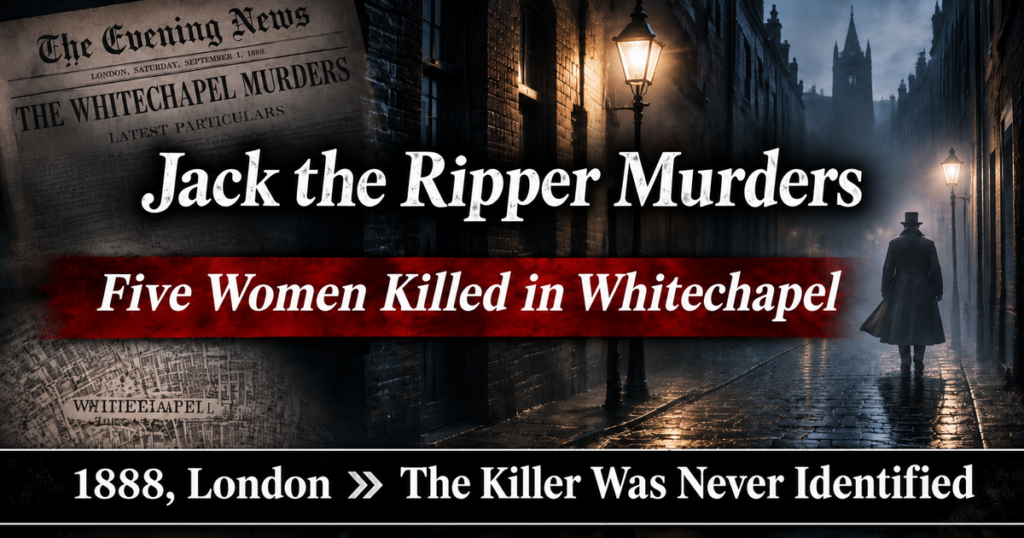
Five women were murdered in Whitechapel, London, in 1888. The perpetrator was never identified, and the investigation closed without an arrest. This record sets out the course of the case from the police records and later examinations.
| Case name | Jack the Ripper murders |
|---|---|
| English name | Jack the Ripper murders |
| Date of occurrence | August 31–November 9, 1888 (the canonical five) |
| Period of related cases | April 3, 1888–February 13, 1891 (the 11 cases in the Whitechapel Murders file) |
| Country | United Kingdom |
| Region | East London, England |
| Location | Whitechapel and the area around Spitalfields. The Eddowes case fell within the jurisdiction of the City of London |
| Type of incident | Serial murders; unsolved case |
| Victims | Mary Ann Nichols, Annie Chapman, Elizabeth Stride, Catherine Eddowes, and Mary Jane Kelly (the canonical five) |
| Suspect | Unidentified. Several suspect theories exist, but none has been proven |
| Legal stage | Police investigations and inquests were conducted. The offender was never identified or arrested, and no charges were brought. There was no trial and no verdict |
| Investigating agencies | Metropolitan Police, City of London Police |
| Current status | Unsolved. The offender has not been identified |
Five women were murdered in succession in East London in 1888
In the autumn of 1888, five women were murdered in succession in Whitechapel and the area around Spitalfields in East London, the capital of the United Kingdom. The killings were concentrated within a short period, and the police began to investigate several of the cases as the work of a single offender. The five later became known as the canonical five. They were Mary Ann Nichols, Annie Chapman, Elizabeth Stride, Catherine Eddowes, and Mary Jane Kelly.
The case remains unsolved. The name “Jack the Ripper” is widely known, but it is not the name of an identified person. It spread after letters were sent by someone claiming to be the killer, and it does not mean that the police confirmed the identity of the offender. The London Museum likewise explains that five women were killed in Whitechapel in 1888 and that the killer has not been identified.
Poverty and housing shortages placed daily life under pressure in Whitechapel
Whitechapel, where the killings took place, was one of the areas of East London where poverty was most severe at the time. In Victorian London, which gathered wealth as the centre of an empire, the supply of housing did not keep pace with population growth, and people on low incomes were concentrated in limited districts. In Whitechapel and Spitalfields, several families sometimes shared a single room, and problems such as ventilation, damp, water supply, drainage, and waste disposal affected living conditions. Casual and low-paid work was unstable, and some people found it difficult even to secure an income.
The five women also lived under these social conditions. According to the London Museum, the five may have been living in or around Whitechapel at the time they were killed, but not all of them came from that district. Some had children, and many had been born into working-class families. Their lives and occupations were not uniform, and it is inaccurate to describe all five, on the basis of contemporary press reports, police records, or later accounts, simply as prostitutes. The museum states that the only person who can be confirmed to have been working in the sex trade at the time of her murder was Mary Jane Kelly.
In press coverage of the case, the lives and social standing of the victims were often simplified, and the sensational aspects of the case were given prominence over their individual lives. The fact that they lived in a poor district does not mean that they were responsible for what happened to them. Each of them was a person with a different background, and their lives cannot be explained by the names left in the records of the case alone.
The murders of the first two women were followed by further cases that became part of the investigation
The first victim of the canonical five was Mary Ann Nichols. In the early hours of August 31, 1888, her body was found in Buck’s Row in Whitechapel, the street now known as Durward Street. In the early hours of September 8, the body of Annie Chapman was found in the back yard of 29 Hanbury Street, Spitalfields. Because women’s bodies were found in the same district within a short interval, the police began to examine whether the cases were connected.
The records of the time include police reports, doctors’ findings, testimony from local residents and witnesses, statements given at inquests, and newspaper articles. Witness accounts differed in the times and details they described, and newspapers reported the same events in different ways. The investigation files record both what was confirmed at the scenes and information and speculation received from residents.
The police treated the cases not only as separate murders but also considered whether they shared common features. The police surgeon Thomas Bond later concluded that the five murders had been committed by the same person, and in 1894 a memorandum by the Metropolitan Police official Melville Macnaghten recorded the view that the five had been victims of the Whitechapel murders. Records left by senior police officers of the time are one of the grounds for the grouping now known as the canonical five.
Two women were murdered on the same night on September 30, widening the investigation
In the early hours of September 30, 1888, Elizabeth Stride and Catherine Eddowes were killed on the same night. The fact that two killings occurred on the same date widened the investigation into the series of murders. The Stride and Eddowes cases occurred in different locations, and Mitre Square, where Eddowes was killed, fell under the jurisdiction of the City of London Police rather than the Metropolitan Police.
Policing in London at the time was not unified under a single organisation. The Metropolitan Police, responsible for Whitechapel, and the City of London Police, responsible for the City of London, were separate organisations. As a result, while the cases were investigated as part of the same series, the response at the scene and interviews with people connected with the Eddowes case were handled by a different police force. Because the boundary between cases and the boundary between police jurisdictions overlapped, the sharing of investigation information and coordination between the forces became necessary.
Police documents published by The National Archives include a letter dated October 9, 1888, from the Commissioner of the Metropolitan Police, Charles Warren, to the Commissioner of the City Police, James Fraser. Warren proposed that the investigation departments of the two forces communicate more frequently about the Whitechapel murders and that officers be sent each morning to exchange information. The letter also records that the police had received a great deal of information and the names of suspects.
This document shows that coordination between the police organisations was actually under consideration. At the same time, it cannot be concluded that differences in jurisdiction alone were the reason the killer was not arrested. What the records confirm is that the two police forces responded within their respective jurisdictions while seeking to adjust the way they shared information.
The killer remained unidentified after Kelly’s murder on November 9
The last case included in the canonical five was that of Mary Jane Kelly. On November 9, 1888, Kelly was killed indoors in the Whitechapel district. Unlike the previous four cases, in which the bodies were found outdoors, Kelly’s killing is understood to have taken place indoors. Medical examinations by police surgeons and records of the scene were preserved, but no evidence leading to the identification of the killer was obtained.
The London Museum presents the five murders of the canonical five as having occurred over three months, including two killings on the same night. It also explains that, although no killings of the same kind continued after November 1888, it is not known why the killings stopped. There is no reliable record showing why they stopped, such as the death, detention, or departure from London of the killer. The end of the killings and the identification of the killer are separate matters.
The police investigated suspects, but ultimately charged no one. Many people came under suspicion during the investigation, and information was also received from newspapers and members of the public. However, having been suspected does not prove that a person was the killer. None of the people investigated by the police was established as the offender.
The police conducted patrols and inquiries but failed to obtain compelling evidence
The Metropolitan Police of the time patrolled the area around the scenes, interviewed people connected with the cases, checked information received, and investigated suspects. According to the London Museum, the police patrolled the area and interviewed thousands of people in an effort to solve the cases. While investigation information accumulated, the police did not explain the progress of the investigation in detail to the press. As a result, newspapers developed their own theories on the basis of limited information, and some reporting was exaggerated.
The educational materials of The National Archives include police correspondence of the time and letters from someone claiming to be the killer. The police considered the use of bloodhounds, received proposals concerning footwear, and responded to suggestions from members of the public. These materials show that the investigating authorities considered several methods within the means available at the time and gathered information about the case.
In 1888, there was no system such as modern DNA testing or fingerprint databases for identifying individuals by comparison. The investigation relied on records of the scenes, witness testimony, medical examinations and findings by doctors, and reports by police officers. Post-mortem examinations and photography were certainly used at the time, but evidence could not be compared by the same methods as in modern forensic investigations.
The fact that information was received by the police does not mean that it was reliable evidence for the investigation. Witness reports, claims by suspects, and letters from someone claiming to be the killer included material that could not be corroborated. The fact that names and statements remain in the investigation files does not confirm any connection with the killer.
Inquests examined the circumstances of the deaths, but the cases did not proceed to criminal trials
In England at the time, when a person died in suspicious circumstances, a coroner held an inquest with a jury to establish the circumstances and cause of death. This was different from a criminal trial. The purpose of an inquest was to examine the facts surrounding the death, not to convict a particular person as a defendant. In the Jack the Ripper case as well, inquests were held for each victim, and the testimony of doctors, police officers, relatives, and other people concerned was examined.
The inquest into the death of Catherine Eddowes was held under the City of London coroner, Samuel Langham. According to contemporary newspaper reports, officers of the City Police and doctors attended and testified about the circumstances at the scene and the medical findings. Part of the inquest record survives through contemporary newspaper reports, and the full proceedings cannot be confirmed from the surviving original records alone.
Even when an inquest examined the circumstances of a death, the case did not proceed to criminal proceedings if no evidence identifying the killer was obtained. In the five cases, no one was arrested, and there was no formal charge, trial, or guilty verdict. This was therefore not a case in which no police investigation or inquest took place at all, but an unsolved case in which procedures were carried out yet did not lead to the identification of the killer or the establishment of criminal responsibility.
Letters from someone claiming to be the killer spread the name “Jack the Ripper”
The name “Jack the Ripper” comes from letters sent to press organisations and others by someone claiming to be the killer. There is no confirmed evidence that the sender of the letters was actually the killer. A document dated October 9, 1888, introduced by The National Archives was a letter sent from Birmingham, in which the sender called himself “Jack the Ripper”. The National Archives presents this letter as one of many letters from people claiming to be the killer and describes it as a hoax.
At the time, the police received many letters from people claiming to be the killer, as well as communications from people saying that they had information about the case. The materials of The National Archives include records of letters held by the police, and Metropolitan Police document reference MEPO 3/142 and others have been identified. The fact that a letter remains in the investigation files does not mean that its contents are true. The identity of the sender and whether the letter contained information that only the killer could have known need to be examined individually.
The adoption of this name by newspapers made the case widely known beyond a single district of London. The London Museum explains that newspapers of the time reported the case extensively and that interest spread internationally. With limited investigation information available, reporting increased in response to readers’ interest, and some articles blurred the boundary between fact and speculation.
A 1894 police memorandum grouped the five victims into a single series of cases
In 1894, Melville Macnaghten, a senior Metropolitan Police official, prepared a memorandum stating that there had been only five victims of the Whitechapel murders. The five named there were Nichols, Chapman, Stride, Eddowes, and Kelly. This memorandum became one of the grounds for treating the five cases now known as the canonical five as a single group.
However, Macnaghten’s memorandum was a record prepared by a senior police official several years after the events, and it was not a court judgment or the result of a scientific identification of the killer. The fact that five people are named in the memorandum shows the cases that a senior police official of the time regarded as connected, but it does not mean that a court established that all five murders had been committed by the same person.
The police surgeon Thomas Bond is also said to have expressed the view, in a report dated November 10, 1888, that the five murders had been committed by the same person. Macnaghten’s memorandum and Bond’s report are materials showing the judgments of the police and doctors of the time that linked the five cases. On the other hand, no decisive evidence establishing the full course of the case has survived.
The Whitechapel Murders file contains 11 cases
The five cases of the canonical five and the scope of the “Whitechapel Murders file” maintained by the police are not the same. The latter is organised as a group of records covering 11 cases from April 3, 1888, to February 13, 1891. It also includes other deaths that occurred before and after the cases of the five women. However, it has not been confirmed that all the cases in the same area were committed by the same offender.
The number five refers to the group of cases connected by senior police officials of the time, while the number 11 refers to the wider scope of the police records. The two numbers do not represent the same set of cases. It has not been confirmed that all 11 cases were committed by the same offender, and there is no evidence showing the involvement of the offender in cases other than the canonical five.
In Whitechapel, there were also other cases suspected of being connected with Jack the Ripper. However, the fact that they occurred nearby or that the victims were women is not in itself grounds for regarding them as the work of the same offender. Inclusion in the police records and inclusion in the canonical five must also be distinguished.
Theories about suspects and claims concerning recent DNA testing have not been established
Since the case, various people have been put forward as candidates for the killer. The candidates have included people of different occupations and backgrounds, and many theories have been proposed in speculation and historical research. However, among the people suspected by the police and those put forward as candidates by later writers, there is no case in which decisive evidence proving that the person was the killer has been confirmed. Macnaghten’s memorandum also mentions several people, but it is not a guilty verdict or a specific record.
In recent years, claims have also been made that a particular person was the killer, based on DNA testing of items said to be connected with the case. However, taking into account the origin of the items tested, the history of their storage and transfer, the possibility of contamination of the samples, the validity of the comparison samples, and the reproducibility of the test results, the claim as a whole cannot be regarded as reliable evidence establishing it. The fact memoranda and public materials examined for this article contain no information confirming that DNA testing identified the killer.
The fact that the names of candidate suspects are widely known is not the same as the case having been solved. The conclusion that can be confirmed at present is that the killer has not been identified and that no one has been arrested, charged, or found guilty.
The case remains unsolved, while the names of the five victims remain on record
The Jack the Ripper case is a series of incidents centred on five murders in East London in 1888, for which police investigation records, doctors’ reports, inquests, and contemporary newspaper reports survive. The police carried out patrols and inquiries, investigated several suspects, and considered coordination with the City Police. Even so, no evidence establishing the identity of the killer was obtained, and no one was held criminally responsible in court.
Although records of the case survive, in press reporting and popular culture, speculation about the killer’s name and identity has often attracted more attention than the lives of the victims. The London Museum notes that recent historical research has focused on the lives of the victims and has reconsidered the case in the context of poverty at the time and society’s view of women.
The names of the five confirmed victims are Mary Ann Nichols, Annie Chapman, Elizabeth Stride, Catherine Eddowes, and Mary Jane Kelly. Each had a different life and background, and each was killed in 1888. The records of the case preserve, together with the victims’ names, information about the life and social conditions of the time. The identity of the killer remains unknown, and the case remains unsolved.
Sources
- London Museum — Jack the Ripper
https://www.londonmuseum.org.uk/collections/london-stories/jack-ripper/ - The National Archives — Jack the Ripper (educational materials concerning police correspondence, investigation records, and letters signed in the killer’s name)
https://cdn.nationalarchives.gov.uk/documents/education/jacktheripper.pdf - Melville Macnaghten — The Macnaghten Memoranda (a full transcription of the police memorandum dated February 23, 1894)
https://www.casebook.org/official_documents/memo/ - Dr Thomas Bond — Report to Robert Anderson (a record concerning the report dated November 10, 1888; original document reference: HO 144/221/A49301C)
https://ripperevidence.com/person/per-thomas-bond - Casebook — Inquests (transcriptions of inquest records as published in contemporary newspapers)
https://www.casebook.org/official_documents/inquests/
Catherine Eddowes’s Inquest
https://www.casebook.org/official_documents/inquests/inquest_eddowes/ - The National Archives — Hoax letter signed by ‘Jack the Ripper’ (MEPO 3/142, a document dated October 9, 1888)
https://www.nationalarchives.gov.uk/explore-the-collection/stories/hoax-letter-signed-by-jack-the-ripper/ - Whitechapel 1888 — The Whitechapel Murders file (an organisation of the records of the 11 cases)
https://ripperevidence.com/cases - Archives Direct — National Archives-related holdings catalogue (records of MEPO and HO documents)
https://www.wtna-findingaid.amdigital.co.uk/results.aspx?SearchString=&topicID=26
Original Japanese record: 切り裂きジャック事件|ホワイトチャペルで続いた5人の女性殺害と未解決の捜査
Last updated: