
Love Canal Disaster | From Emergency Declarations and Resident Relocation to the Enactment of the Superfund Act
The environmental disaster in which a school and housing were built over a chemical waste dump and contamination came to light. State and federal emergency declarations in 1978 led to residents being relocated, and federal litigation and consent judgements followed; the case became a leading impetus for the Superfund law. This record traces those events.
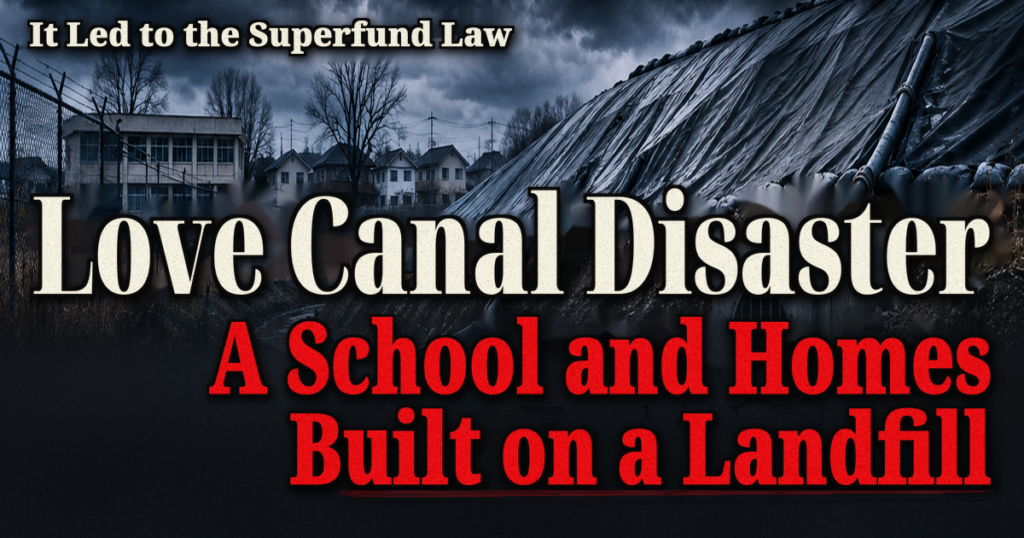
The relocation of residents living on a chemical waste landfill site began.
On 7 August 1978, US President Carter declared a federal emergency for Love Canal in the city of Niagara Falls, New York. Five days earlier, the New York State Commissioner of Health had declared a health emergency and recommended the closure of the neighbourhood’s primary school and the immediate evacuation of pregnant women and children under two years of age.
What was affecting the lives of residents was the large quantity of chemical waste buried beneath the residential neighbourhood. The waste disposed of by Hooker Chemical between 1942 and 1953 amounted to approximately 21,800 tons. Once the landfill operations had ended, the land was transferred to the city’s Board of Education, and a primary school and residential neighbourhood were built on it. The containment of the waste was compromised through activities including school construction and municipal sewer works, and by the late 1970s it had become apparent that contamination had spread to homes.
The first federal emergency declaration covered the relocation of the 239 households closest to the canal. However, the relocation of residents did not end at this stage. A second declaration was issued in May 1980, and the federal and state governments ultimately purchased the homes of approximately 950 households. In December of the same year, federal legislation to address contamination by hazardous substances, commonly known as the Superfund Act, was enacted.
Basic Information
| Item | Details |
|---|---|
| Name | Love Canal disaster |
| Country | United States of America |
| Location | City of Niagara Falls, New York |
| Year | 1978 (state and federal emergency declarations) |
| Classification | Environmental contamination incident; human-made disaster |
| Waste burial period | 1942–1953 |
| Landfill operator | Hooker Chemical (later Occidental Chemical) |
| Quantity of chemical waste buried | Approximately 21,800 tons |
| First federal emergency declaration | 7 August 1978; relocation of 239 households |
| Second federal emergency declaration | 21 May 1980 |
| Home purchases | Homes of approximately 950 households ultimately purchased by the federal and state governments |
| Legal proceedings | Civil litigation, settlements and consent decrees (no criminal prosecution) |
| Legislative outcome | Superfund Act enacted on 11 December 1980 |
| Completion of remediation works | 29 September 1998 |
| Deletion from the National Priorities List (NPL) | 30 September 2004 |
| Assessment of remedial measures | Effectiveness confirmed in the EPA’s fifth five-year review in February 2024 |
A canal excavated for power generation became a chemical waste disposal site.
The history of Love Canal dates back to the late nineteenth century. In 1894, entrepreneur William T. Love began a project to construct a canal connecting the upper and lower reaches of the Niagara River for use in power generation. However, worsening economic conditions brought the project to a halt. Only the canal, approximately 15 metres wide and 1.6 kilometres long, remained, and by the 1920s it had come to be used as a municipal refuse dump for the city of Niagara Falls.
In 1942, the Niagara Power and Development Company granted the Hooker Electrochemical Company permission to dump waste in the canal. Hooker drained the canal, lined it with clay and began burying drums containing waste. In 1947, it purchased the canal and the land on both banks and used them as a disposal site. According to EBSCO’s account, approximately 21,800 tons of chemical waste were buried during the period leading up to the cessation of use in early 1952 and the closure of the site with a clay cover in 1953.
The buried materials included benzene, chloroform, pesticides and PCBs. According to EBSCO, 82 different chemical residues were identified, with dioxin also cited as a particularly hazardous constituent. At the time, the burial of this type of waste was a common disposal practice in the United States and, according to the same source, was not illegal until 1980, except where waste was dumped into bodies of water.
The canal intended for a power generation project had changed from a municipal refuse dump into a waste disposal site for the chemical industry. In 1953, ownership of the land was to change once again.
The one-dollar land transfer recorded the presence of waste and included an exemption from liability.
On 28 April 1953, Hooker Chemical transferred the land where landfill operations had been completed to the Niagara Falls Board of Education for one dollar. The deed executed on that occasion expressly stated that the land had been filled with waste from chemical manufacturing.
The proviso in the deed extended to 17 lines. Among other provisions, it stipulated that the Board of Education would assume the risks and responsibilities associated with using the land and would not bring claims or legal proceedings against Hooker for personal injury or property damage. In addition to making the site’s history as a waste disposal facility explicit, the provision sought to place future responsibility arising from the use of the land on the recipient of the property.
Hooker maintained that it had warned against building a school directly over the canal. The Board of Education, meanwhile, reportedly rejected Hooker’s proposal to restrict the use of the land to parkland. The fact that the presence of waste was documented when the land was transferred to the Board of Education, and that school construction subsequently proceeded, formed part of the sequence of events relevant to later questions of liability.
Although the deed contained a clause seeking exemption from liability, this did not prevent claims from being brought in later years. The federal government, New York State and former residents each pursued civil claims, and Occidental Chemical subsequently became responsible for costs through settlements and consent decrees.
School construction and residential development compromised the containment of the waste.
The Board of Education built the 99th Street Elementary School on the land it had acquired. During construction between 1954 and 1955, drums of waste were discovered, and the location of the school building was shifted by approximately 80–85 feet before the school opened.
Alongside the construction of the school, residential development proceeded in the surrounding area. In the process, the Board of Education removed the topsoil covering the canal and used it to level the land. Municipal sewer works penetrated the clay cover and canal walls that had contained the waste. Development of the land thus compromised the existing containment and created pathways through which the buried chemicals could escape.
The land used for waste disposal came to overlap with the site of a school attended by children and a neighbourhood where residents lived. The cover installed by Hooker when its landfill operations ended was not maintained during the subsequent use of the land. The contamination problems that became apparent in the 1970s involved not only what had happened while the land was used as a disposal site, but also the development and construction works undertaken after the Board of Education acquired it.
Contamination spread to homes after heavy snowfall and snowmelt, and investigative reporting began.
Between 1975 and 1976, heavy snowfall and snowmelt caused the groundwater level to rise. Buried drums became exposed, and contaminated water began entering the gardens and basements of homes. Complaints about chemical odours also followed in succession. The waste buried in the former canal had come to affect the immediate surroundings of people living in the residential neighbourhood.
Michael Brown, a reporter for the local newspaper, the Niagara Gazette, pursued investigative reporting on the neighbourhood’s chemical waste problems from 1976 onwards. In April 1978, a series of articles on the buried hazardous waste was published, bringing the problem to national attention.
While the reporting continued, city and state health authorities also conducted investigations. Concern about health grew among residents, and Lois Gibbs and others began surveying health conditions in the neighbourhood. The scope of the investigations widened from the question of what kinds of waste had been buried beneath the land to examining the spread of contamination to nearby homes and the health of residents.
City and state health authorities reported findings on residential contamination and birth outcomes.
A survey conducted in 1977 by the health authorities of the city and New York State reported that contamination had affected 57 per cent of the homes at the southern end of the canal. The figure of 57 per cent refers to the proportion of homes at the southern end of the canal and is not the incidence of disease among all Love Canal residents.
A moderate excess of spontaneous miscarriages and low-birthweight infants was also reported among households on 99th Street adjoining the landfill site. The results of this 1977 survey are recorded by EBSCO. The confirmation of contamination in homes and the reported excess in birth-related indicators among the households surveyed were two important findings of the health authorities’ investigations at the time.
However, the reported excess did not establish a causal relationship between the health of individual residents and exposure to chemicals. The scientific assessment of health effects continued to be a subject of controversy. In 1978, the state closed the school and recommended evacuation, and in 1980 the US Environmental Protection Agency (EPA) was to publish a preliminary study concerning chromosomes. Investigations into health effects and administrative measures concerning the relocation of residents proceeded in parallel.
The state and federal governments declared emergencies, and funds were allocated to relocate 239 households.
On 2 August 1978, Robert Whalen, the New York State Commissioner of Health, declared a health emergency. The 99th Street Elementary School was closed, and pregnant women and children under two years of age were advised to evacuate immediately. The investigation by state health authorities led to administrative measures suspending use of the school and calling on residents to leave.
In August of the same year, residents formed the Love Canal Homeowners Association (LCHA), with Lois Gibbs, who had been surveying health conditions in the neighbourhood, becoming its president. The residents’ activities developed from surveys of individual households into collective action by an organisation of homeowners seeking measures including relocation.
On 7 August, President Carter declared a federal emergency. According to an account by the EPA’s Region 2 office, federal funds were used under this first federal emergency declaration to relocate 239 households living in the two rows of houses closest to the canal. Love Canal is described as the first instance in which federal emergency funds were used for a situation other than a natural disaster.
Whereas the state declaration involved school closure and evacuation recommendations in response to a health emergency, the presidential declaration opened the way for federal funding to be used for the relocation of residents. The response to the contamination of a residential neighbourhood by chemical waste expanded from state public health administration to an emergency response involving the federal government as well.
The second emergency declaration expanded the scope of relocation.
The first declaration covered the homes closest to the canal, but residents continued to demand relocation afterwards. Gibbs testified before the US Congress in 1979. The residents’ organisation extended its activities beyond local health surveys and appeals to local authorities to the federal level.
In May 1980, the EPA published research findings indicating the possibility of chromosomal damage among Love Canal residents. Britannica also discusses the reported abnormally high levels of chromosomal damage. On the other hand, as EBSCO’s account explains, the research published by the EPA was preliminary, and its methodology was also criticised. The publication prompted a stronger reaction from residents and intensified demands for relocation, but controversy remained over the scientific assessment of the findings.
On 21 May 1980, President Carter issued a second federal emergency declaration, expanding the scope of relocation. In October of the same year, the federal government and New York State established a funding programme to enable residents within the emergency declaration area to relocate permanently.
According to the EPA’s account, the federal and state governments ultimately purchased the homes of approximately 950 households. Relocation expanded considerably from the initial 239 households through the second declaration and the financial arrangements for purchasing homes. While administrative measures to relocate residents were being pursued, the question of remediating the contaminated land and who should bear the costs had already become the subject of civil litigation.
The federal government brought a lawsuit, and the Superfund Act was enacted.
Hooker Chemical was acquired by Occidental Petroleum in 1968 and later became Occidental Chemical. In 1979, the federal government brought a civil action against Occidental Chemical and others in the United States District Court for the Western District of New York. The civil action number was 79-990, and the federal government sought injunctive relief and recovery of the costs incurred in responding to the contamination. There was no criminal prosecution, and the legal proceedings concerning the response to contamination and the allocation of costs took place within the framework of civil law.
In 1980, the year in which the second emergency declaration was issued, federal environmental legislation also underwent a major change. On 11 December, President Carter signed the Comprehensive Environmental Response, Compensation, and Liability Act (CERCLA), enacting the legislation. It is commonly known as the Superfund Act. Love Canal is regarded as one of the principal cases that prompted the enactment of this legislation.
The Act established federal powers and a trust fund to respond to releases of hazardous substances and remediate contaminated land. It also adopted a mechanism for holding parties involved in contamination liable for the costs of remediation. Liability under the Act cannot be avoided on the grounds that responsibility has been transferred to another party by a deed or contract.
At Love Canal, the 1953 deed had contained an exemption from liability clause stipulating that the Board of Education, as the user of the land, would assume responsibility. In addressing the contamination that subsequently arose, the federal government had brought a civil action seeking cost recovery, independently of the arrangements made when the land was transferred. The enactment of the Superfund Act established a framework for the federal response to contamination by hazardous substances and for allocating the costs to parties involved in that contamination.
Remediation of the contaminated land proceeded alongside a settlement with former residents.
Separately from the purchase of homes by the federal and state governments, former residents had sought damages through civil claims. According to Britannica, a tentative settlement was reached in October 1983, under which 1,300 former residents settled their claims against Occidental Chemical and the city of Niagara Falls for a total of $20 million. According to EBSCO, individual payments began on 19 February 1984, ranging from $2,000 to $400,000 per person. This settlement addressed claims by former residents and was a separate proceeding from cost recovery by the federal and state governments.
On 8 September 1984, Love Canal was placed on the National Priorities List (NPL), a list of sites designated for remediation under Superfund. The remediation involved covering the landfill with a clay and plastic cap and installing a system to collect and treat leachate. The buried waste remained beneath the cap and was to be managed through containment and leachate treatment.
In 1988, the New York State Department of Health determined that areas to the west and north of the canal were habitable. Homes in those areas were renovated and resold. In the early 1990s, the state declared certain areas safe, the area north of the landfill was renamed Black Creek Village, and auctions of homes began. Following the relocation of residents, remediation to manage the source of contamination proceeded alongside the reuse of homes in areas deemed habitable.
State and federal consent decrees established responsibility for costs and the maintenance of remediation equipment.
The civil action brought by the federal government in 1979 led not only to cost recovery but also to arrangements for carrying out remediation. On 20 September 1989, a partial consent decree concerning the implementation of remediation was entered in the United States District Court for the Western District of New York. The arrangements governing the progress of remediation were co-ordinated under the supervision of the court.
On 1 July 1994, the consent decree between New York State and Occidental Chemical was approved by the federal district court. According to a Department of Justice notice published in the Federal Register dated 4 December 1996, Occidental was to pay $98 million in settlement of the state’s claims. It was also to undertake the operation and maintenance of the remediation equipment. This consent decree included not only a monetary payment but also an obligation to continue managing the equipment involved in waste containment and remediation.
On 19 March 1996, a consent decree with the federal government was entered. According to the notice in the same issue of the Federal Register, the federal government was to recover a total of $137 million in response costs. Interest was additional to this amount.
On 15 November of that year, a proposed second modification of the partial consent decree concerning remediation was lodged, and notice of it was published in the Federal Register on 4 December. The damages settlement with former residents, the payment and maintenance of equipment in respect of the state’s claims, and the recovery of response costs by the federal government addressed distinct matters. The arrangements concerning the implementation of remediation also continued to be adjusted through these legal proceedings.
The effectiveness of waste containment measures continues to be confirmed after the completion of remediation works.
On 29 September 1998, remediation works at Love Canal were completed. Fourteen years had elapsed since the site was placed on the National Priorities List in 1984. Subsequently, on 30 September 2004, Love Canal was deleted from the list.
Deletion from the National Priorities List does not mean that the buried chemical waste itself has disappeared. The waste remains contained beneath the cap, and management of the remedial measures, including the equipment for collecting and treating leachate, continues. Even after the site’s deletion from the list, the EPA has continued to conduct reviews every five years to assess the effectiveness of the remedial measures.
According to EBSCO, the fifth five-year review, completed in February 2024, concluded that the remedial measures taken at Love Canal continued to protect human health and the environment. This was an assessment of the effectiveness of the remedial measures installed at the site. It assessed a different subject from the 1977 health survey by the city and state health authorities and the preliminary chromosomal study of 1980. The next review is scheduled to begin in 2029.
The sequence of events at Love Canal, from the canal project begun in 1894 through the burial of chemical waste, the construction of a school and residential neighbourhood, and the emergency declarations of 1978 and 1980, prompted the enactment of the Superfund Act in 1980. Following the relocation of residents and the determination of responsibility for costs through civil proceedings, remediation works at the site were completed. Even after deletion from the National Priorities List, the system for managing the buried waste remains in place, and the EPA continues to conduct regular reviews to confirm its effectiveness.
Sources
- Encyclopaedia Britannica, ‘Love Canal’ — https://www.britannica.com/place/Love-Canal
- Federal Register, Vol. 61, No. 234 (1996-12-04), Department of Justice notice, ‘Notice of Lodging; Second Modification of the Partial Consent Decree on Remediation Between United States, State of New York and Occidental Chemical Corporation’ (primary record of the 1979 civil action, the 1994 state consent decree for $98 million and the 1996 federal consent decree for $137 million) — https://www.govinfo.gov/content/pkg/FR-1996-12-04/html/96-30893.htm
- EBSCO Research Starters, ‘Love Canal disaster’ (21,800 tons of waste buried, the 1977 survey, the 1983 settlement and payments, and the fifth five-year review in 2024) — https://www.ebsco.com/research-starters/environmental-sciences/love-canal-disaster/
- English-language Wikipedia, ‘Love Canal’ (wording of the 1953 deed, chronology, and dates of NPL listing and deletion) — https://en.wikipedia.org/wiki/Love_Canal
- US Environmental Protection Agency (EPA), Region 2 office, podcast transcript, ‘History of Love Canal and the Superfund Program’ (239 households under the first declaration on 7 August 1978, the second declaration on 21 May 1980, purchases of homes of approximately 950 households, and the 1988 determination of habitability) — https://archive.epa.gov/region02/mediacenter/web/pdf/lovecanal_podcast.pdf
Original Japanese record: ラブキャナル事件|緊急事態宣言と住民移転からスーパーファンド法成立へ
Last updated: