
The Assassination of Prime Minister Yitzhak Rabin | The Night Political Conflict over the Peace Process Took the Prime Minister's Life
On the night of November 4, 1995, Prime Minister Yitzhak Rabin was shot and killed in Tel Aviv, Israel, just after a peace rally. The gunman, Yigal Amir, was arrested at the scene; his life sentence with additional imprisonment became final, and he remains in prison. This record follows the trial and the official investigation into the security failure.
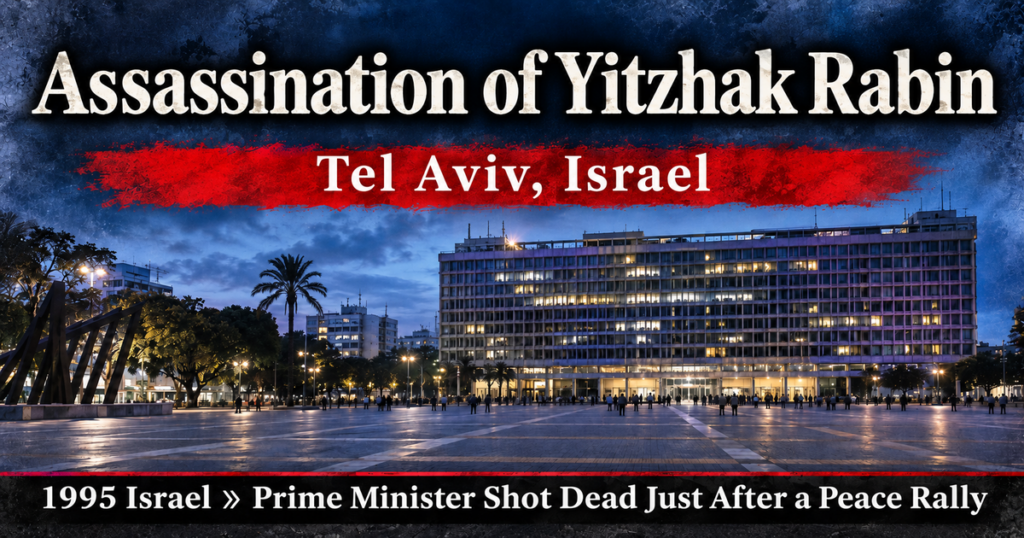
Basic Information
| 項目 | 内容 |
|---|---|
| Date and time | Around 9:30 p.m. on November 4, 1995 (local time) |
| Location | Kings of Israel Square (now Rabin Square), Tel Aviv, Israel |
| Circumstances | Immediately after a large peace rally in support of the Oslo Accords had ended |
| Victim | Prime Minister Yitzhak Rabin |
| Other injured person | Security guard Yoram Rubin |
| Perpetrator | Yigal Amir (25 at the time, a law student at Bar-Ilan University, and a far-right nationalist) |
| Outcome | Prime Minister Rabin was taken to hospital and died later that night. Security guard Rubin was injured. |
| Trial | Proceedings at the Tel Aviv District Court from January 23 to March 27, 1996 |
| Verdict and sentence | Convicted of murder and other offenses. A life sentence and additional prison terms were imposed; the sentence is commonly summarized as life imprisonment plus 14 years. |
| Aftermath | The conviction remained in force after appeal, and Amir is still serving his sentence. No reduction was granted through a presidential pardon. |
On the night of November 4, 1995, a shooting took place just after a peace rally in Tel Aviv had ended.
On November 4, 1995, Prime Minister Yitzhak Rabin was shot in Tel Aviv, Israel. The incident occurred at around 9:30 p.m., immediately after a large peace rally held at Kings of Israel Square had ended. The square is now called Rabin Square. The rally supported the Oslo Accords, and Prime Minister Rabin was also present.
After the rally ended, Rabin descended the steps of City Hall and was heading toward his car. At that moment, Yigal Amir fired a gun at close range. Three shots were fired: two bullets struck Rabin, and the remaining bullet hit security guard Yoram Rubin. Amir was restrained at the scene.
Rabin was taken to hospital from the scene and died that same night. The assassination of an Israeli prime minister immediately after a rally supporting peace came to be remembered as an event in which political conflict over the Oslo Accords escalated into violence that took the prime minister’s life.
Rabin’s pursuit of the Oslo Accords formed the political backdrop to the assassination.
The background to the assassination lay in the peace policy pursued by Prime Minister Rabin and Amir’s opposition to it. On September 13, 1993, Rabin signed the Oslo Accords, a Declaration of Principles on Interim Self-Government Arrangements. This was also the agreement that the peace rally held shortly before the incident had expressed support for. The purpose of the rally and the circumstances in which Rabin was shot were part of the same political conflict.
In 1994, Rabin received the Nobel Peace Prize together with Shimon Peres and Yasser Arafat. In the same year, Israel also signed a peace treaty with Jordan. These events showed that moves toward peace were being pursued during the Rabin administration.
Amir, by contrast, opposed the territorial concessions made under the Oslo Accords. The fact that the prime minister was assassinated immediately after a rally supporting the peace agreement showed that the conflict over the agreement did not remain merely a policy dispute but also took the form of political violence. Amir’s act connected his opposition to Rabin’s policies with the killing of Rabin himself.
Yigal Amir carried out the assassination as a far-right nationalist.
The person who shot Rabin was Yigal Amir, who was 25 years old at the time. Amir was a law student at Bar-Ilan University and a far-right nationalist. He opposed the Oslo Accords and the peace policy pursued by Prime Minister Rabin. On the night of the incident, Amir shot Rabin after the rally ended and was restrained at the scene.
According to trial-related materials and media reports, Amir had made three unsuccessful attempts to assassinate Rabin during 1995. These attempts indicate that the shooting on November 4 was not an act that arose suddenly that night, but followed repeated moves to plot an assassination during the same year.
At trial, it was established that Amir had fired the shots on November 4. Amir was the person who carried out the attack, and after being arrested at the scene, he was charged with murder and other offenses. Whatever his political claims or ideological background, Amir was held criminally responsible for shooting the prime minister and causing his death.
Amir attempted to justify the killing by invoking a religious legal principle.
Amir sought to justify his actions from his position opposing territorial concessions under the Oslo Accords. One of the things he invoked was a principle in Jewish law known as “din rodef.” Amir sought to give his actions religious significance by relying on this and other ideas.
However, this was Amir’s own claim; it was not accepted as an objective basis for justifying the assassination. The court did not accept Amir’s explanation. The invocation of din rodef therefore shows how the perpetrator tried to explain his own actions, not a fact that established the legitimacy of the killing.
Amir opposed territorial concessions under the Oslo Accords and carried out the assassination on that basis. His explanation invoking din rodef was his own claim in an attempt to justify the crime, and the court did not accept it.
Two bullets struck Rabin, and a security guard was also injured in the shooting.
After the rally ended, as Rabin was descending the steps of City Hall and heading toward his car, Amir fired three shots at close range. Two of the bullets struck Rabin, and one injured security guard Yoram Rubin. After the shooting, Amir was restrained at the scene.
The shooting injured not only the prime minister but also a member of the team assigned to protect him. Rabin was taken to hospital immediately, but his life could not be saved. The incident took place just after a large peace rally in support of the Oslo Accords had ended.
The established sequence of the shooting is that Amir fired three shots toward Rabin, two struck Rabin, and one injured security guard Rubin.
Rabin died at the hospital from blood loss and lung injuries.
After being shot, Rabin was taken to Ichilov Hospital in Tel Aviv. Despite medical treatment, he died on the operating table that same night. The cause of death was blood loss and lung injuries. Reports stated that he died approximately 40 minutes after arriving at the hospital.
Rabin’s death made the shooting a murder case involving the prime minister. An incumbent prime minister had been shot immediately after a peace rally and died that same night. Several people were affected by the shooting, including security guard Rubin, who was injured at the scene.
Rabin’s death led to proceedings to hold Amir criminally responsible. Amir had been detained at the scene, and a trial concerning the person who carried out the attack was to take place. The fact that the victim was the prime minister, that the attack occurred immediately after a rally supporting the Oslo Accords, and that the perpetrator was arrested at the scene formed the starting point for the subsequent judicial proceedings.
Amir was arrested at the scene and tried at the Tel Aviv District Court.
Amir was restrained immediately after the shooting and arrested at the scene. He was subsequently indicted on charges including murder, and proceedings were held at the Tel Aviv District Court from January 23 to March 27, 1996. The case was heard by a panel of three judges.
At trial, Amir’s criminal responsibility for shooting Rabin and causing his death was examined. Amir had been arrested at the scene, and the court found that he had carried out the assassination. The verdict was delivered on March 27, 1996, and Amir was convicted of murder and other offenses.
The trial also addressed the involvement in the conspiracy of Amir’s brother, Hagai Amir, and his friend, Dror Adani. This showed that the question of the person who actually fired the gun and the question of the conspiracy surrounding the crime were considered separately. Even though proceedings concerning accomplices took place, the court’s finding that Amir was the person who shot Rabin remained unchanged.
The court convicted Amir and imposed a life sentence with additional imprisonment.
On March 27, 1996, the Tel Aviv District Court delivered its verdict against Amir. Amir was convicted of the murder of Prime Minister Rabin and other offenses, and was sentenced to life imprisonment and additional terms. Initially, an additional six-year sentence was imposed for injuring security guard Rubin. Later, when combined with a separate judgment concerning conspiracy and related matters, the sentence came to be commonly summarized as life imprisonment plus 14 years.
This sentence is explained not only in relation to Rabin’s murder but also in relation to the injury suffered by the security guard in the shooting and the conspiracy matters addressed in a separate case. However, the way the additional years are presented reflects the sequence in which the initial sentence for the injury and the later separate judgment were combined.
Amir was unable to overturn his conviction on appeal, and the conviction remained in force. He is still serving his sentence. His criminal responsibility was not overturned after the verdict, and he continues to serve a sentence that includes life imprisonment as the person who carried out the assassination.
No pardon or commutation was granted to the prime minister’s assassin, and Amir remains in prison.
Amir has not received a reduction in his sentence through a presidential pardon. The decision not to grant a pardon or commutation to the person who assassinated a prime minister has become a political and social premise. Amir continued serving his sentence after his conviction and remains in prison.
This point, together with the fact that a life sentence was imposed, is important to understanding the judicial treatment of the case after the assassination. The terms of the sentence are not the only relevant factor; whether a pardon or commutation was subsequently granted is also an element of Amir’s treatment. In the course of events that has been confirmed, there has been no reduction of his sentence through a presidential pardon.
Because of the nature of the assassination of a prime minister, the handling of Amir’s sentence has carried considerable social significance. The life sentence and additional terms, the fact that the conviction remained in force after appeal, and the absence of a reduction through a presidential pardon have shaped the legal course of the case since the assassination. Amir is still serving his sentence, and the judgment remains in effect.
The security failure was officially investigated, and Shimon Peres succeeded Rabin as prime minister.
After Rabin’s assassination, the prime minister’s security arrangements also became a major issue. Security failures by the domestic security service, Shin Bet, were questioned, and an official investigation into the security failures was conducted. The Shamgar Commission was established as the commission of inquiry. In the review following the incident, the arrangements for protecting the prime minister came under scrutiny.
The Shamgar Commission was established, and an official investigation into the security failures was conducted. At trial, Amir was found to have acted alone in carrying out the assassination; separately from the question of criminal responsibility for the attack, the prime minister’s security arrangements were also subject to an official review.
After the prime minister’s death, Shimon Peres succeeded him as prime minister. Peres advanced the Oslo II Accord. While Rabin’s assassination resulted in a change of prime minister, the political efforts relating to the peace agreements were carried forward by the succeeding Peres administration. Rabin’s death was an event directly connected not only to the loss of an individual’s life but also to the office of prime minister in Israel and the continuity of its peace policy.
The Rabin assassination remains an event in which political conflict over peace led to the killing of a prime minister.
The assassination of Prime Minister Yitzhak Rabin took place on November 4, 1995, immediately after a peace rally in Tel Aviv had ended. Rabin, who had attended the rally in support of the Oslo Accords, was shot by Yigal Amir while walking toward his car. He was taken to hospital and died later that night. Security guard Yoram Rubin was also injured, and Amir was arrested at the scene.
Amir opposed the territorial concessions under the Oslo Accords and attempted to justify his actions by invoking a religious legal principle. That explanation was his own claim, and the court did not accept it. At trial, the court found that Amir had carried out the assassination and convicted him of murder and other offenses. The involvement of his brother, Hagai, and his friend, Adani, in the conspiracy was also addressed, but Amir was the person who carried out the shooting.
Amir was sentenced to life imprisonment and additional terms, and the conviction remained in force after appeal. No reduction was granted through a presidential pardon, and he is still serving his sentence. The Shamgar Commission was established to conduct an official investigation into the security failures. Shimon Peres succeeded Rabin as prime minister and advanced the Oslo II Accord.
This was an assassination in which a prime minister who had pursued a peace policy was killed by a far-right nationalist who opposed that policy. Through Rabin’s death, the conviction and imprisonment of Amir, the official investigation into the security arrangements, and the succession of Peres as prime minister, the incident became a major event affecting both Israeli politics and its judicial system.
Sources
- Assassination of Yitzhak Rabin — Encyclopaedia Britannica: https://www.britannica.com/topic/assassination-of-Yitzhak-Rabin
- On this day: Rabin assassinated by far-right activist Yigal Amir — The Jerusalem Post: https://www.jpost.com/history/article-913788
- Assassination of Yitzhak Rabin — Wikipedia(判決日・量刑・裁判経過の整理): https://en.wikipedia.org/wiki/Assassination_of_Yitzhak_Rabin
- Yigal Amir — Wikipedia(付加刑の変遷、共犯関係の整理): https://en.wikipedia.org/wiki/Yigal_Amir
Original Japanese record: イツハク・ラビン首相暗殺事件|和平路線をめぐる対立が首相の命を奪った夜
Last updated: