
Thousand Oaks shooting | The loss of 12 lives and the investigations and reviews that followed
The shooting at a bar in Thousand Oaks, California, in which twelve people were killed. This record traces how the fatally wounded sheriff's sergeant was struck by a colleague's round and the district attorney's finding that both officers acted lawfully, the sheriff's after-action review and its recommendations, and a motive that remains officially undetermined.
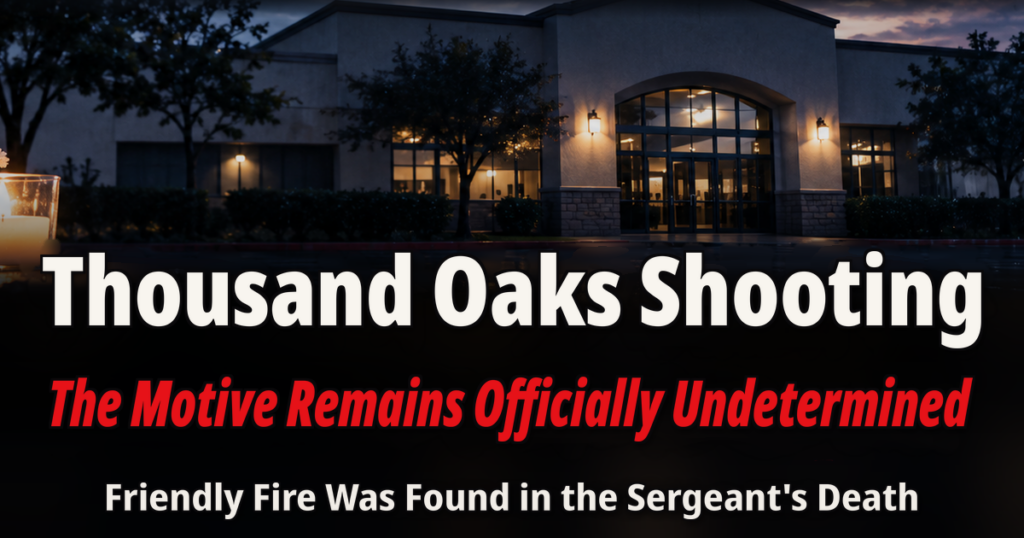
The shooting occurred on the night of a regular event for university students.
On 7 November 2018, a mass shooting occurred in Thousand Oaks, California, in the United States. The venue was the Borderline Bar and Grill, a country-and-western-themed bar and restaurant in the city, located in the north-western suburbs of Los Angeles.
That evening, the establishment was hosting College Country Night, a regular event aimed at university and college students. According to an after-action review subsequently compiled by the Ventura County Sheriff’s Office, approximately 259 people were inside the venue. The event provided an opportunity for students attending nearby universities and colleges to gather, and it was during this event that patrons and employees fell victim to the shooting.
The shooting claimed the lives of 12 victims. Eleven were patrons or employees of the establishment, whilst the remaining victim was Sergeant Ron Helus of the Ventura County Sheriff’s Office, who died in the line of duty whilst responding to the incident. Many of the victims were students or graduates of nearby universities and colleges, and the loss extended to those academic communities.
Ian David Long, who was identified as the perpetrator, also died at the scene. Including Long himself, the total number of deaths was 13. No trial of the perpetrator took place, and several investigations and reviews were subsequently conducted by the District Attorney’s Office and the Sheriff’s Office.
Basic Information
| Item | Details |
| Case name | Thousand Oaks shooting |
| English case name | Thousand Oaks shooting |
| Date of incident | 7 November 2018 (local date) |
| Country | United States of America |
| Location | Borderline Bar and Grill, Thousand Oaks, California |
| Victims killed | 12 (11 patrons and employees, and one police officer who died in the line of duty) |
| Total deaths, including the perpetrator | 13 |
| Injuries | 16 according to the FBI annual report; 25 according to news reports based on announcements immediately following the incident. The figures differ between sources. |
| Perpetrator | Ian David Long (aged 28 at the time) |
| Motive | Not officially established |
| Death of the perpetrator | Died at the scene (death by suicide confirmed by post-mortem examination) |
| Criminal proceedings | Not initiated (no arrest, prosecution or trial) |
| Subsequent official investigations | District Attorney’s review of the officer-involved shooting, and the Sheriff’s Office’s after-action review and homicide investigation |
Nearby academic communities were also affected, and discrepancies remained in the injury figures.
Among the patrons and employees who died in the shooting at the Borderline Bar and Grill were people associated with nearby educational institutions, including Pepperdine University, California Lutheran University and Moorpark College. As the establishment was hosting a regular event aimed at university and college students, students and graduates accounted for a substantial proportion of the victims.
Eleven patrons and employees died, but Sergeant Helus also lost his life in the line of duty whilst responding to the incident, bringing the number of victims killed to 12. The death of the perpetrator, by contrast, is counted separately from those of the victims.
The reported number of injured people varies between sources. In its annual report, Active Shooter Incidents in the United States in 2018, which covered shootings during that year, the Federal Bureau of Investigation (FBI) recorded 16 injuries. According to the report, only one person was injured by gunfire, whilst the remaining injuries resulted from other causes, such as falls during the evacuation.
By contrast, some news reports based on announcements made immediately after the shooting by the county fire service and other authorities put the number of injured people at 25. The figure in the FBI’s annual report does not match that in the immediate news coverage, leaving a discrepancy between the injury totals recorded in the two sets of sources.
The perpetrator, who was 28 at the time, had served in the Marine Corps.
In the early hours of 8 November, the day after the shooting, Ventura County Sheriff Geoff Dean publicly identified the perpetrator as Ian David Long. Long was a former United States Marine who lived in Newbury Park, near Thousand Oaks. A subsequent report by the District Attorney’s Office recorded his date of birth as 27 March 1990.
According to news reports based on information released by the Marine Corps, Long enlisted in 2008 and served until 2013. He had been deployed to Afghanistan from November 2010 to June 2011, and his final rank was corporal. He was honourably discharged from the Marine Corps in March 2013.
After leaving the military, he enrolled at California State University, Northridge. He attended the university from 2013 to 2016 but did not graduate. This period of university attendance subsequently formed part of the background considered in the examination of his possible motive in the investigative report published by the Sheriff’s Office.
Long’s military service and university attendance were elements of his personal history established during the investigation. Although both were examined in the investigations following the shooting, neither his experience in the Marine Corps nor his experience at university was established as the cause of the attack.
Medical records and a reported disturbance at his home before the shooting were examined.
According to coverage of the District Attorney’s report, Long received treatment for physical and mental health conditions from the private healthcare provider Kaiser Permanente between 2015 and 2016. His diagnoses included adjustment disorder with mixed anxiety and depressed mood, post-traumatic stress disorder (PTSD), combat and operational stress reaction, and chronic pain.
The FBI, however, established that the United States Department of Veterans Affairs (VA) held no record of Long receiving treatment. The absence of treatment records at the Department of Veterans Affairs is not inconsistent with the existence of records of diagnoses and treatment at a private healthcare provider. The subsequent investigation established that there had indeed been a period during which he received medical treatment.
In April 2018, approximately seven months before the shooting, sheriff’s deputies and a mental health crisis team responded to a report of a disturbance at Long’s home. His mother reportedly told those responding that Long was suffering from severe PTSD but was refusing assistance.
The crisis team determined at the time that he posed no imminent danger to himself or others. Consequently, he was neither detained nor admitted to hospital. This assessment was also documented in the after-action review published in 2021.
The diagnoses of PTSD and other conditions, the family’s expressed concern about the need for assistance, and the assessment made by the crisis team at the time are each established facts. However, no causal relationship between PTSD and the mass shooting has been officially established.
Sergeant Helus died in the line of duty after 29 years of service.
Sergeant Ron Helus, who responded to the shooting, was 54 years old and had served with the Ventura County Sheriff’s Office for 29 years. In addition to officers from the Sheriff’s Office, officers of the California Highway Patrol (CHP) were involved in the response that night. CHP Officer Todd Barrett responded alongside Sergeant Helus.
Sergeant Helus was struck by five bullets fired by the perpetrator and died after being taken to hospital. The medical examiner determined that the separate, fatal gunshot wound resulted from an accidental shot fired from the rifle of his fellow officer, Barrett, at the perpetrator. In its report published in December 2020, the District Attorney’s Office concluded that the gunfire of both Helus and Barrett constituted lawful self-defence and defence of others, and that the accidental shooting did not constitute a criminal offence.
Three aspects of Sergeant Helus’s death were thus officially documented: the fact that he had been shot by the perpetrator, the direct cause of his death as established by the post-mortem examination, and the District Attorney’s review of the lawfulness of the officers’ use of force.
Sergeant Helus’s funeral took place on 15 November 2018, with the state governor among those in attendance. Having lost his life whilst responding to a mass shooting after 29 years of service, Sergeant Helus was commemorated as one of the 12 victims of the incident.
The perpetrator’s death meant that no criminal trial took place.
Long, the perpetrator, died at the scene on 7 November 2018. A post-mortem examination confirmed that his death was a suicide resulting from a self-inflicted gunshot wound. It was also established that gunfire from police officers had not caused his death.
Consequently, no criminal proceedings against Long were ever initiated, and there was no arrest, prosecution or trial. Unlike cases in which a defendant dies after being charged and whilst on trial, there was no criminal trial in which charges or penalties were considered. No conviction was entered and no sentence was imposed.
Nevertheless, investigations were conducted into the shooting that claimed 12 victims’ lives. Separate official enquiries pursued different objectives: determining whether the officers’ use of force was lawful, identifying shortcomings in the response of public safety agencies, and establishing what the homicide investigation had revealed.
The results were set out in three principal documents: the District Attorney’s report of December 2020, the Sheriff’s Office’s after-action review of March 2021, and the investigative report published by the same office in June 2021. None of these documents represented a judgement handed down in a criminal trial of the perpetrator. Rather, each presented the findings of a distinct investigation or review relating to the incident.
The District Attorney determined in 2020 that the officers’ use of force was lawful.
On 17 December 2020, more than two years after the shooting, the Ventura County District Attorney’s Office published its report on the officer-involved shooting. In California, when someone dies as a result of police gunfire, it is customary for the county District Attorney to review the lawfulness of the use of force and publish the findings. The review in this case was likewise a process distinct from any criminal prosecution of the perpetrator.
One of the principal issues addressed in the report was the use of deadly force by Sergeant Helus and Officer Barrett. The District Attorney’s Office examined the actions of both officers in responding to the incident and the facts surrounding Sergeant Helus’s death, concluding that both officers had acted lawfully in self-defence and in defence of others when discharging their firearms.
Sergeant Helus had been struck by five bullets fired by the perpetrator, and the medical examiner had determined that the fatal wound had resulted from an accidental shot fired from Officer Barrett’s rifle. The District Attorney’s Office concluded that the accidental shooting was also justified and did not constitute a criminal offence.
The medical examiner’s role was to establish the medical cause of death, whereas the District Attorney’s role was to make a legal determination concerning the officers’ use of force. The 2020 report set out these two distinct official findings concerning Sergeant Helus’s death.
The 86-page after-action review contained 30 recommendations.
Following the publication of the District Attorney’s report, the Ventura County Sheriff’s Office released its After Action Review (AAR) in March 2021. The 86-page document was an administrative report evaluating the response of public safety agencies to the shooting.
The review committee spent more than two years conducting its enquiries and drew up 30 recommendations. Unlike the District Attorney’s review, which assessed whether individual police officers’ use of firearms had been lawful, this review examined the response as a whole, including interagency co-ordination, command and control, communications, and the provision of emergency medical assistance.
One of the issues identified in the report concerned communications. It noted that the volume of emergency calls had overwhelmed the dispatch centre, leading to delays in approving assistance from other law enforcement agencies and requesting specialist units.
Problems were also identified in radio interoperability and information sharing between the Sheriff’s Office and the California Highway Patrol. Because the incident involved several law enforcement agencies, communications across organisational boundaries also formed part of the review.
The report identified further areas for improvement in on-scene command, control and supervision, the use of protective equipment by officers, and the designation of casualty collection points. These findings did not establish that individual officers’ use of force constituted a criminal offence. Rather, they were the outcome of an organisational review of the activities of public safety agencies.
The after-action review also recognised the achievements of the emergency response.
The Sheriff’s Office’s after-action review was not a document concerned solely with shortcomings in the response. It also explicitly acknowledged that the swift response of Sergeant Helus and Officer Barrett had saved lives.
This recognition of the two officers’ actions and the recommendations for improving communications and command and control appeared in the same report. The review acknowledged the contribution of officers who responded rapidly whilst identifying aspects of the wider organisational response that required improvement.
The District Attorney’s report examined the lawfulness of the use of force, whereas the Sheriff’s Office’s report evaluated the activities of public safety agencies. Although the two reports dealt with the same incident, they were prepared for different purposes. The District Attorney’s determination that the use of force was lawful was not an assessment of whether there were improvements to be made in communications or organisational management.
Following the shooting, Ventura County also established a task force on mental health and safety. Some bereaved families called for gun control legislation, and alongside the review of the public safety response, there were developments concerning community safety and firearms regulation.
The investigative report presented a working hypothesis about the motive but reached no definitive conclusion.
Regarding the motive for the shooting, the after-action review published by the Sheriff’s Office in March 2021 expressed the view that the true motive would probably never be known. This was because Long had left no written explanation for the shooting and there was little digital evidence that could help establish his motive.
On 30 June of the same year, the Sheriff’s Office published a report setting out the findings of its homicide investigation. The report put forward a working hypothesis that the motive may have involved a strong aversion towards civilians, particularly university and college students, arising from his experiences at university.
However, the investigative report itself qualified that hypothesis, making clear that it could not be stated with absolute certainty that this had been Long’s motive. This interpretation was strictly a working hypothesis advanced by investigators after examining the available material, rather than an officially established motive for the shooting.
Although it was established that Long had been diagnosed with PTSD and other conditions before the shooting, no causal relationship between the diagnoses recorded in his medical records and the attack was established. At the time of the incident, a behavioural science expert also cautioned that it was too early to determine whether PTSD had been a contributing factor.
The identity of the perpetrator and the circumstances of his death were established through official investigations. In contrast, the motive remained unresolved even when the principal investigative reports were released in 2021. The incident has not been officially classified as an act of terrorism.
Records relating to the shooting were released following legal action by news organisations.
Efforts to secure the disclosure of records concerning the shooting continued even after the principal reports had been published. In 2022, following legal action brought by a local newspaper and other parties, Ventura County released audio and video records relating to the incident.
The released material included recordings of police radio communications and emergency calls, surveillance camera footage, and police body-worn camera footage. In addition to the reports prepared by the District Attorney’s Office and the Sheriff’s Office, the underlying records relating to the incident were themselves made available to the public.
This litigation was not brought to establish the perpetrator’s criminal liability. It concerned the disclosure of records produced on the day of the incident and did not alter the fact that no arrest, prosecution or trial of Long had taken place.
The publication of the principal reports between 2020 and 2021 and the release of records in 2022 followed separate processes. The legal assessment of the officers’ use of force, the administrative review of the organisational response, the findings of the homicide investigation, and the disclosure of records constituted the principal official developments following the incident, in the absence of any criminal trial.
A memorial garden was established, and demolition of the building where the shooting occurred began.
Shortly after the shooting, a separate disaster struck the area around Thousand Oaks. The Woolsey Fire forced many local residents and survivors of the mass shooting to evacuate. The community thus faced another disaster within a short period of the shooting.
On 7 November 2019, exactly one year after the incident, a memorial known as the Healing Garden was dedicated at Conejo Creek North Park. The memorial was established to commemorate the 12 victims, including the patrons and employees of the establishment and Sergeant Helus, who died in the line of duty.
The Borderline Bar and Grill never reopened at the site of the shooting. In 2020, the business owner opened another establishment in nearby Agoura Hills, but this did not represent a reopening of the building in which the shooting had occurred.
In November 2023, demolition began on the building where the shooting had taken place, for which the property owner had already obtained a demolition permit. This coincided with the fifth anniversary of the incident, and the victims were also commemorated at the Healing Garden.
The building where the shooting occurred and the memorial established to commemorate the victims subsequently followed different paths. Although the perpetrator’s death meant that no criminal trial took place, official investigations and reviews continued after the incident, and the local community retained a place in which to remember the 12 victims.
Sources
- English-language Wikipedia, ‘Thousand Oaks shooting’ (the course of the incident, victims, perpetrator, and summaries of the investigative report and after-action review)
- Ventura County Sheriff’s Office, ‘2018 Borderline Bar and Grill Mass Shooting: Public Safety Response After Action Review’ (March 2021; official after-action review covering the chronology of the incident, the perpetrator’s background, the crisis team’s response in April 2018, the conclusion that the motive remained unknown, and the review of the response and its recommendations)
- Police Magazine, ‘DA Releases Detailed Report on Death of CA Deputy During 2018 Mass Shooting Response’ (December 2020; findings of the Ventura County District Attorney’s report: Helus’s fatal wound resulted from an accidental shot fired by a fellow officer, and both officers’ use of firearms was lawful)
- Associated Press (republished by Military.com), ‘Report Details Marine Veteran’s Likely Motive in 2018 California Bar Shooting’ (3 July 2021; the working hypothesis concerning the motive presented in the investigative report and the limits of that hypothesis)
- Pacific Coast Business Times, ‘Five years after Borderline mass shooting, building being demolished’ (9 November 2023; the start of demolition of the building where the shooting occurred and the fifth-anniversary commemoration at the Healing Garden)
Original Japanese record: サウザンドオークス銃乱射事件|12人の犠牲と事件後に続いた調査・検証
Last updated: