
Trial of Saddam Hussein | A Death Sentence Upheld for Crimes Against Humanity and Genocide Charges Left Unadjudicated
The trial of former Iraqi president Saddam Hussein, convicted of crimes against humanity in the Dujail case. His death sentence became final and was carried out in 2006, whilst the genocide charges in the Anfal case ended without a judgement against him. This record also traces the conflicting assessments of the trial's fairness.
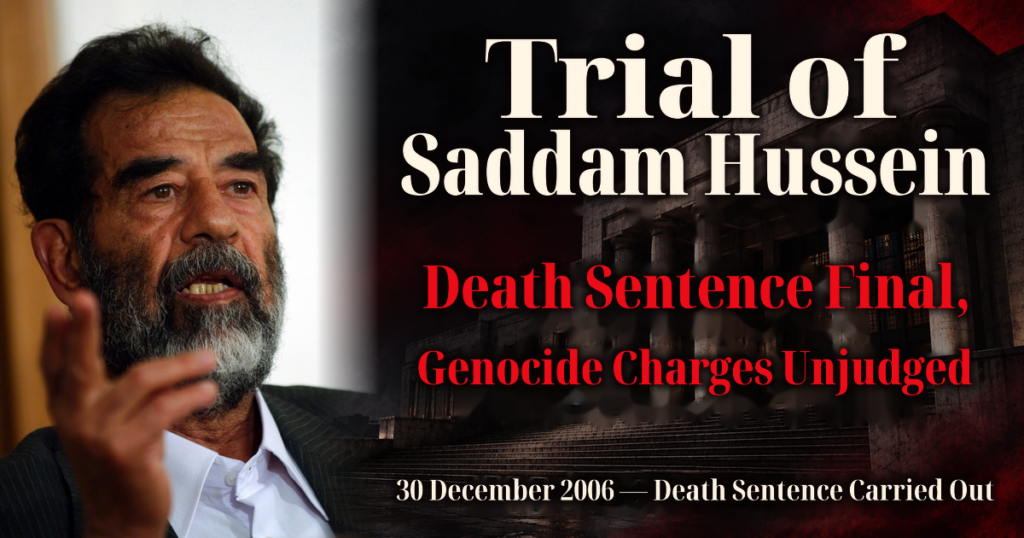
The former president was tried for crimes against humanity.
On 5 November 2006, the Iraqi High Tribunal in Baghdad sentenced former Iraqi President Saddam Hussein to death. Hussein, who had served as president from 1979 to 2003, was convicted of crimes against humanity in connection with the repression of residents of Dujail, a town in central Iraq, in 1982.
Alongside Hussein, the defendants appearing before the tribunal included the former regime’s intelligence chief, a former vice-president, the presiding judge of the Revolutionary Court and individuals associated with the local Ba’ath Party. Three defendants, including Hussein, were sentenced to death at first instance. The remaining defendants received different outcomes: life imprisonment, 15 years’ imprisonment or acquittal.
On 26 December that year, the Appeals Chamber of the Iraqi High Tribunal upheld Hussein’s death sentence, and the judgement became final. The sentence was carried out on 30 December, bringing the criminal proceedings against him to an end approximately three years after he had been taken into custody by US forces.
At that point, however, Hussein was also standing trial in a separate case. He had been charged with genocide and other crimes in connection with the Anfal campaign against the Kurdish population of northern Iraq. The proceedings against Hussein himself ended while that trial was still under way, without a verdict of guilty or not guilty being delivered against him.
Basic Information
| Item | Details |
| Case name | Trial of Saddam Hussein |
| Country | Iraq |
| Defendants | Saddam Hussein (1937–2006) and seven co-defendants (Dujail trial) |
| Taken into custody | 13 December 2003 |
| Announcement of first indictment | 18 July 2005 |
| Start of trial at first instance | 19 October 2005 |
| Trial location | Baghdad |
| Tribunal | Iraqi High Tribunal (formerly the Iraqi Special Tribunal) |
| Principal case heard | The 1982 Dujail case |
| Offence of which Hussein was finally convicted | Crimes against humanity |
| Judgement at first instance | 5 November 2006: death sentence |
| Appeals Chamber decision | 26 December 2006: death sentence upheld and made final |
| Execution of sentence | 30 December 2006 |
| Separate trial | The Anfal proceedings against Hussein himself ended without a verdict |
The first trial concerned the repression of the residents of Dujail.
Dujail is a town in Salah al-Din Governorate in central Iraq. On 8 July 1982, an alleged attempt to assassinate the then President Hussein took place in the town. The attempt was attributed to members of the Islamic Dawa Party, and a large-scale campaign of repression against local residents followed in retaliation.
Hundreds of residents were detained, people were forcibly relocated, and property, including orchards, was destroyed. On 14 June 1984, the Revolutionary Court, presided over by Awad al-Bandar, sentenced a total of 148 men and boys to death following summary proceedings. Hussein is reported to have approved the sentences on 16 June that month.
The number of people sentenced to death does not correspond to the number actually executed. Many of the 148 were executed, but some died in detention. Other acts, including the detention and forced relocation of residents and the destruction of property, also became the subject of the subsequent criminal trial.
More than 20 years after the Dujail incident, it was the president of the time, the head of the security apparatus, the presiding judge of the Revolutionary Court that had sentenced the residents to death, and others who stood before a tribunal as defendants. The Iraqi High Tribunal was to examine the series of acts committed under the former regime as crimes against humanity.
Approximately one year and seven months elapsed between Hussein’s detention by US forces and his indictment.
On 9 December 2003, the Coalition Provisional Authority (CPA) decided to establish the Iraqi Special Tribunal. Four days later, on 13 December, Hussein was taken into custody by US forces near Tikrit. He was subsequently held at Camp Cropper in Baghdad.
At the time of his detention, criminal proceedings in the Dujail case had not yet reached the trial stage. Hussein first appeared before the Iraqi Special Tribunal on 1 July 2004. He was informed of the charges on that occasion, but refused to recognise the legitimacy of the tribunal and maintained that he was still the serving president.
Although Hussein rejected the very tribunal responsible for trying crimes committed under the former regime, the judicial process continued. On 18 July 2005, the first indictment of Hussein in connection with the Dujail case was announced. According to the case summary in the International Crimes Database, the indictment was filed on 31 July that year.
Following his detention in December 2003, his first court appearance in July 2004 and his indictment in July 2005, the trial at first instance finally began in October 2005. In the meantime, the law governing the tribunal responsible for conducting the trial had also been revised.
Proceedings against eight defendants began under a new tribunal law.
In October 2005, the Iraqi National Assembly enacted a new tribunal law, Law No. 10 of 2005. Under this legislation, the Iraqi Special Tribunal, originally established by the Coalition Provisional Authority, was reorganised as the Iraqi High Tribunal (IHT). The new law was published in the Official Gazette on 18 October, and the following day, 19 October, the Dujail trial began in Baghdad.
The tribunal had jurisdiction over genocide, crimes against humanity, war crimes and certain offences under Iraqi law committed by Iraqi nationals or residents between 1968 and 2003. The period covered almost the entirety of Ba’ath Party rule and extended beyond Hussein’s own term as president.
The proceedings followed an inquisitorial model consistent with Iraq’s criminal justice tradition, with investigative judges responsible for investigations. The Trial Chamber consisted of five judges and the Appeals Chamber of nine judges. No jury was used. Although provisions allowed for the appointment of international judges, none were actually appointed.
In the Dujail case, Hussein and seven co-defendants stood trial. All eight pleaded not guilty. The tribunal examined the criminal responsibility not only of Hussein, who had been president, but also of each of the other defendants associated with the intelligence service, the Revolutionary Court or local party organisations.
The killings of defence lawyers and a change of presiding judge disrupted the proceedings.
On 20 October 2005, the day after the trial began, Saadoun al-Janabi, defence counsel for al-Bandar, was killed. On 8 November, Adel al-Zubeidi, who represented former Vice-President Taha Yassin Ramadan and others, was also killed in Baghdad. Defence lawyers lost their lives in succession shortly after the trial opened, and ensuring the safety of the defence team became a serious concern.
In January 2006, the presiding judge, Rizgar Mohammed Amin, resigned, citing government interference. He was succeeded by Raouf Rashid Abd al-Rahman. The question of judicial independence had come to the fore while the trial was still in progress.
On 15 March, Hussein’s political remarks provoked disorder in the courtroom, and the proceedings were closed to the public. On 21 June, Hussein’s lead defence counsel, Khamis al-Obeidi, was killed in Baghdad. Hussein went on hunger strike in protest.
Those responsible for defending the accused faced threats to their safety, and the presiding judge had been replaced during the trial. The Dujail proceedings continued under these circumstances, and the hearings concluded on 27 July 2006. While the verdict was still awaited, the tribunal began hearing a separate case.
The outcomes at first instance ranged from death sentences to acquittal.
On 5 November 2006, the Iraqi High Tribunal delivered its judgement at first instance in the Dujail case. Hussein was found guilty of crimes against humanity and sentenced to death.
Also sentenced to death at first instance were Barzan Ibrahim al-Tikriti, Hussein’s half-brother and the intelligence chief at the time of the incident, and Awad Hamed al-Bandar, who had presided over the Revolutionary Court in 1982. Former Vice-President Ramadan, by contrast, was sentenced to life imprisonment.
Three individuals associated with the local Ba’ath Party in Dujail — Abdullah Kazim Ruwaid, his son Mizher Abdullah Ruwaid and Ali Dayih Ali — each received a sentence of 15 years’ imprisonment. Mohammed Azawi Ali, who was also associated with the local Ba’ath Party, was acquitted for lack of sufficient evidence. The prosecution was also reported to have sought his acquittal.
Although the judgement was delivered on 5 November, the full written reasons for the judgement were not made available to the defendants and the public until 22 November. As the tribunal law provided for appellate review of death sentences and sentences of life imprisonment, the death sentences imposed on Hussein and the other defendants had not yet become final at this stage.
Human rights organisations raised concerns about the disclosure of evidence and the independence of the tribunal.
On 19 November, two weeks after the judgement at first instance, the international human rights organisation Human Rights Watch (HRW) published a 97-page report entitled Judging Dujail. Having observed the proceedings for ten months and interviewed judges, prosecutors and defence lawyers, HRW concluded that the trial proceedings had been fundamentally unfair and that the verdict could not be regarded as sound.
One particular concern identified by the organisation was the advance disclosure of prosecution evidence. HRW pointed to repeated failures to disclose sufficient evidence to the defence, including material that might have favoured the defendants. It also criticised violations of the defendants’ right to confront witnesses, the presiding judge’s conduct of the proceedings and significant gaps in the prosecution’s case.
Furthermore, HRW concluded that the government’s statements and actions had threatened the tribunal’s independence. Its criticism went beyond opposition to the death penalty and extended to the proceedings themselves, including whether the evidence necessary to establish guilt was adequate and whether the defence had been given sufficient opportunity to challenge it.
Amnesty International also concluded that the trial had been seriously flawed and unfair. It cited, among other issues, the removal of a judge during proceedings, the killings of members of the defence team and the closure of hearings before the defence had finished presenting its case. It argued that political interference had undermined the tribunal’s independence and impartiality.
The UN High Commissioner for Human Rights, the Working Group on Arbitrary Detention and others also expressed concern that international fair trial standards had not been met. The then UN Secretary-General, Annan, withheld his endorsement of the tribunal’s proceedings.
The Iraqi government welcomed the judgement, and the president defended the fairness of the trial.
While human rights organisations identified problems with the proceedings, Iraqi President Talabani expressed the view that the trial had been fair. He made the remarks during a visit to Paris on 5 November 2006, the day the judgement at first instance was delivered. He maintained that the defendants had been given ample opportunity to say what they wished and called for respect for the independence of the Iraqi judiciary.
Talabani himself, however, was personally opposed to the death penalty. He declined to comment on the death sentence itself on the grounds that the appeal period was still under way, and took the position that he would refuse to sign an execution order. Although he defended the fairness of the trial, he opposed the execution of the death sentence.
Prime Minister Nouri al-Maliki welcomed the judgement at first instance, and government spokesman Ali al-Dabbagh made remarks to the effect that the sentence was the least that Hussein deserved. US President Bush also described the judgement as a major achievement, while the White House expressed the view that it demonstrated the independence of the Iraqi judiciary.
The tribunal itself maintained that it was independent and that its proceedings were legitimate. While human rights organisations considered that there were problems with judicial independence and the defendants’ rights of defence, Iraq’s president, government and tribunal took a different position. The Appeals Chamber proceeded with its review while assessments of the fairness of the trial remained divided.
The Appeals Chamber upheld the death sentence, and it was carried out four days after the judgement became final.
At the Iraqi High Tribunal, death sentences and sentences of life imprisonment were automatically referred to the Appeals Chamber for review, without requiring an application from the defence. Hussein’s case was reviewed in accordance with this procedure, and on 26 December 2006 the Appeals Chamber upheld the death sentence imposed at first instance. On that date, both his conviction for crimes against humanity and his death sentence became final.
The tribunal law did not permit any authority, including the president, to grant a pardon or commute a sentence imposed by the tribunal. Death sentences were required to be carried out within 30 days of the final appellate decision. In connection with the decision of 26 December, Appeals Chamber judge Arif Shaheen explained that the 30-day deadline could not be exceeded and that the chamber’s decision was binding.
The Iraqi Constitution, however, provided for presidential ratification of death sentences, and the relationship between this constitutional provision and the tribunal law became a matter of controversy. President Talabani’s opposition to capital punishment also intersected with this issue. The tribunal emphasised the finality of the judgement and the deadline for carrying out the sentence.
On 30 December 2006, Hussein’s death sentence was carried out in Baghdad. Less than two months had passed since the judgement at first instance, and just four days since the decision of the Appeals Chamber. As far as Hussein himself was concerned, the execution of the sentence that had become final in the Dujail case also brought the other criminal proceedings against him to an end. HRW criticised the execution both because of the problems with the trial proceedings and because of its opposition to the death penalty itself.
Co-defendant Ramadan was sentenced to death after his case was remitted.
Proceedings concerning the co-defendants in the Dujail case continued after Hussein’s execution. The death sentences imposed at first instance on Barzan and al-Bandar, as on Hussein, were upheld by the Appeals Chamber and carried out on 15 January 2007.
Ramadan’s case followed a different course. At first instance on 5 November 2006, he had been sentenced to life imprisonment, but on 26 December that year the Appeals Chamber found the sentence too lenient. Rather than imposing a death sentence itself at that point, the Appeals Chamber remitted the case to the Trial Chamber.
Following the remittal, the Trial Chamber sentenced Ramadan to death on 12 February 2007. The sentence was carried out on 20 March that year. In the Dujail case, Ramadan, who was sentenced to death following the remittal, joined the three defendants originally sentenced to death at first instance, bringing the total number of death sentences carried out to four.
The criticism voiced by human rights organisations after the judgement at first instance continued even after the sentences imposed on the co-defendants had been carried out. On 21 June 2007, HRW published a paper entitled The Poisoned Chalice. Having examined the approximately 300-page judgement at first instance, the organisation identified serious errors both in the findings of fact and in the application of the law. It further concluded that the 17-page decision of the Appeals Chamber, far from correcting the problems, had compounded the errors.
The genocide charges against Hussein were never adjudicated in the Anfal trial.
On 21 August 2006, after the hearings in the Dujail case had concluded but before the judgement at first instance had been delivered, the Anfal trial began at the Iraqi High Tribunal. The case concerned the Anfal campaign conducted against the Kurdish population of northern Iraq between 1987 and 1988. Large-scale killings, the destruction of villages and forced relocation took place.
Estimates of the number of victims of the Anfal campaign vary. HRW estimated the number at between 50,000 and 100,000 on the basis of its field research in 1992, while Kurdish estimates put it at up to approximately 180,000.
In this trial, Hussein and six co-defendants were charged with genocide, crimes against humanity and war crimes. On 19 September, the presiding judge, Abdullah al-Amiri, was removed by the prime minister and cabinet on the grounds of remarks perceived as sympathetic to the defendants. His removal drew international criticism as an instance of political interference.
On 30 December 2006, when Hussein’s death sentence in the Dujail case was carried out, the Anfal proceedings against Hussein himself also came to an end. No verdict was delivered against him in this trial. His final conviction in the Dujail case was for crimes against humanity, and the genocide charges brought against him in the Anfal case remained without a judicial determination.
The trial continued against the six remaining defendants. In the judgement at first instance on 24 June 2007, three defendants were sentenced to death: Ali Hassan al-Majid, former Defence Minister Sultan Hashim Ahmad al-Tai and former senior military officer Hussein Rashid al-Tikriti. Sabir al-Douri and Farhan Mutlaq Salih were sentenced to life imprisonment, while the charges against Tahir Tawfiq al-Ani were dismissed for lack of sufficient evidence.
On 4 September that year, the appellate court upheld the death sentences imposed on al-Majid and the others concerned. The genocide convictions of al-Majid and the relevant co-defendants also became final.
Hussein was never tried in the Halabja case.
On 16 March 1988, chemical weapons were used in the Kurdish town of Halabja, claiming many lives. Although the incident occurred during the period of the Anfal campaign, it was not included in the scope of the Anfal trial that began in 2006. The Halabja incident was to be treated as a separate case.
Hussein was not tried in connection with the Halabja incident. Al-Majid, by contrast, whose death sentence in the Anfal case had become final, was subsequently tried in the Halabja case as well. On 17 January 2010, al-Majid received his fourth death sentence, which was carried out on 25 January that month.
The Iraqi High Tribunal continued to hear cases concerning the former regime after Hussein’s execution. Sentences imposed on the co-defendants who had stood trial alongside him in the Dujail case were carried out, verdicts were delivered against the remaining defendants in the Anfal case, and the Halabja incident was subsequently dealt with in a separate trial.
All criminal proceedings against Hussein himself ended on 30 December 2006. As of November 2026, there are no new investigations or indictments concerning Hussein. The Dujail case was the one in which a judgement concerning the former president’s criminal responsibility became final. The genocide charges in the Anfal case remained unadjudicated, and he never stood trial in the Halabja case.
Sources
- Trial of Saddam Hussein — English-language Wikipedia (the overall course of the trial, the judgements concerning the co-defendants, the mandatory nature of appellate review and the sequence of proceedings leading to execution): https://en.wikipedia.org/wiki/Trials_of_Saddam_Hussein
- Iraq: Dujail Trial Fundamentally Flawed — Human Rights Watch press release (19 November 2006, announcing the publication of the report Judging Dujail. It includes confirmation that, under the tribunal’s statute, death sentences had to be carried out within 30 days of the final appellate decision and could not be commuted): https://www.hrw.org/news/2006/11/19/iraq-dujail-trial-fundamentally-flawed
- Iraq: Dujail Judgment Marred by Serious Flaws — Human Rights Watch (21 June 2007, announcing the publication of the briefing paper The Poisoned Chalice. The paper itself states that up to 46 of the 148 died in detention between 1982 and 1984 and that many of the survivors were executed in 1985. It also addresses legal defects in the ratification procedure): https://text.hrw.org/news/2007/06/21/iraq-dujail-judgment-marred-serious-flaws
- Ali Hassan al-Majid — English-language Wikipedia (the course of the Anfal trial, a statement that more than 5,000 people died in Halabja, the four death sentences imposed on al-Majid and his execution on 25 January 2010, and the circumstances surrounding the decision of the Presidency Council): https://en.wikipedia.org/wiki/Ali_Hassan_al-Majid
- ICD – Al Dujail — International Crimes Database (Asser Institute) (a summary of the judgement in the Dujail case, including case number 1/E First/2005, the indictment of 31 July 2005 and a reference to Law No. 10 of 2005 as the governing legislation): https://www.internationalcrimesdatabase.org/Case/187
Original Japanese record: サッダーム・フセイン裁判|人道に対する罪での死刑確定と判決に至らなかったジェノサイド訴因
Last updated: